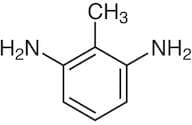
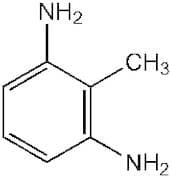
CAS 823-40-5
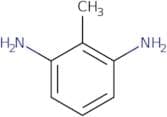
:2,6-Diaminotoluol
- 1,3-Benzenediamine, 2-methyl-
- 1,3-Diamino-2-methylbenzene
- 2,6-Diamino Toluene
- 2,6-Diamino-1-methylbenzene
- 2,6-Diaminotoluen
- 2,6-Toluenediamine
- 2,6-Toluylenediamine
- 2,6-Tolylenediamine
- 2-Methyl-1,3-benzenediamine
- 2-Methyl-1,3-phenylenediamine
- 2-Methyl-M-Phenylenediamine
- Diaminotoluene
- NSC 147490
- Toluene-2,6-diamine
- Weitere Synonyme anzeigen
2,6-Diaminotoluene
CAS:Formel:C7H10N2Reinheit:>98.0%(GC)(T)Farbe und Form:White to Gray to Brown powder to crystalMolekulargewicht:122.172,6-Diaminotoluene, 97%
CAS:This Thermo Scientific Chemicals brand product was originally part of the Alfa Aesar product portfolio. Some documentation and label information may refer to the legacy brand. The original Alfa Aesar product / item code or SKU reference has not changed as a part of the brand transition to Thermo Sci
Formel:C7H10N2Reinheit:97%Farbe und Form:White to pale grey to dark grey to pale brown to dark brown and/or grey-brown, Powder or crystals or flakesMolekulargewicht:122.172,6-Diaminotoluene
CAS:2,6-DiaminotolueneFormel:C7H10N2Reinheit:98%Farbe und Form: dark beige to dark brown solidMolekulargewicht:122.17g/mol2,6-Diaminotoluene
CAS:Kontrolliertes ProduktFormel:C7H10N2Farbe und Form:NeatMolekulargewicht:122.172,6-Diaminotoluene
CAS:Applications Aromatic amines likely to have high carcinogenic potency. QSARs of aromatic amines.
Not a dangerous good if item is equal to or less than 1g/ml and there is less than 100g/ml in the package
References Franke, R., et al.: Carcinogenesis, 22, 1561 (2001), Benigni, R., et al.: Chem. Rev., 105, 1767 (2005), Benigni, R., et al.: Environ. Mol. Mutagen., 50, 152 (2009),Formel:C7H10N2Farbe und Form:GreyMolekulargewicht:122.172-Methylbenzene-1,3-diamine
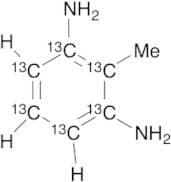
CAS:Formel:C7H10N2Reinheit:95.0%Farbe und Form:SolidMolekulargewicht:122.1712,6-Diaminotoluene-13C6
CAS:Applications 2,6-Diaminotoluene-13C6 is labelled 2,6-Diaminotoluene which is an aromatic amine likely to have high carcinogenic potency.
Not a dangerous good if item is equal to or less than 1g/ml and there is less than 100g/ml in the package
References Franke, R., et al.: Carcinogenesis, 22, 1561 (2001), Benigni, R., et al.: Chem. Rev., 105, 1767 (2005), Benigni, R., et al.: Environ. Mol. Mutagen., 50, 152 (2009),Formel:C13C6H10N2Farbe und Form:NeatMolekulargewicht:128.122,6-Diaminotoluene
CAS:2,6-Diaminotoluene (2,6-TDA), also known as o-tolidine, is a colorless to yellowish crystalline solid that is soluble in organic solvents. This compound has been shown to be genotoxic and carcinogenic in laboratory animals. 2,6-TDA binds to the receptor molecule of DNA and inhibits the repair of DNA strand breaks, leading to mutations and cancerous cells. 2,6-TDA has been shown to have toxic effects on fetal bovine kidney cells at low doses. The toxicity studies showed that 2,6-TDA inhibits cell growth and induces apoptosis in a dose dependent manner. This study also shows that 2,6-TDA inhibits protein synthesis by binding to ribosomes in the cytoplasm.Formel:C7H10N2Reinheit:Min. 95%Farbe und Form:PowderMolekulargewicht:122.17 g/mol