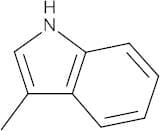
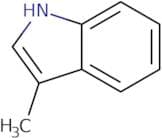
CAS 83-34-1
:Skatol
Beschreibung:
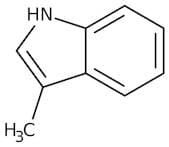
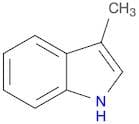
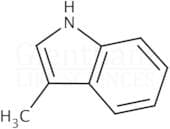
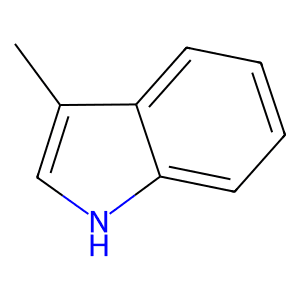
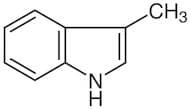
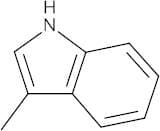
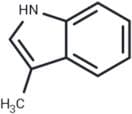
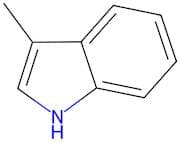
Skatol, auch bekannt als 3-Methylindol, ist eine organische Verbindung mit der chemischen Formel C9H9N. Es ist ein farbloser bis blassgelber Feststoff bei Raumtemperatur und hat einen charakteristischen fäkalen Geruch, weshalb es oft mit dem Geruch von Fäkalien assoziiert wird. Skatol ist ein Derivat von Indol und wird im menschlichen Körper während der Verdauung von Tryptophan, einer Aminosäure, die in verschiedenen Lebensmitteln vorkommt, produziert. Es ist in organischen Lösungsmitteln wie Ethanol und Ether löslich, hat jedoch eine begrenzte Löslichkeit in Wasser. Skatol wird in der Parfümindustrie wegen seines starken Duftes verwendet und wird auch auf seine potenziellen biologischen Aktivitäten untersucht, einschließlich seiner Rolle bei der Entwicklung bestimmter Pheromone. Darüber hinaus wurde Skatol auf seine Auswirkungen auf das Verhalten von Tieren und seine potenziellen Anwendungen in der Landwirtschaft als natürliches Insektenschutzmittel untersucht. Aufgrund seines starken Geruchs wird Skatol in Laborumgebungen vorsichtig behandelt, um unangenehme Expositionen zu vermeiden.
Formel:C9H9N
InChl:InChI=1S/C9H9N/c1-7-6-10-9-5-3-2-4-8(7)9/h2-6,10H,1H3
InChI Key:InChIKey=ZFRKQXVRDFCRJG-UHFFFAOYSA-N
SMILES:CC=1C=2C(=CC=CC2)NC1
Synonyme:- 1H-Indole, 3-methyl-
- 3-Methyindole
- 3-Methyl indole
- 3-Methyl-1H-indole
- 3-Methyl-4,5-benzopyrrole
- 3-Methylindol
- 3-Metilindol
- Beta-Methylindole
- Fema 3019
- Indole(1H), 3-Methyl-
- Indole, 3-methyl-
- Indole, 3-methyl-(skatole)
- Nsc 122024
- Scatole
- Skatol
- Skatole
- β-Methylindole
- Weitere Synonyme anzeigen
Sortieren nach
Reinheit (%)
0
100
|
0
|
50
|
90
|
95
|
100
12 Produkte.
3-Methylindole, 99%
CAS:3-Methylindole is often used as a component of commercial fragrances and perfumes.It helps fluorescent guanosine analogue, which in a dimethoxytrityl, phosphoramidite protected form, can be site-specifically inserted into oligonucleotides through a 3?5?phosphodiester linkage using an automated DNA sFormel:C9H9NReinheit:99%Farbe und Form:White to pale brown, Crystals or powder or crystalline powder or flakesMolekulargewicht:131.183-Methylindole
CAS:Formel:C9H9NReinheit:>98.0%(GC)Farbe und Form:White to Light yellow powder to crystalMolekulargewicht:131.18Skatole
CAS:Skatole (3-Methyl-1H-indole), produced by bacteria, regulates intestinal epithelial cellular functions through activating aryl hydrocarbon receptors and p38.Formel:C9H9NReinheit:99.74%Farbe und Form:Leaves From Petroleum Ether; White-Brown Scales SolidMolekulargewicht:131.173-Methylindole
CAS:Applications A naturally abundant pneumotoxin, found primarily in mammalian feces providing its strong fecal odor. In lower concentrations however, the compound has a pleasent aroma, giving orange blossoms and jasmine their pleasing scent. It is often a component of commercial fragrances and perfumes. This compound is a contaminant of emerging concern (CECs)
Not a dangerous good if item is equal to or less than 1g/ml and there is less than 100g/ml in the package
References Nakashima, T., et al.: Biol. Pharm. Bull., 32, 832 (2009), Xu, H., et al.: Chem. Pharm. Bull., 57, 321 (2009), Bodoor, K., et al.: J. Med. Chem., 52, 3753 (2009), Naskar, S., et al.: J. Chem. Res., 3, 174 (2009), Sollner, K., et al.: J. Agric. Food Chem., 57, 4319 (2009),Formel:C9H9NFarbe und Form:NeatMolekulargewicht:131.173-Methylindole
CAS:Also called Skatole. It occurs naturally in the feces of mammals and birds and is the primary contributor to fecal odour.Formel:C9H9NReinheit:Min. 97.5%Farbe und Form:White PowderMolekulargewicht:131.17 g/mol3-Methyl-1H-Indole
CAS:Formel:C9H9NReinheit:97%Farbe und Form:White to slightly pale yellow powderMolekulargewicht:131.178