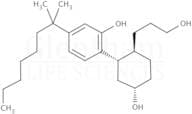
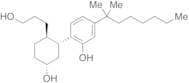
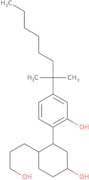
![5-(1,1-Dimethylheptyl)-2-[(1R,2R,5R)-5-hydroxy-2-(3-hydroxypropyl)cyclohexyl]phenol](/_next/image/?url=https%3A%2Fstatic.cymitquimica.com%2Fcas-image%2Fthumb-webp%2F2403-5-11-dimethylheptyl-2-1r-2r-5r-5-hydroxy-2-3-hydroxypropyl-cyclohexyl-phenol.webp&w=3840&q=75)
CAS 83002-04-4
:5-(1,1-Dimethylheptyl)-2-[(1R,2R,5R)-5-hydroxy-2-(3-hydroxypropyl)cyclohexyl]phenol
Beschreibung:
Die chemische Substanz, die als 5-(1,1-Dimethylheptyl)-2-[(1R,2R,5R)-5-hydroxy-2-(3-hydroxypropyl)cyclohexyl]phenol bekannt ist, mit der CAS-Nummer 83002-04-4, ist eine synthetische Verbindung, die hauptsächlich für ihre Anwendung im Bereich der Cannabinoidforschung anerkannt ist. Diese Verbindung weist eine komplexe molekulare Struktur auf, die eine phenolische Gruppe und eine Cyclohexylgruppe umfasst, die zu ihrer potenziellen biologischen Aktivität beitragen. Sie zeichnet sich durch ihre hydrophobe Natur aufgrund der Anwesenheit von langen Alkylketten aus, die ihre Löslichkeit und Interaktion mit biologischen Membranen beeinflussen können. Die durch die Konfiguration (1R,2R,5R) angegebene Stereochemie deutet auf spezifische räumliche Anordnungen hin, die die pharmakologischen Eigenschaften der Verbindung beeinflussen können. Als Cannabinoid-Analog kann es mit Cannabinoid-Rezeptoren im Körper interagieren und potenziell verschiedene physiologische Prozesse beeinflussen. Detaillierte Studien sind jedoch erforderlich, um seine Wirksamkeit, Sicherheit und potenziellen therapeutischen Anwendungen vollständig zu verstehen.
Formel:C24H40O3
InChl:InChI=1S/C24H40O3/c1-4-5-6-7-14-24(2,3)19-11-13-21(23(27)16-19)22-17-20(26)12-10-18(22)9-8-15-25/h11,13,16,18,20,22,25-27H,4-10,12,14-15,17H2,1-3H3/t18-,20-,22-/m1/s1
InChI Key:InChIKey=YNZFFALZMRAPHQ-SYYKKAFVSA-N
SMILES:C(CCO)[C@H]1[C@@H](C[C@H](O)CC1)C2=C(O)C=C(C(CCCCCC)(C)C)C=C2
Synonyme:- (-)-Cp 55940
- 2-[(1S,2R,5S)-5-hydroxy-2-(3-hydroxypropyl)cyclohexyl]-5-(2-methyloctan-2-yl)phenol
- 5-(1,1-Dimethylheptyl)-2-[(1R,2R,5R)-5-hydroxy-2-(3-hydroxypropyl)cyclohexyl]phenol
- 5-(1,1-dimethylheptyl)-2-[(1S,2R,5S)-5-hydroxy-2-(3-hydroxypropyl)cyclohexyl]phenol
- Phenol, 5-(1,1-dimethylheptyl)-2-[5-hydroxy-2-(3-hydroxypropyl)cyclohexyl]-, (1α,2β,5α)-(-)-
- phenol, 5-(1,1-dimethylheptyl)-2-[(1R,2R,5R)-5-hydroxy-2-(3-hydroxypropyl)cyclohexyl]-
- phenol, 5-(1,1-dimethylheptyl)-2-[(1S,2R,5S)-5-hydroxy-2-(3-hydroxypropyl)cyclohexyl]-
Sortieren nach
Reinheit (%)
0
100
|
0
|
50
|
90
|
95
|
100
3 Produkte.
(-)-CP 55,940 (10 mg/mL in methanol)
CAS:Kontrolliertes ProduktApplications CP 55,940 is a cannabinoid agonist which is considerably more potent than Δ9-THC in both behavioral tests and receptor binding assays. Displays high and roughly equal affinity for both central and peripheral cannabinoid receptors (Ki = 0.6 - 5.0 and 0.7 - 2.6 nM at CB1 and CB2 respectively; EC50 values are 0.2, 0.3 and 5 nM at CB1, CB2 and GRP55 respectively).Controlled substance. Synthetic Cannabinoids
References Wiley, et al.: Neuropharmacology, 34, 669 (1995); Griffin, et al.: J. Pharmacol. Exp. Ther., 285, 553 (1998); Thomas, et al.: J. Pharmacol. Exp. Ther., 285, 285 (1998); Ryberg, et al.: Br. J. Pharmacol., 152, 1092 (2007);Formel:C24H40O3Farbe und Form:Single SolutionMolekulargewicht:376.57CP 55940
CAS:Kontrolliertes ProduktCP 55940 is a cannabinoid receptor agonist that inhibits acetylcholine release in the brain and has been shown to cause neuronal death. CP 55940 binds to the α7 nicotinic acetylcholine receptor, which is important for memory and learning. The binding of this drug causes an increase in guanine nucleotide-binding protein (G protein) activity by reducing the rate of GTP hydrolysis, leading to inhibition of adenylyl cyclase activity and subsequent decrease in cAMP levels. CP 55940 has significant up-regulation of toll-like receptors following exposure, which leads to an increased immune response. This drug can also cause bowel disease or side effects such as seizures and psychotic symptoms. CP 55940 can interact with other drugs, including cannabinoids that may lead to serious side effects.Formel:C24H40O3Reinheit:Min. 95%Molekulargewicht:376.57 g/mol