CAS 831-29-8
:(2,4-dimethoxyphenyl)aceton
Beschreibung:
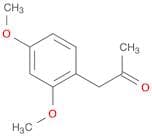
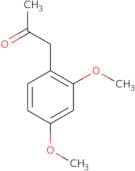
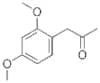
(2,4-dimethoxyphenyl)aceton, mit der CAS-Nummer 831-29-8, ist eine organische Verbindung, die durch ihre aromatische Struktur und funktionelle Gruppen gekennzeichnet ist. Sie weist einen Phenylring auf, der an den Positionen 2 und 4 mit zwei Methoxygruppen substituiert ist, was ihre elektronen-donierenden Eigenschaften verbessert und ihre Reaktivität beeinflusst. Die Aceton-Gruppe trägt zu ihrer Ketonen-Funktionalität bei, was sie zu einem potenziellen Kandidaten für verschiedene chemische Reaktionen, einschließlich Kondensations- und Substitutionsreaktionen, macht. Diese Verbindung ist typischerweise eine farblose bis blassgelbe Flüssigkeit oder ein Feststoff, abhängig von ihrer Reinheit und Temperatur. Sie ist in organischen Lösungsmitteln wie Ethanol und Ether löslich, hat jedoch eine begrenzte Löslichkeit in Wasser aufgrund ihrer hydrophoben aromatischen Struktur. (2,4-dimethoxyphenyl)aceton ist von Interesse in der organischen Synthese und kann in der Entwicklung von Arzneimitteln, Agrochemikalien und anderen feinen Chemikalien verwendet werden. Sicherheitsvorkehrungen sollten beim Umgang mit dieser Verbindung beachtet werden, da sie gesundheitliche Risiken darstellen kann, wenn sie eingenommen oder eingeatmet wird.
Formel:C11H14O3
InChl:InChI=1/C11H14O3/c1-8(12)6-9-4-5-10(13-2)7-11(9)14-3/h4-5,7H,6H2,1-3H3
SMILES:CC(=O)Cc1ccc(cc1OC)OC
Synonyme:- 2,4-Dimethoxyphenylacetone
Sortieren nach
Reinheit (%)
0
100
|
0
|
50
|
90
|
95
|
100
2 Produkte.
(2,4-Dimethoxyphenyl)acetone
CAS:2,4-dimethoxyphenylacetone is a high quality chemical intermediate that is used as a reagent in the synthesis of complex compounds. It is also useful in the synthesis of fine chemicals and speciality chemicals. This compound has been shown to be an excellent scaffold for the construction of other molecules and has been used as a building block in reactions with other functional groups. 2,4-dimethoxyphenylacetone can be used as a versatile building block with many different functional groups and has been shown to be reactive with nucleophiles such as amines, alcohols, and thiols.
Formel:C11H14O3Reinheit:Min. 95%Farbe und Form:PowderMolekulargewicht:194.23 g/mol