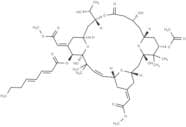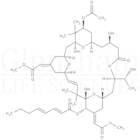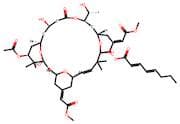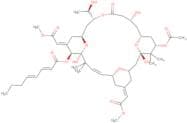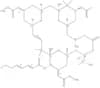
CAS 83314-01-6
:Bryostatin 1
Beschreibung:
Bryostatin 1 ist ein Naturprodukt, das aus dem marinen Bryozoen Bugula neritina gewonnen wird, bekannt für seine komplexe Struktur und signifikante biologische Aktivität. Es wird als makrozyklische Lacton klassifiziert und weist eine einzigartige polycyclische Struktur auf, die zu seinen pharmakologischen Eigenschaften beiträgt. Bryostatin 1 wird hauptsächlich für seine Rolle als Modulator der Proteinkinase C (PKC) anerkannt, die verschiedene zelluläre Prozesse wie Differenzierung, Proliferation und Apoptose beeinflusst. Seine potenziellen therapeutischen Anwendungen werden in der Krebsbehandlung, bei neurodegenerativen Erkrankungen und zur kognitiven Verbesserung untersucht. Die Verbindung zeichnet sich durch ihre Fähigkeit aus, bestimmte Signalwege zu aktivieren, was zu neuroprotektiven Effekten führen kann. Darüber hinaus hat Bryostatin 1 in klinischen Studien für Erkrankungen wie Alzheimer vielversprechende Ergebnisse gezeigt, was seine Bedeutung in der medizinischen Chemie unterstreicht. Allerdings stellen die komplexe Synthese und die begrenzte Verfügbarkeit Herausforderungen für eine breite Anwendung dar. Insgesamt stellt Bryostatin 1 ein faszinierendes Beispiel dafür dar, wie Naturprodukte zu bedeutenden Fortschritten in der Pharmakologie und der therapeutischen Entwicklung führen können.
Formel:C47H68O17
InChl:InChI=1S/C47H68O17/c1-10-11-12-13-14-15-39(51)62-43-31(22-41(53)58-9)21-34-25-37(28(2)48)61-42(54)24-32(50)23-35-26-38(59-29(3)49)45(6,7)46(55,63-35)27-36-19-30(20-40(52)57-8)18-33(60-36)16-17-44(4,5)47(43,56)64-34/h12-17,20,22,28,32-38,43,48,50,55-56H,10-11,18-19,21,23-27H2,1-9H3/b13-12+,15-14+,17-16+,30-20+,31-22+/t28-,32-,33+,34+,35-,36+,37-,38+,43+,46+,47-/m1/s1
InChI Key:InChIKey=MJQUEDHRCUIRLF-TVIXENOKSA-N
SMILES:O[C@]12[C@@H](OC(/C=C/C=C/CCC)=O)\C(=C\C(OC)=O)\C[C@](O1)(C[C@]([C@@H](C)O)(OC(=O)C[C@H](O)C[C@]3(O[C@@](O)(C[C@]4(O[C@@](\C=C\C2(C)C)(C/C(=C\C(OC)=O)/C4)[H])[H])C(C)(C)[C@@H](OC(C)=O)C3)[H])[H])[H]
Synonyme:- (1S,3S,5E,13E,17R,21R,23R,25S)-25-(acetyloxy)-1,11,21-trihydroxy-17-[(1R)-1-hydroxyethyl]-5,13-bis(2-methoxy-2-oxoethylidene)-10,10,26,26-tetramethyl-19-oxo-18,27,28,29-tetraoxatetracyclo[21.3.1.13,7.111,15]nonacos-8-en-12-yl (2E,4E)-octa-2,4-dienoate
- (1S,3S,5Z,7R,8E,11S,12S,13E,15S,17R,21R,23R,25S)-25-(acetyloxy)-1,11,21-trihydroxy-17-[(1R)-1-hydroxyethyl]-5,13-bis(2-methoxy-2-oxoethylidene)-10,10,26,26-tetramethyl-19-oxo-18,27,28,29-tetraoxatetracyclo[21.3.1.1~3,7~.1~11,15~]nonacos-8-en-12-yl (2E,4E)-octa-2,4-dienoate
- 18,27,28,29-Tetraoxatetracyclo[21.3.1.1<sup>3,7</sup>.1<sup>11,15</sup>]nonacosane, bryostatin 1 deriv.
- 2,4-Octadienoic acid, (1S,3S,5Z,7R,8E,11S,12S,13E,15S,17R,21R,23R,25S)-25-(acetyloxy)-1,11,21-trihydroxy-17-[(1R)-1-hydroxyethyl]-5,13-bis(2-methoxy-2-oxoethylidene)-10,10,26,26-tetramethyl-19-oxo-18,27,28,29-tetraoxatetracyclo[21.3.1.1<sup>3,7</sup>.1<sup>11,15</sup>]nonacos-8-en-12-yl ester, (2E,4E)-
- 2,4-Octadienoic acid, 25-(acetyloxy)-1,11,21-trihydroxy-17-(1-hydroxyethyl)-5,13-bis(2-methoxy-2-oxoethylidene)-10,10,26,26-tetramethyl-19-oxo-18,27,28,29-tetraoxatetracyclo[21.3.1.1<sup>3,7</sup>.1<sup>11,15</sup>]nonacos-8-en-12-yl ester, [1S-[1R*,3R*,5Z,7S*,8E,11R*,12R*(2E,4E),13E,15R*,17S*(S*),21S*,23S*,25R*]]-
- Bmy-45618
- Bryostatin 1
- Nsc-339555
- [1S-[1R*,3R*,5Z,7S*,8E,11R*,12R*(2E,4E),13E,15R*,17S*(S*),21S*,23S*,25R*]]-25-(Acetyloxy)-1,11,21-trihydroxy-17-(1-hydroxyethyl)-5,13-bis(2-methoxy-2-oxoethylidene)-10,10,26,26-tetramethyl-19-oxo-18,27,28,29-tetraoxatetracyclo[21.3.1.1<sup>3,7</sup>.1<sup>11,15</sup>]nonacos-8-en-12-yl 2,4-octadienoate
- 2,4-Octadienoic acid, (1S,3S,5Z,7R,8E,11S,12S,13E,15S,17R,21R,23R,25S)-25-(acetyloxy)-1,11,21-trihydroxy-17-[(1R)-1-hydroxyethyl]-5,13-bis(2-methoxy-2-oxoethylidene)-10,10,26,26-tetramethyl-19-oxo-18,27,28,29-tetraoxatetracyclo[21.3.1.13,7.111,15]nonacos-8-en-12-yl ester, (2E,4E)-
- 18,27,28,29-Tetraoxatetracyclo[21.3.1.13,7.111,15]nonacosane, bryostatin 1 deriv.
- [1S-[1R*,3R*,5Z,7S*,8E,11R*,12R*(2E,4E),13E,15R*,17S*(S*),21S*,23S*,25R*]]-25-(Acetyloxy)-1,11,21-trihydroxy-17-(1-hydroxyethyl)-5,13-bis(2-methoxy-2-oxoethylidene)-10,10,26,26-tetramethyl-19-oxo-18,27,28,29-tetraoxatetracyclo[21.3.1.13,7.111,15]nonacos-8-en-12-yl 2,4-octadienoate
- 2,4-Octadienoic acid, 25-(acetyloxy)-1,11,21-trihydroxy-17-(1-hydroxyethyl)-5,13-bis(2-methoxy-2-oxoethylidene)-10,10,26,26-tetramethyl-19-oxo-18,27,28,29-tetraoxatetracyclo[21.3.1.13,7.111,15]nonacos-8-en-12-yl ester, [1S-[1R*,3R*,5Z,7S*,8E,11R*,12R*(2E,4E),13E,15R*,17S*(S*),21S*,23S*,25R*]]-
- (1S,3S,5Z,7R,8E,11S,12S,13E,15S,17R,21R,23R,25S)-25-(Acetyloxy)-1,11,21-trihydroxy-17-[(1R)-1-hydroxyethyl]-5,13-bis(2-methoxy-2-oxoethylidene)-10,10,26,26-tetramethyl-19-oxo-18,27,28,29-tetraoxatetracyclo[21.3.1.13,7.111,15]nonacos-8-en-12-yl-(2E, 4E)-2,4-octadienoic acid ester
- BRYOSTATIN
- Bryostatin 1 - CAS 83314-01-6 - Calbiochem
- 2,4-Octadienoic acid, (1S,3S,5Z,7R,8E,11S,12S,13E,15S,17R,21R,23R,25S)-25-(acetyloxy)-1,11,21-trihydroxy-17-(1R)-1-hydroxyethyl-5,13-bis(2-methoxy-2-oxoethylidene)-10,10,26,26-tetramethyl-19-oxo-18,27,28,29-tetraoxatetracyclo21.3.1.13,7.111,15nonacos-8-en
- BRYO 1
- (1S,3S,5Z,7R,8E,11S,12S,13E,15S,17R,21R,23R,25S)-25-(Acetyloxy)-1,11,21-trihydroxy-17-[(1R)-1-hydroxyethyl]-5,13-bis(2-methoxy-2-oxoethylidene)-10,10,26,26-tetramethyl-19-oxo-18,27,28,29-tetraoxatetracyclo[21.3.1.13,7.111,15]nonacos-8-en-12-yl2,4-octadienoicacidester
- bryostatin1,0
- (1S,3S,5Z,7R,8E,11S,12S,13E,15S,17R,21R,23R,25S)-25-(Acetyloxy)-1,11,21-trihydroxy-17-[(1R)-1-hydroxyethyl]-5,13-bis(2-Methoxy-2-oxoethylidene)-10,10,26,26-tetraMethyl-19-oxo-18,27,28,29-tetraoxatetracyclo[21.3.1.13,7.111,15]nonacos-8-en-12-y
- (26R)-Bryostatin 1
- CS-1164
- Weitere Synonyme anzeigen
Sortieren nach
Reinheit (%)
0
100
|
0
|
50
|
90
|
95
|
100
4 Produkte.
Bryostatin 1
CAS:Bryostatin 1, a marine macrolide, permeates CNS and modulates PKC, with strong affinity for Munc13-1 (Ki: 8.07 nM and 0.45 nM).Formel:C47H68O17Reinheit:98%Farbe und Form:SolidMolekulargewicht:905.03Bryostatin 1
CAS:Bryostatin 1 is a cyclic lipopeptide that has been shown to induce apoptosis in cells by inhibiting protein kinase activity. Bryostatin 1 induces the release of mitochondrial cytochrome c and other pro-apoptotic proteins from the mitochondria into the cytosol, which leads to cell death. This drug has also been shown to increase intracellular levels of Ca2+, leading to activation of proteases such as calpain. It also inhibits DNA methyltransferase, which may make it useful for the treatment of cancer.
Formel:C47H68O17Reinheit:Min. 95%Molekulargewicht:905.04 g/mol