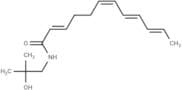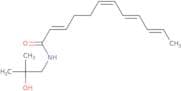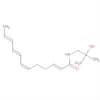
CAS 83883-10-7
:Hydroxy-α-sanshool
Beschreibung:
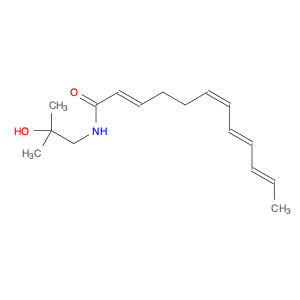
Hydroxy-α-sanshool ist eine chemische Verbindung, die hauptsächlich für ihre Präsenz im Sichuan-Pfeffer bekannt ist, einem Gewürz, das ein einzigartiges Taubheits- und Kribbelgefühl im Mund vermittelt. Es gehört zur Klasse der Verbindungen, die als Sanshools bekannt sind, die sich durch ihre langkettigen aliphatischen Strukturen auszeichnen. Hydroxy-α-sanshool ist bekannt für seine Fähigkeit, spezifische sensorische Rezeptoren zu aktivieren, insbesondere diejenigen, die an der Schmerz- und Temperaturwahrnehmung beteiligt sind, was zu seinen charakteristischen sensorischen Effekten beiträgt. Die Verbindung hat sowohl in kulinarischen als auch in medizinischen Kontexten Interesse geweckt, aufgrund ihrer potenziellen gesundheitlichen Vorteile, einschließlich entzündungshemmender und schmerzlindernder Eigenschaften. Ihre molekulare Struktur umfasst Hydroxylgruppen, die ihre Löslichkeit und Reaktivität erhöhen. Hydroxy-α-sanshool wird typischerweise im Kontext der Lebensmittelchemie und Pharmakologie untersucht, wo seine sensorischen und biologischen Aktivitäten erforscht werden. Wie bei vielen natürlichen Verbindungen können Stabilität und Wirksamkeit durch Faktoren wie Temperatur, pH-Wert und das Vorhandensein anderer Substanzen beeinflusst werden.
Formel:C16H25NO2
InChl:InChI=1S/C16H25NO2/c1-4-5-6-7-8-9-10-11-12-13-15(18)17-14-16(2,3)19/h4-9,12-13,19H,10-11,14H2,1-3H3,(H,17,18)/b5-4+,7-6+,9-8-,13-12+
InChI Key:InChIKey=LHFKHAVGGJJQFF-UEOYEZOQSA-N
SMILES:C(/C=C/CC/C=C\C=C\C=C\C)(NCC(C)(C)O)=O
Synonyme:- 2,6,8,10-Dodecatetraenamide, N-(2-hydroxy-2-methylpropyl)-, (E,E,Z,E)-
- Hydroxy-α-sanshool
- 2E,6Z,8E,10E-Dodecatetraenoic acid N-(2-hydroxy-2-methylpropyl)amide
- (2E,6Z,8E,10E)-N-(2-Hydroxy-2-methylpropyl)-2,6,8,10-dodecatetraenamide
- 2,6,8,10-Dodecatetraenamide, N-(2-hydroxy-2-methylpropyl)-, (2E,6Z,8E,10E)-
- Hydroxy-alpha-Sanshool
- (2E,6Z,8E,10E)-N-(2-hydroxy-2-Methylpropyl)dodeca-2,6,8,10-tetra
- alpha-Hydroxy-Sanshool
- -N-(2-Hydroxy-2-methylpropyl)
- dodeca-2,6,8,10-tetraenamide
- (2E,6Z,8E,10E)-N-(2-hydroxy-2-methylpropyl)dodeca-2,6,8,10-tetraenamide
- Weitere Synonyme anzeigen
Sortieren nach
Reinheit (%)
0
100
|
0
|
50
|
90
|
95
|
100
6 Produkte.
(2E,6Z,8E,10E)-N-(2-Hydroxy-2-methylpropyl)dodeca-2,6,8,10-tetraenamide
CAS:Formel:C16H25NO2Reinheit:98%Farbe und Form:SolidMolekulargewicht:263.3752Hydroxy-α-sanshool
CAS:Formel:C16H25NO2Reinheit:≥ 98.0%Farbe und Form:White to beige solidMolekulargewicht:263.38Hydroxy-α-sanshool
CAS:Hydroxy-alpha-sanshool exerts antiobesity and hypolipidemic activities in HFD rats by reducing liver oxidative stress and thus could be considered as a potential candidate drug to cure or prevent obesity and hyperlipidemia. It also has analgesic properties, it activates TRPV1 and TRPA1 in sensory neurons.Formel:C16H25NO2Reinheit:95%~99%Molekulargewicht:263.381Hydroxy-α-sanshool
CAS:Hydroxy-α-sanshool is an alkyl amide isolated from the pepper. It acts as a TRPA1 covalent and TRPV1 non-covalent agonist (EC50s: 69 and 1.1 μM).Formel:C16H25NO2Reinheit:97.51% - 99.47%Farbe und Form:SolidMolekulargewicht:263.38Hydroxy-α-sanshool
CAS:Hydroxy-α-sanshool is a bioactive compound, which is a naturally occurring alkylamide. It is predominantly sourced from the fruit husks of the plant Zanthoxylum species, commonly known as Sichuan pepper. Hydroxy-α-sanshool is known for its unique mode of action, which involves the activation of specific ion channels in sensory neurons, notably the TRPV1 and TRPA1 channels. This activation results in a characteristic tingling and numbing sensation, commonly referred to as the "Sichuan pepper effect."Formel:C16H25NO2Reinheit:Min. 98 Area-%Farbe und Form:Clear Viscous LiquidMolekulargewicht:263.38 g/mol