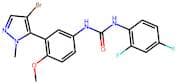
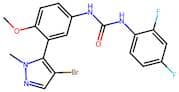
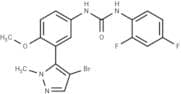
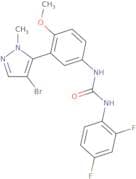
![N-[3-(4-Bromo-1-methyl-1H-pyrazol-5-yl)-4-methoxyphenyl]-N′-(2,4-difluorophenyl)urea](/_next/image/?url=https%3A%2Fstatic.cymitquimica.com%2Fcas-image%2Fthumb-webp%2F85395-n-3-4-bromo-1-methyl-1h-pyrazol-5-yl-4-methoxyphenyl-n-24-difluorophenyl-urea.webp&w=3840&q=75)
CAS 839713-36-9
:N-[3-(4-Brom-1-methyl-1H-pyrazol-5-yl)-4-methoxyphenyl]-N′-(2,4-difluorphenyl)harnstoff
Beschreibung:
N-[3-(4-Brom-1-methyl-1H-pyrazol-5-yl)-4-methoxyphenyl]-N′-(2,4-difluorphenyl)harnstoff, mit der CAS-Nummer 839713-36-9, ist eine synthetische organische Verbindung, die durch ihre komplexe molekulare Struktur gekennzeichnet ist, die eine Harnstofffunktionalgruppe umfasst, die mit zwei verschiedenen aromatischen Moieties verbunden ist. Die Anwesenheit eines Bromatoms und von Difluorphenylgruppen trägt zu ihrer potenziellen biologischen Aktivität bei, was sie für die pharmazeutische Forschung von Interesse macht. Der Pyrazolring der Verbindung und die Methoxysubstitution erhöhen ihre chemische Reaktivität und Löslichkeitseigenschaften. Typischerweise werden solche Verbindungen auf ihre Wirksamkeit in verschiedenen biologischen Tests bewertet, insbesondere im Kontext der Arzneimittelentwicklung. Die molekularen Wechselwirkungen, einschließlich Wasserstoffbrückenbindungen und π-π-Stapeln, spielen eine entscheidende Rolle in ihrer biologischen Aktivität. Darüber hinaus können die Stabilität, Löslichkeit und Reaktivität der Verbindung durch die Anwesenheit von Halogensubstituenten beeinflusst werden, die ihre pharmakokinetischen Eigenschaften beeinträchtigen können. Insgesamt stellt diese Verbindung eine Klasse von Molekülen dar, die ein signifikantes therapeutisches Potenzial aufweisen können, was eine weitere Untersuchung in der medizinischen Chemie rechtfertigt.
Formel:C18H15BrF2N4O2
InChl:InChI=1S/C18H15BrF2N4O2/c1-25-17(13(19)9-22-25)12-8-11(4-6-16(12)27-2)23-18(26)24-15-5-3-10(20)7-14(15)21/h3-9H,1-2H3,(H2,23,24,26)
InChI Key:InChIKey=COSPVUFTLGQDQL-UHFFFAOYSA-N
SMILES:O(C)C1=C(C=C(NC(NC2=C(F)C=C(F)C=C2)=O)C=C1)C3=C(Br)C=NN3C
Synonyme:- 1-[3-(4-Bromo-2-methyl-2H-pyrazol-3-yl)-4-methoxyphenyl]-3-(2,4-difluorophenyl)urea
- APD 125
- N-[3-(4-Bromo-1-methyl-1H-pyrazol-5-yl)-4-methoxyphenyl]-N′-(2,4-difluorophenyl)urea
- 1-(2,4-Difluorophenyl)-3-[4-methoxy-3-(4-bromo-1-methyl-1H-pyrazol-5-yl)phenyl]urea
- Urea, N-[3-(4-bromo-1-methyl-1H-pyrazol-5-yl)-4-methoxyphenyl]-N′-(2,4-difluorophenyl)-
Sortieren nach
Reinheit (%)
0
100
|
0
|
50
|
90
|
95
|
100
5 Produkte.
1-[3-(4-Bromo-1-methyl-1H-pyrazol-5-yl)-4-methoxyphenyl]-3-(2,4-difluorophenyl)urea
CAS:Formel:C18H15BrF2N4O2Reinheit:98%Farbe und Form:SolidMolekulargewicht:437.23811-(3-(4-Bromo-1-Methyl-1H-Pyrazol-5-Yl)-4-Methoxyphenyl)-3-(2,4-Difluorophenyl)Urea
CAS:1-(3-(4-Bromo-1-Methyl-1H-Pyrazol-5-Yl)-4-Methoxyphenyl)-3-(2,4-Difluorophenyl)UreaReinheit:99%Molekulargewicht:437.24g/molNelotanserin
CAS:Nelotanserin (APD125): strong 5-HT2A inverse agonist (IC50: 1.7 nM), moderate 5-HT2C (79 nM), weak 5-HT2B (791 nM).Formel:C18H15BrF2N4O2Reinheit:98.42% - 99.88%Farbe und Form:SolidMolekulargewicht:437.24Ref: TM-T7350
1mg38,00€2mg50,00€1mL*10mM (DMSO)80,00€5mg84,00€10mg113,00€25mg178,00€50mg333,00€100mg495,00€500mg1.071,00€Nelotanserin
CAS:1-[3-(4-Bromo-1-methyl-1H-pyrazol-5-yl)-4-methoxyphenyl]-3-(2,4-difluorophenyl)urea is the active ingredient in a drug that is used to treat chronic schizophrenia. It has been shown to have both antipsychotic and antidepressant properties. The drug works by blocking the 5HT2A receptor, which inhibits the effects of serotonin on heterocyclic amines at the postsynaptic membrane. This causes hyperpolarization of the membrane, which blocks neurotransmitter release and prevents further transmission of signals. It also blocks the H1 receptor, which decreases histamine release and reduces inflammation in the brain.Formel:C18H15BrF2N4O2Reinheit:Min. 95%Farbe und Form:PowderMolekulargewicht:437.24 g/mol
![1-[3-(4-Bromo-1-methyl-1H-pyrazol-5-yl)-4-methoxyphenyl]-3-(2,4-difluorophenyl)urea](/_next/image/?url=https%3A%2Fstatic.cymitquimica.com%2Fproducts%2FIN%2Fthumb%2FDA00G3SM.jpg&w=3840&q=75)