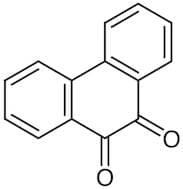
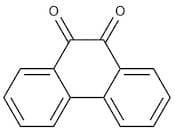
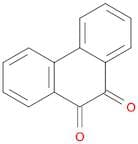
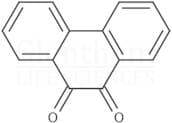
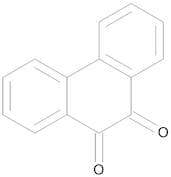
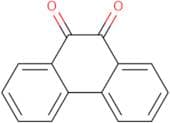
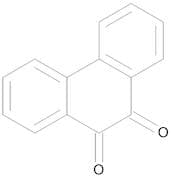
CAS 84-11-7
:9,10-Phenanthrenchinon
- 9,10-Dihydro-9,10-Dioxo-Phenanthren
- 9,10-Fenantrenoquinona
- 9,10-Phenanthraquinone
- 9,10-Phenanthrenchinon
- 9,10-Phenanthrene Quinone
- 9,10-Phenanthrenedione
- 9,10-Phenanthrenequinone
- Nsc 10446
- Nsc 7389
- Phenanthraquinone
- Phenanthrene chinone 95%
- Phenanthrene-9,10-Dione
- Phenanthrenechinone
- Weitere Synonyme anzeigen
9,10-Phenanthrenequinone
CAS:Formel:C14H8O2Reinheit:>98.0%(GC)Farbe und Form:Orange to Brown powder to crystalMolekulargewicht:208.229,10-Phenanthrenequinone, 95%
CAS:9,10-Phenanthrenequinon may be used for high quality passivation on silicon (100) surfaces. Quinones may serve as substrates for a variety of flavoenzymes, useful fluorescent compound and quinone. Also used in dyes, as a hardener for dental restoration, for the determination of copper by spectrophot
Formel:C14H8O2Reinheit:95%Farbe und Form:Orange to orange-brown, crystalline powderMolekulargewicht:208.229,10-Phenanthrenequinone
CAS:Formel:C14H8O2Reinheit:≥ 98.0%Farbe und Form:Orange to red powderMolekulargewicht:208.229,10-Phenanthrenequinone
CAS:Formel:C14H8O2Reinheit:>99.0%(GC)Farbe und Form:Light yellow to Yellow to Orange powder to crystalMolekulargewicht:208.229,10-Phenanthrenequinone
CAS:9,10-PhenanthrenequinoneFormel:C14H8O2Reinheit:98%Farbe und Form: light yellow to yellow solidMolekulargewicht:208.21g/molPhenanthrene-9,10-dione
CAS:Reinheit:98.0%Farbe und Form:Solid, Crystalline Powder or PowderMolekulargewicht:208.21600341796875Phenanthrenequinone
CAS:Phenanthrenequinone is a redox potential inhibitor that binds to the catalytic site of the enzyme. It is an inhibitor with a redox potential of -0.4 V (vs Ag/AgCl). Phenanthrenequinone has been shown to be toxicologically safe in human serum and has no carcinogenic potential. The reaction mechanism is not well understood, but it may be due to hydrogen bonding interactions with the enzyme active site.Formel:C14H8O2Reinheit:90%Farbe und Form:Orange PowderMolekulargewicht:208.22 g/mol9,10-Phenanthrenequinone
CAS:Kontrolliertes ProduktApplications 9,10-Phenanthrenequinone is used in the formation of spirophosphoranes containing acyclic 5-methyl-2-phenyl-2H-1,2,3-diazaphosphol-4-yl substituent.
References Mironov, V. F., et al.: Russ. J. Electrochem., 88, 430-438 (2018)Formel:C14H8O2Farbe und Form:NeatMolekulargewicht:208.219,10-Phenanthrenequinone
CAS:9,10-Phenanthrenequinone is an inhibitor of claudin-5/CLDN5, which induces apoptosis via an NO synthase/ROS-dependent mechanism. It also promotes caspase activation and DNA fragmentation while reducing CLDN5 expression and proteasome proteolysis, contributing to endothelial barrier dysfunction.
Formel:C14H8O2Farbe und Form:SolidMolekulargewicht:208.21