CAS 84-63-9
:Bis(4-Methyl-2-pentyl) phthalat
Beschreibung:
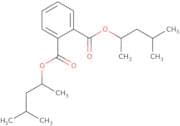
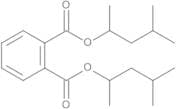
Bis(4-Methyl-2-pentyl) phthalat, allgemein als Phthalatester bekannt, ist eine organische Verbindung, die durch ihre Esterfunktionalgruppen, die vom Phthalsäure abgeleitet sind, gekennzeichnet ist. Es handelt sich typischerweise um eine farblose bis blassgelbe Flüssigkeit mit einer leicht ölig-texturierten Konsistenz und einem schwachen aromatischen Geruch. Diese Substanz wird hauptsächlich als Weichmacher verwendet, um die Flexibilität und Haltbarkeit von Kunststoffen, insbesondere von Polyvinylchlorid (PVC), zu verbessern. Ihre molekulare Struktur umfasst zwei 4-Methyl-2-pentyl Gruppen, die an einem Phthalat-Rückgrat befestigt sind, was zu ihren Eigenschaften beiträgt. Bis(4-Methyl-2-pentyl) phthalat ist bekannt für seine relativ geringe Flüchtigkeit und gute thermische Stabilität, was es für verschiedene industrielle Anwendungen geeignet macht. Allerdings hat es, wie viele Phthalate, Umwelt- und Gesundheitsbedenken aufgeworfen, aufgrund seiner potenziellen endokrinen disruptiven Wirkungen und wurde regulatorischen Prüfungen unterzogen. Eine ordnungsgemäße Handhabung und Entsorgung sind entscheidend, um Risiken im Zusammenhang mit der Exposition zu mindern.
Formel:C20H30O4
InChl:InChI=1S/C20H30O4/c1-13(2)11-15(5)23-19(21)17-9-7-8-10-18(17)20(22)24-16(6)12-14(3)4/h7-10,13-16H,11-12H2,1-6H3
InChI Key:InChIKey=UAFXUVUVOTXFND-UHFFFAOYSA-N
SMILES:C(OC(CC(C)C)C)(=O)C1=C(C(OC(CC(C)C)C)=O)C=CC=C1
Synonyme:- Phthalic acid, bis(1,3-dimethylbutyl) ester
- Di-(4-Methyl-2-pentyl)phthalate
- 1,2-Benzenedicarboxylic acid, 1,2-bis(1,3-dimethylbutyl) ester
- 1,2-Benzenedicarboxylic acid, bis(1,3-dimethylbutyl) ester
- 2-Pentanol, 4-methyl-, phthalate (2:1)
Sortieren nach
Reinheit (%)
0
100
|
0
|
50
|
90
|
95
|
100
13 Produkte gefunden.
Phthalic acid, bis-4-methyl-2-pentyl ester
CAS:Formel:C20H30O4Farbe und Form:NeatMolekulargewicht:334.45Bis(4-methyl-2-pentyl) phthalate
CAS:Dibutyl phthalate is a mixture of two isomers, butyl benzyl phthalate and dibutyl phthalate. It is used as a plasticizer in the manufacture of polyvinyl chloride plastics. The health effects of dibutyl phthalate are not well-studied, although it has been shown to cause liver toxicity in rats. Dibutyl phthalate can be analyzed by gas chromatography or high-performance liquid chromatography. The chromatographic method for determining the presence of dibutyl phthalate is based on the chemical properties of the functional groups, which are determined by the type of solvent and the matrix effect. Dibutyl phthalate can also be determined using magnetic particles. This technique uses an analytical method that involves preparing a solution with a known concentration, followed by adding magnetic particles to the solution and measuring their response to an applied magnetic field.Formel:C20H30O4Reinheit:Min. 95%Farbe und Form:PowderMolekulargewicht:334.45 g/molBis(4-Methyl-2-pentyl) Phthalate
CAS:Kontrolliertes ProduktFormel:C20H30O4Farbe und Form:NeatMolekulargewicht:334.45