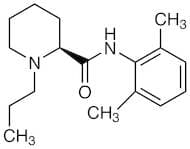
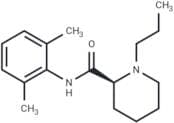
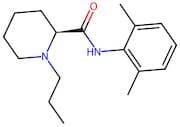
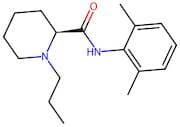
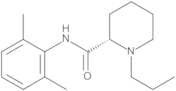
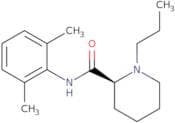
CAS 84057-95-4
:Ropivacain
Beschreibung:
Ropivacain ist ein Lokalanästhetikum, das zur Amidklasse gehört und hauptsächlich für die regionale Anästhesie und Schmerzmanagement verwendet wird. Es zeichnet sich durch die Fähigkeit aus, die Nervenleitung zu blockieren, indem es den Einstrom von Natriumionen durch spannungsabhängige Natriumkanäle hemmt, was zu einem reversiblen Verlust der Empfindung in den Zielbereichen führt. Ropivacain ist bekannt für seine relativ geringere Kardiotoxizität im Vergleich zu anderen Lokalanästhetika, was es in bestimmten klinischen Situationen zur bevorzugten Wahl macht. Die Substanz wird typischerweise durch Injektion verabreicht und ist in verschiedenen Konzentrationen erhältlich. Ihr pharmakokinetisches Profil umfasst einen langsameren Wirkungseintritt und eine längere Wirkungsdauer, was für eine verlängerte Analgesie vorteilhaft sein kann. Ropivacain ist auch für sein geringeres Potenzial für systemische Toxizität bekannt, was eine sicherere Anwendung bei epiduralen und peripheren Nervenblockaden ermöglicht. Darüber hinaus hat es ein chirales Zentrum und existiert als ein einzelnes Enantiomer, was zu seinem Wirkungs- und Sicherheitsprofil beiträgt. Insgesamt ist Ropivacain ein wertvolles Mittel im Bereich der Anästhesiologie und Schmerztherapie.
Formel:C17H26N2O
InChl:InChI=1/C17H26N2O.CH4O3S/c1-4-11-19-12-6-5-10-15(19)17(20)18-16-13(2)8-7-9-14(16)3;1-5(2,3)4/h7-9,15H,4-6,10-12H2,1-3H3,(H,18,20);1H3,(H,2,3,4)
InChI Key:InChIKey=ZKMNUMMKYBVTFN-HNNXBMFYSA-N
SMILES:C(NC1=C(C)C=CC=C1C)(=O)[C@H]2N(CCC)CCCC2
Synonyme:- (-)-Lea 103
- (2S)-N-(2,6-Dimethylphenyl)-1-propyl-2-piperidinecarboxamide
- (2S)-N-(2,6-Dimethylphenyl)-1-propylpiperidine-2-carboxamide
- (S)-(-)-1-propyl-2\',6\'-pipecolinoxylidide
- (S)-(-)-Ropivacaine
- 2-Piperidinecarboxamide, N-(2,6-dimethylphenyl)-1-propyl-, (2S)-
- 2-Piperidinecarboxamide, N-(2,6-dimethylphenyl)-1-propyl-, (S)-
- Anapeine
- N-(2,6-Dimethylphenyl)-1-propyl-piperidine-2-carboxamide
- N-(2,6-dimethylphenyl)-1-propylpiperidine-2-carboxamide methanesulfonate (1:1)
- Narop
- Naropeine
- Naropine
- Ropivacaine
- (S)-N-(2,6-Dimethylphenyl)-1-pKIpyl-2-piperidinecarboxamide
- ROPIVACAINE MESYLATER
- (2S)-1-Propyl-N-(2,6-dimethylphenyl)piperidine-2-carboxamide
- Naropin
- (2S)-1-Propyl-2-(2,6-dimethylphenyl)carbamoylpiperidine
- ROPACARAINEHCL
- Weitere Synonyme anzeigen
Sortieren nach
Reinheit (%)
0
100
|
0
|
50
|
90
|
95
|
100
10 Produkte.
Ropivacaine
CAS:Formel:C17H26N2OReinheit:>98.0%(HPLC)Farbe und Form:White to Light yellow powder to crystalMolekulargewicht:274.41Ropivacaine
CAS:Compounds containing an unfused pyridine ring in the structure, nesoiFormel:C17H26N2OFarbe und Form:White Off-White PowderMolekulargewicht:274.20451Ropivacaine
CAS:Ropivacaine (LEA-103 HCl) is a local anaesthetic drug belonging to the amino amide group.Formel:C17H26N2OReinheit:97.75% - >99.99%Farbe und Form:SolidMolekulargewicht:274.40(S)-Ropivacaine
CAS:Kontrolliertes ProduktApplications (S)-Ropivacaine acts as a local anaesthetic for use during medical procedures. Frequently used in epidural procedures as a labor analgesia
References Bataille, A. et al.: Brit. J. Anaesthesia., 112, 703 (2014); Zhai, Y. et al.: Int. j. Pharm., 47, 103 (2014); Yue, H. et al.: Chin Med. J., 126. 4301 (2013);Formel:C17H26N2OFarbe und Form:NeatMolekulargewicht:274.4Ropivacaine
CAS:Kontrolliertes ProduktRopivacaine is an amide local anesthetic that is used to provide pain relief during surgery. It can also be used in other medical procedures, such as endoscopy and diagnostic angiography. Ropivacaine binds to the α1-acid glycoprotein in the blood, which prevents its passage into the central nervous system. Ropivacaine has been shown to have a polymerase chain-reaction (PCR) assay of clinical properties and a matrix effect on bupivacaine. Injection solutions containing ropivacaine are available with concentrations between 0.5% and 2%. The optimum concentration depends on the type of procedure being performed and the desired duration of anesthesia. Ropivacaine has also been shown to have cardiac effects, including an increase in heart rate, but does not appear to interfere with cardiac conduction or contractility. It also provides analgesia by blocking nerve impulses from reaching the brain.Formel:C17H26N2OReinheit:Min. 98 Area-%Farbe und Form:PowderMolekulargewicht:274.4 g/mol