CAS 84100-84-5
:2,3,3-Trimethyl-3H-indol-5-carbonsäure
Beschreibung:
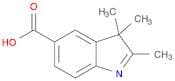
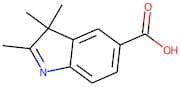
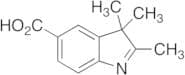
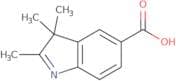
2,3,3-Trimethyl-3H-indol-5-carbonsäure ist eine organische Verbindung, die durch ihre Indolstruktur gekennzeichnet ist, die eine bicyclische Verbindung darstellt, die aus einem Benzolring besteht, der mit einem Pyrrolring verschmolzen ist. Diese Verbindung weist drei Methylgruppen an den Positionen 2 und 3 des Indolrings auf, was zu ihren einzigartigen Eigenschaften beiträgt. Das Vorhandensein einer Carbonsäurefunktion an der Position 5 erhöht ihre Säure und Löslichkeit in polaren Lösungsmitteln. Diese Verbindung wird typischerweise in der organischen Synthese verwendet und kann als Zwischenprodukt in der Herstellung von Arzneimitteln oder Agrochemikalien dienen. Ihre molekulare Struktur ermöglicht potenzielle Wechselwirkungen mit biologischen Systemen, was sie in der medizinischen Chemie von Interesse macht. Darüber hinaus kann das Vorhandensein mehrerer Methylgruppen ihre sterischen und elektronischen Eigenschaften beeinflussen, was ihre Reaktivität und Stabilität beeinflusst. Wie viele Indolderivate kann sie interessante biologische Aktivitäten aufweisen, obwohl spezifische Anwendungen von weiteren Forschungen und Charakterisierungen abhängen.
Formel:C12H13NO2
InChl:InChI=1S/C12H13NO2/c1-7-12(2,3)9-6-8(11(14)15)4-5-10(9)13-7/h4-6H,1-3H3,(H,14,15)
InChI Key:InChIKey=QUDAPQXQGBIUAR-UHFFFAOYSA-N
SMILES:CC1(C)C=2C(N=C1C)=CC=C(C(O)=O)C2
Synonyme:- 2,3,3-Trimethyl-5-carboxyindolenine
- 5-Carboxyl-2,3,3-trimethyl-3H-indolenine
- 3H-Indole-5-carboxylic acid, 2,3,3-trimethyl-
- 2,3,3-Trimethyl-3H-indole-5-carboxylic acid
Sortieren nach
Reinheit (%)
0
100
|
0
|
50
|
90
|
95
|
100
6 Produkte.
3H-Indole-5-carboxylicacid, 2,3,3-trimethyl-
CAS:Formel:C12H13NO2Reinheit:95%Farbe und Form:SolidMolekulargewicht:203.23712,3,3-Trimethyl-3H-indole-5-carboxylic acid
CAS:2,3,3-Trimethyl-3H-indole-5-carboxylic acidReinheit:97%Molekulargewicht:203.24g/mol2,3,3-Trimethyl-5-carboxyindolenine
CAS:Kontrolliertes ProduktApplications Intermediate in the synthesis of cyanine dyes for fluorescence imaging of tumor hypoxia and as contrast agents for near-IR tumor imaging.
References Pavlik, C. et al.; Dyes Pigments 89, 9 (2010)Formel:C12H13NO2Farbe und Form:NeatMolekulargewicht:203.242,3,3-Trimethyl-3H-indole-5-carboxylic acid
CAS:Formel:C12H13NO2Reinheit:95%Farbe und Form:SolidMolekulargewicht:203.2412,3,3-Trimethyl-5-carboxyindolenine
CAS:2,3,3-Trimethyl-5-carboxyindolenine (TMCI) is a fluorescent probe that can be used for the detection of hypoxic tumor tissue. It is a fluorimetric compound that reacts with nucleophilic sites on proteins and other functional groups to form conjugates. TMCI has been shown to react with cyanines, fluoroalkyl esters, and other compounds bearing electron-donating substituents. The optimum concentration of TMCI is between 0.1 and 1 mM in PBS buffer at pH 7.4 at 37°C. This probe is also sensitive to changes in its environment such as pH or temperature. TMCI has been shown to react with 2-nitroimidazole and unsymmetrical indolsium complexes, which are used as optical sensors for oxygen concentration measurements.Formel:C12H13NO2Reinheit:Min. 95%Molekulargewicht:203.24 g/mol