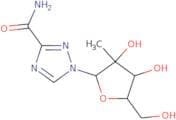
CAS 847651-91-6
:1H-1,2,4-Triazol-3-carboxamid,1-(2-C-methyl-beta-D-ribofuranosyl)-
Beschreibung:
1H-1,2,4-Triazol-3-carboxamid, 1-(2-C-Methyl-beta-D-Ribofuranosyl) ist eine chemische Verbindung, die durch ihre Triazolringstruktur gekennzeichnet ist, die eine fünfgliedrige heterocyclische Verbindung mit drei Stickstoffatomen ist. Diese Verbindung weist eine Carboxamid-Funktionalgruppe auf, die zu ihrem Potenzial als bioaktive Molekül beiträgt. Die Anwesenheit der 2-C-Methyl-beta-D-Ribofuranosyl-Gruppe deutet darauf hin, dass es sich um ein Nukleosid-Analog handelt, das möglicherweise seine biologische Aktivität, insbesondere in Bezug auf den Nukleinsäurestoffwechsel, beeinflusst. Die Verbindung wird wahrscheinlich in polaren Lösungsmitteln löslich sein, aufgrund der Anwesenheit der Carboxamidgruppe, und sie kann an Wasserstoffbrückenbindungen teilnehmen. Ihre strukturellen Merkmale deuten auf potenzielle Anwendungen in der medizinischen Chemie hin, insbesondere in der antiviralen oder krebsbekämpfenden Forschung, da viele Triazolderivate vielversprechende pharmakologische Eigenschaften gezeigt haben. Spezifische biologische Aktivitäten, Stabilität und Reaktivität erfordern jedoch weitere Untersuchungen durch experimentelle Studien.
Sortieren nach
Reinheit (%)
0
100
|
0
|
50
|
90
|
95
|
100
2 Produkte.
1-(2-C-Methyl-b-D-ribofuranosyl)-1H-1,2,4-triazole-3-carboxamide
CAS:1-(2-C-Methyl-b-D-ribofuranosyl)-1H-1,2,4-triazole-3-carboxamide is a modified nucleoside that is used as an antiviral and anticancer agent. It is a diphosphate derivative of 1-(2'-deoxyribofuranosyl)-1H-1,2,4-triazole. The compound has been shown to have antiviral activity against herpes simplex virus (HSV) type I and HSV type II in vitro. It also inhibits the growth of human tumor cells in culture by interfering with DNA synthesis. The compound has been reported to be active against leukemia cells in vivo but not against normal cells. It has a high level of toxicity at high doses.
Reinheit:Min. 95%