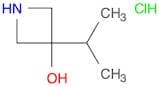
CAS 848192-94-9
:3-Azetidinol, 3-(1-methylethyl)-, Hydrochlorid (1:1)
Beschreibung:
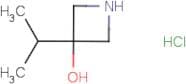
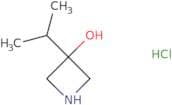
3-Azetidinol, 3-(1-methylethyl)-, Hydrochlorid (1:1) ist eine chemische Verbindung, die durch ihre Azetidin-Ringstruktur gekennzeichnet ist, die eine viergliedrige gesättigte heterocyclische Verbindung mit einem Stickstoffatom enthält. Diese spezifische Verbindung weist ein 3-(1-Methyl-ethyl)-Substituent auf, was auf die Anwesenheit einer Isopropylgruppe hinweist, die am Azetidin-Ring angebracht ist. Die Hydrochlorid-Form deutet darauf hin, dass sich die Verbindung in ihrer Salzform befindet, was typischerweise ihre Löslichkeit in Wasser und Stabilität verbessert. Als Hydrochlorid wird sie wahrscheinlich Eigenschaften wie erhöhte Bioverfügbarkeit und verbesserte Handhabungseigenschaften in pharmazeutischen Anwendungen aufweisen. Die Verbindung könnte aufgrund ihrer potenziellen biologischen Aktivität von Interesse in der medizinischen Chemie sein, obwohl spezifische pharmakologische Wirkungen von weiteren Forschungen abhängen würden. Sicherheitsdaten und Handhabungsvorschriften sollten beachtet werden, wie bei jeder chemischen Substanz, insbesondere in Laborumgebungen. Insgesamt ist 3-Azetidinol, 3-(1-Methyl-ethyl)-, Hydrochlorid eine Verbindung mit einzigartigen strukturellen Merkmalen, die in verschiedenen chemischen und biologischen Kontexten von Bedeutung sein könnten.
Formel:C6H13NO·ClH
InChl:InChI=1S/C6H13NO.ClH/c1-5(2)6(8)3-7-4-6;/h5,7-8H,3-4H2,1-2H3;1H
InChI Key:InChIKey=QXMCUWMTTJAAHT-UHFFFAOYSA-N
SMILES:C(C)(C)C1(O)CNC1.Cl
Synonyme:- 3-Isopropylazetidin-3-ol hydrochloride
- 3-Azetidinol, 3-(1-methylethyl)-, hydrochloride (1:1)
- 3-Azetidinol, 3-(1-methylethyl)-, hydrochloride
Sortieren nach
Reinheit (%)
0
100
|
0
|
50
|
90
|
95
|
100
4 Produkte.
3-(Propan-2-yl)azetidin-3-ol hydrochloride
CAS:3-(Propan-2-yl)azetidin-3-ol hydrochlorideReinheit:≥95%Molekulargewicht:151.63g/mol3-(Propan-2-yl)azetidin-3-ol hydrochloride
CAS:3-(Propan-2-yl)azetidin-3-ol hydrochloride is a compound that belongs to the group of pyrrolizidine alkaloids. It acts as an inhibitor, particularly against selenite, by forming electrostatic interactions. This compound has been shown to modulate dopamine release and uptake in the brain, making it a potential candidate for research in neurological disorders. Additionally, 3-(Propan-2-yl)azetidin-3-ol hydrochloride can be used as a research chemical for electrode modification due to its ability to form stable complexes with 1,2,4-oxadiazole benzoic acid and benzoate derivatives. Furthermore, this compound exhibits emission properties when activated by collagen or alkaloid compounds. Its unique characteristics make it a versatile compound for various research applications.Formel:C6H14ClNOReinheit:Min. 95%Molekulargewicht:151.63 g/mol