CAS 855-38-9
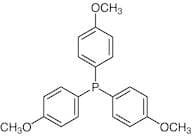
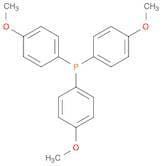
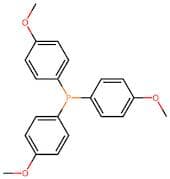
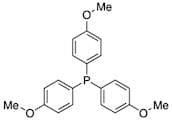
:Tris(4-methoxyphenyl)phosphan
Beschreibung:
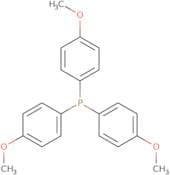
Tris(4-methoxyphenyl)phosphan, mit der CAS-Nummer 855-38-9, ist eine organophosphorverbindung, die durch das Vorhandensein eines Phosphoratoms gekennzeichnet ist, das an drei 4-Methoxyphenylgruppen gebunden ist. Diese Verbindung erscheint typischerweise als weißes bis hellgelbes Feststoff und ist in organischen Lösungsmitteln wie Dichlormethan und Chloroform löslich. Sie weist eine relativ hohe thermische Stabilität auf, was sie für verschiedene chemische Anwendungen geeignet macht. Die Methoxygruppen verbessern ihre Löslichkeit und Reaktivität, sodass sie an verschiedenen organischen Reaktionen teilnehmen kann, einschließlich solcher, die nucleophile Substitution und Koordinationschemie betreffen. Tris(4-methoxyphenyl)phosphan wird häufig als Ligand in Übergangsmetallkomplexen verwendet, was zur Katalyse und Materialwissenschaft beiträgt. Darüber hinaus kann sie aufgrund der Anwesenheit der Methoxysubstituenten interessante elektronische Eigenschaften aufweisen, die die elektronische Verteilung innerhalb des Moleküls beeinflussen können. Sicherheitsvorkehrungen sollten beim Umgang mit dieser Verbindung beachtet werden, wie bei vielen organophosphorverbindungen, aufgrund potenzieller Toxizität und Umweltbedenken.
Formel:C21H21O3P
InChl:InChI=1S/C21H21O3P/c1-22-16-4-10-19(11-5-16)25(20-12-6-17(23-2)7-13-20)21-14-8-18(24-3)9-15-21/h4-15H,1-3H3
InChI Key:InChIKey=UYUUAUOYLFIRJG-UHFFFAOYSA-N
SMILES:P(C1=CC=C(OC)C=C1)(C2=CC=C(OC)C=C2)C3=CC=C(OC)C=C3
Synonyme:- Ai3-62578
- Nsc 136458
- Phosphine, tris(4-methoxyphenyl)-
- Phosphine, tris(p-methoxyphenyl)-
- Tri(4-methoxyphenyl)phosphine
- Tri(p-methoxyphenyl)phosphine
- Tri-p-anisylphosphine
- Trianisylphosphine
- Tris(4-Methoxyphenyl)Phosphane
- Tris(4-anisyl)phosphine
- Tris(4-methoxylphenyl)phosphine
- Tris(p-anisyl)phosphine
- tris(p-Methoxyphenyl)phosphine
- Weitere Synonyme anzeigen
Sortieren nach
Reinheit (%)
0
100
|
0
|
50
|
90
|
95
|
100
7 Produkte.
Tris(4-methoxyphenyl)phosphine
CAS:Formel:C21H21O3PReinheit:>97.0%(T)Farbe und Form:White to Yellow to Orange powder to crystalMolekulargewicht:352.37Tris(4-Methoxyphenyl)Phosphine
CAS:Formel:C21H21O3PReinheit:95%Farbe und Form:SolidMolekulargewicht:352.3634Ref: IN-DA0035S1
1kgNachfragen5kgNachfragen50gNachfragen1g24,00€5g27,00€10g36,00€25g58,00€100g141,00€250g280,00€500g672,00€Tris(p-methoxyphenyl)phosphine
CAS:Tris(p-methoxyphenyl)phosphineFormel:C21H21O3PReinheit:97%Farbe und Form: white crystalline solidMolekulargewicht:352.36g/molTris(4-methoxyphenyl)phosphine
CAS:Formel:C21H21O3PReinheit:95%Farbe und Form:Solid, White to yellow crystal powderMolekulargewicht:352.37Tris(4-methoxyphenyl)phosphine
CAS:Kontrolliertes ProduktFormel:C21H21O3PFarbe und Form:NeatMolekulargewicht:352.36Tris(p-methoxyphenyl)phosphine, 98%
CAS:Tris(p-methoxyphenyl)phosphine, 98%
Formel:(pCH3OC6H4)3PReinheit:98%Farbe und Form:white to pale yellow xtl.Molekulargewicht:352.37Tris(4-methoxyphenyl)phosphine
CAS:Tris(4-methoxyphenyl)phosphine (TMPP) is a molecule that exhibits a variety of biological properties. TMPP has been shown to inhibit transcription and DNA replication in prostate cancer cells. It also has the ability to form palladium complexes, which are used in analytical methods for the determination of metal ions. The binding constants of TMPP have been determined by x-ray crystal structures and molecular modeling techniques. TMPP is water soluble and is able to bind metal ions such as zinc or mercury, which may be due to its zwitterion structure. TMPP has been used as a chemiluminescence agent in titration calorimetry experiments, where it reacts with oxygen to produce light at a wavelength of 560 nm. This reaction is exothermic and can be used to measure energy changes in chemical reactions without the need for expensive equipment.Formel:C21H21O3PReinheit:Min. 95%Farbe und Form:Yellow PowderMolekulargewicht:352.36 g/mol