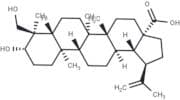
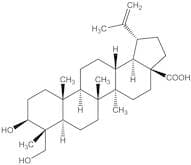
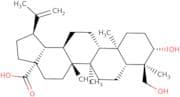
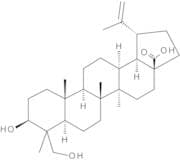
CAS 85999-40-2
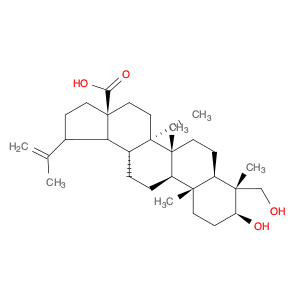
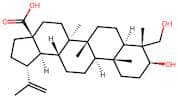
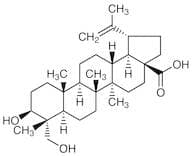
:(1R,3aS,5aR,5bR,7aR,8R,9S,11aR,11bR,13aS,13bR)-9-hydroxy-8-(hydroxymethyl)-1-isopropenyl-5a,5b,8,11a-tetramethyl-1,2,3,4,5,6,7,7a,9,10,11,11b,12,13,13a,13b-hexadecahydrocyclopenta[a]chrysen-3a-carbonsäure
Beschreibung:
Die chemische Substanz mit dem Namen "(1R,3aS,5aR,5bR,7aR,8R,9S,11aR,11bR,13aS,13bR)-9-hydroxy-8-(hydroxymethyl)-1-isopropenyl-5a,5b,8,11a-tetramethyl-1,2,3,4,5,6,7,7a,9,10,11,11b,12,13,13a,13b-hexadecahydrocyclopenta[a]chrysen-3a-carbonsäure" und der CAS-Nummer "85999-40-2" ist eine komplexe organische Verbindung, die durch ihre komplizierte polycyclische Struktur und mehrere Stereozentren gekennzeichnet ist. Diese Verbindung weist eine Hydroxylgruppe und eine Isopropenylgruppe auf, was auf potenzielle Reaktivität und funktionale Vielseitigkeit hinweist. Das Vorhandensein mehrerer Methylgruppen trägt zu ihrem hydrophoben Charakter bei, während die carboxylische Säuregruppe auf saure Eigenschaften hinweist. Die Stereochemie, die durch die spezifischen R- und S-Konfigurationen gekennzeichnet ist, spielt eine entscheidende Rolle bei der Bestimmung der biologischen Aktivität der Verbindung und ihrer Wechselwirkung mit anderen Molekülen. Solche Verbindungen werden häufig wegen ihrer potenziellen Anwendungen in der Pharmazie, in Naturprodukten und in der Materialwissenschaft aufgrund ihrer einzigartigen strukturellen Merkmale und funktionalen Gruppen untersucht. Insgesamt veranschaulicht diese Substanz die Komplexität und Vielfalt, die in der organischen Chemie zu finden sind, insbesondere im Bereich der Synthese und Modifikation von Naturprodukten.
Formel:C30H48O4
InChl:InChI=1/C30H48O4/c1-18(2)19-9-14-30(25(33)34)16-15-28(5)20(24(19)30)7-8-22-26(3)12-11-23(32)27(4,17-31)21(26)10-13-29(22,28)6/h19-24,31-32H,1,7-17H2,2-6H3,(H,33,34)/t19-,20-,21+,22+,23-,24+,26-,27-,28+,29+,30-/m0/s1
Synonyme:- (3β,13α)-3,23-Dihydroxylup-20(29)-en-28-oic acid
- Lup-20(29)-En-28-Oic Acid, 3,23-Dihydroxy-, (3Β,13Α)-
- 23-Hydroxybetulinic Acid
Sortieren nach
Reinheit (%)
0
100
|
0
|
50
|
90
|
95
|
100
10 Produkte.
23-Hydroxybetulinic acid
CAS:Formel:C30H48O4Reinheit:98%Farbe und Form:SolidMolekulargewicht:472.699723-Hydroxybetulinic Acid
CAS:Formel:C30H48O4Reinheit:>98.0%(HPLC)Farbe und Form:White to Light yellow powder to crystalMolekulargewicht:472.7123-Hydroxybetulinic acid
CAS:23-Hydroxybetulinic acid (Anemosapogenin) shows potent anti-tumor effect in vivo, but it has some toxicity, structure modification should be needed.Formel:C30H48O4Reinheit:99.27% - 99.37%Farbe und Form:SolidMolekulargewicht:472.70Anemosapogenin
CAS:Carboxylic acid with alcohol functionFormel:C30H48O4Reinheit:≥ 90.0 % (HPLC)Farbe und Form:PowderMolekulargewicht:472.7123-Hydroxybetulinic acid
CAS:23-Hydroxybetulinic acid is a saponin that belongs to the group of polysaccharides. It is obtained from Curcuma aromatica, which is an edible plant also known as turmeric. 23-Hydroxybetulinic acid has been shown to have a low bioavailability, with plasma concentrations reached after 2 hours. This compound has been used in the preparation of medicines for the treatment of liver diseases, such as cirrhosis and hepatitis. Pharmacokinetic modeling has been done on both animals and humans. The results show that the metabolic pathways for 23-hydroxybetulinic acid are catalysed by beta-elemonic acid and that its absorption is facilitated by acidic conditions. 23-Hydroxybetulinic acid can be found in plasma samples after sample preparation using analytical methods such as HPLC or GC/MS.Formel:C30H48O4Reinheit:Min. 95%Farbe und Form:PowderMolekulargewicht:472.7 g/mol23-Hydroxybetulinic Acid
CAS:Kontrolliertes ProduktApplications 23-Hydroxybetulinic Acid is a potential cytoxic agent in the treatment of cancer. Apoptotic effect. Antiproliferative.
References Zhao-Ning, J. et al.: Life Sci., 72, 1 (2002); Lan, P. et al.: Eur. J. Med. Chem., 46, 2490 (2011);Formel:C30H48O4Farbe und Form:NeatMolekulargewicht:472.7