CAS 86-38-4
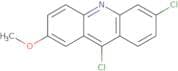
:6,9-Dichlor-2-methoxyacridin
Beschreibung:
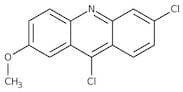
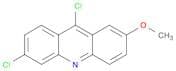
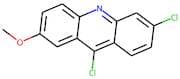
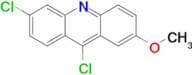
6,9-Dichlor-2-methoxyacridin ist eine organische Verbindung, die zur Familie der Acridine gehört und durch ihre fusionierte Dreiringstruktur gekennzeichnet ist. Sie weist zwei Chloratome an den Positionen 6 und 9 sowie eine Methoxygruppe an der Position 2 auf, was zu ihrer chemischen Reaktivität und potenziellen biologischen Aktivität beiträgt. Diese Verbindung ist typischerweise ein Feststoff bei Raumtemperatur und kann je nach Reinheit und Form eine Vielzahl von Farben aufweisen. Sie ist bekannt für ihre Anwendungen in verschiedenen Bereichen, einschließlich der medizinischen Chemie und der Farbstoffproduktion, aufgrund ihrer fluoreszierenden Eigenschaften. Die Anwesenheit von Chloratomen erhöht ihre Lipophilie, was potenziell ihre Wechselwirkung mit biologischen Membranen beeinflussen kann. Darüber hinaus kann die Methoxygruppe ihre Löslichkeit und Reaktivität beeinflussen. Sicherheitsüberlegungen sind wichtig, wenn man mit dieser Verbindung umgeht, da sie Gesundheitsrisiken, einschließlich potenzieller Karzinogenität, darstellen kann. Angemessene Laborprotokolle sollten befolgt werden, um die Exposition zu minimieren. Insgesamt ist 6,9-Dichlor-2-methoxyacridin eine Verbindung von Interesse sowohl in der Forschung als auch in industriellen Anwendungen.
Formel:C14H9Cl2NO
InChl:InChI=1S/C14H9Cl2NO/c1-18-9-3-5-12-11(7-9)14(16)10-4-2-8(15)6-13(10)17-12/h2-7H,1H3
InChI Key:InChIKey=RYRNQWYNHLLOGX-UHFFFAOYSA-N
SMILES:ClC=1C2=C(N=C3C1C=CC(Cl)=C3)C=CC(OC)=C2
Synonyme:- 2-Methoxy-6,9-dichloroacridine
- 3,9-Dichloro-7-methoxyacridine
- Acridine, 6,9-dichloro-2-methoxy-
- Halocrin
- Halocrine
- NSC 2095
- NSC 2951
- 6,9-Dichloro-2-methoxyacridine
Sortieren nach
Reinheit (%)
0
100
|
0
|
50
|
90
|
95
|
100
5 Produkte.
6,9-Dichloro-2-methoxyacridine, 98%
CAS:6,9-Dichloro-2-methoxyacridine is used to prepare 6-chloro-2-methoxy-acridin-9-ylamine by reacting with phenol and ammonium carbonate. It is used in the preparation of 9-amino-6-chloro-2-methoxyacridine, N'-(6-Chloro-2-methoxy-acridin-9-yl)-heptylamine and N,N'-bis-(6-chloro-2-methoxy-acridin-9-yl)-
Formel:C14H9Cl2NOReinheit:98%Farbe und Form:Yellow to yellow-green, PowderMolekulargewicht:278.136,9-Dichloro-2-methoxyacridine
CAS:Formel:C14H9Cl2NOReinheit:98%Farbe und Form:SolidMolekulargewicht:278.13346,9-Dichloro-2-methoxyacridine
CAS:6,9-Dichloro-2-methoxyacridineReinheit:98%Farbe und Form:Yellow PowderMolekulargewicht:278.13g/mol6,9-Dichloro-2-methoxyacridine
CAS:Reinheit:97.0%Farbe und Form:Solid, No data available.Molekulargewicht:278.13000488281256,9-Dichloro-2-methoxyacridine
CAS:6,9-Dichloro-2-methoxyacridine (DCA) is a fluorescent probe that can be used to measure the cytosolic Ca2+ concentration in mammalian cells. DCA binds to chloride ions and emits a fluorescence signal proportional to the cytosolic Ca2+ concentration. The binding constants for DCA and chloride are low, which makes this probe an ideal candidate for measuring cytosolic Ca2+. DCA has been shown to inhibit cancer cell growth by decreasing mitochondrial membrane potential. This effect may be caused by the inhibition of mitochondrial ATP production or the disruption of ion transport across the mitochondrial membrane.Formel:C14H9Cl2NOReinheit:Min. 95%Farbe und Form:Slightly Yellow PowderMolekulargewicht:278.13 g/mol