CAS 86-48-6
:1-Hydroxy-2-naphthoesäure
Beschreibung:
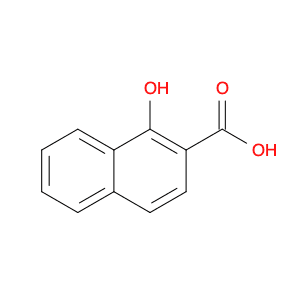
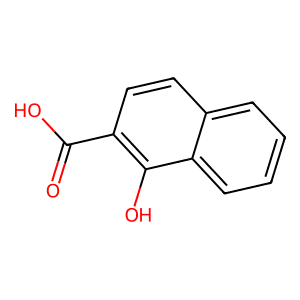
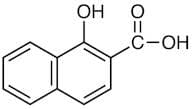
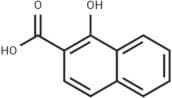
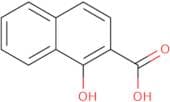
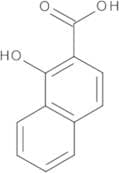
1-Hydroxy-2-naphthoesäure, mit der CAS-Nummer 86-48-6, ist eine organische Verbindung, die zur Klasse der Naftoic-Säuren gehört. Sie weist ein Naftalen-Ringsystem auf, das mit einer Hydroxylgruppe und einer Carbonsäuregruppe substituiert ist, was zu ihren sauren Eigenschaften beiträgt. Diese Verbindung ist typischerweise ein weißer bis hellgelber kristalliner Feststoff, der in Wasser schwer löslich, aber in organischen Lösungsmitteln wie Ethanol und Ether besser löslich ist. Ihre molekulare Struktur ermöglicht es ihr, an verschiedenen chemischen Reaktionen teilzunehmen, einschließlich Esterifizierung und Acylierung. 1-Hydroxy-2-naphthoesäure wird häufig als Reagenz in der organischen Synthese verwendet und kann als Zwischenprodukt in der Herstellung von Farbstoffen und Arzneimitteln dienen. Darüber hinaus zeigt sie Eigenschaften, die sie in der analytischen Chemie nützlich machen, insbesondere bei der Bestimmung bestimmter Metallionen. Ihre Fähigkeit, Komplexe mit Metallen zu bilden, ist auch von Interesse in verschiedenen Anwendungen, einschließlich Katalyse und Materialwissenschaft.
Formel:C11H8O3
InChl:InChI=1S/C11H8O3/c12-10-8-4-2-1-3-7(8)5-6-9(10)11(13)14/h1-6,12H,(H,13,14)
InChI Key:InChIKey=SJJCQDRGABAVBB-UHFFFAOYSA-N
SMILES:OC=1C2=C(C=CC1C(O)=O)C=CC=C2
Synonyme:- 1-Hydroxy 2-naphthalic acid
- 1-Hydroxy-2-naphthalenecarboxylic acid
- 1-Hydroxynaphthalene-2-Carboxylate
- 1-Hydroxynaphthalene-2-Carboxylic Acid
- 1-Naphthol-2-carboxylic acid
- 2-Carboxy-1-naphthol
- 2-Naphthalenecarboxylic acid, 1-hydroxy-
- 2-Naphthoic acid, 1-hydroxy-
- H 0279
- N-{[5-(dimethylamino)naphthalen-1-yl]sulfonyl}-L-alpha-glutamyl-N-{(3S)-1-chloro-6-[(diaminomethylidene)amino]-2-oxohexan-3-yl}glycinamide
- NSC 3717
- Xinafoic acid
- α-Hydroxy-β-naphthoic acid
- Weitere Synonyme anzeigen
Sortieren nach
Reinheit (%)
0
100
|
0
|
50
|
90
|
95
|
100
12 Produkte.
1-Hydroxy-2-naphthoic Acid (1-Hydroxy-naphthalene-2-carboxylic acid)
CAS:Carboxylic acids with phenol function but without other oxygen function, their anhydrides, halides, peroxides etc, nesoiFormel:C11H8O3Farbe und Form:Off-White SolidMolekulargewicht:188.18 g/mol1-hydroxy-2-naphthoic acid
CAS:Formel:C11H8O3Reinheit:98%Farbe und Form:SolidMolekulargewicht:188.17941-Hydroxy-2-naphthoic acid
CAS:1-Hydroxy-2-naphthoic acidFormel:C11H8O3Reinheit:98%Farbe und Form: faint beige powderMolekulargewicht:188.18g/mol1-Hydroxy-2-naphthoic Acid
CAS:Formel:C11H8O3Reinheit:>98.0%(T)(HPLC)Farbe und Form:White to Light yellow to Light orange powder to crystalMolekulargewicht:188.181-Hydroxy-2-naphthoic acid
CAS:1-Hydroxy-2-naphthoic acid (ALPHA-HYDROXYNAPHTHOIC ACID) is a Metabolite from phenanthrene degradation.Formel:C11H8O3Reinheit:99.85%Farbe und Form:White PowderMolekulargewicht:188.181-Hydroxy-2-naphthoic acid
CAS:1-Hydroxy-2-naphthoic acid is a chemical compound that belongs to the group of carboxylic acids. It is used in the treatment of malonic acidemia and as a reagent for the structural analysis of organic compounds. 1-Hydroxy-2-naphthoic acid has been shown to react with protonated malonic acid in a synchronous fluorescence experiment. The reaction mechanism involves an intramolecular hydrogen transfer from the carboxylate group to the naphthalene ring, leading to formation of a methyl ethyl cation. This cation can then either react with another malonic acid molecule or be deprotonated by water, depending on pH and concentration. 1-Hydroxy-2-naphthoic acid has also shown photochemical properties and can be used for wastewater treatment due to its ability to degrade organic pollutants such as phenols and amines.Formel:C11H8O3Reinheit:Min. 98 Area-%Farbe und Form:PowderMolekulargewicht:188.18 g/mol1-Hydroxy-2-naphthoic acid
CAS:Formel:C11H8O3Reinheit:95%Farbe und Form:Solid, Very pale yellow to pale reddish yellow powderMolekulargewicht:188.1821-Hydroxy-2-naphthoic Acid
CAS:Kontrolliertes ProduktApplications Metabolite from phenanthrene degradation.
References Pinyakong, O. et al.: FEMS Microbiol. Lett. 191, 115 (2000)Formel:C11H8O3Farbe und Form:NeatMolekulargewicht:188.18