CAS 86-95-3
:2,4-Dihydroxychinolin
Beschreibung:
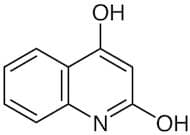
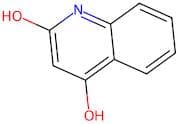
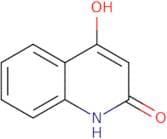
2,4-Dihydroxychinolin, mit der CAS-Nummer 86-95-3, ist eine organische Verbindung, die zur Klasse der Chinoline gehört, die bicyclische aromatische Verbindungen sind. Diese Substanz weist zwei Hydroxylgruppen (-OH) auf, die an den Positionen 2 und 4 des Chinolinerings lokalisiert sind, was zu ihrer chemischen Reaktivität und potenziellen Anwendungen beiträgt. Sie ist typischerweise ein Feststoff bei Raumtemperatur und bekannt für ihre blassgelbe bis bräunliche Farbe. Das Vorhandensein von Hydroxylgruppen erhöht ihre Löslichkeit in polaren Lösungsmitteln und kann ihre biologische Aktivität beeinflussen, was sie in verschiedenen Bereichen, einschließlich der medizinischen Chemie und der Materialwissenschaft, von Interesse macht. 2,4-Dihydroxychinolin kann an verschiedenen chemischen Reaktionen teilnehmen, wie Oxidation und Komplexierung, und kann antioxidative Eigenschaften aufweisen. Ihre Derivate werden auf potenzielle therapeutische Anwendungen, einschließlich antimikrobieller und krebsbekämpfender Aktivitäten, untersucht. Sicherheitsdaten sollten für den Umgang konsultiert werden, wie bei jeder chemischen Substanz, um sicherzustellen, dass die richtigen Vorsichtsmaßnahmen getroffen werden.
Formel:C9H7NO2
InChl:InChI=1S/C9H7NO2/c11-8-5-9(12)10-7-4-2-1-3-6(7)8/h1-5H,(H2,10,11,12)
InChI Key:InChIKey=HDHQZCHIXUUSMK-UHFFFAOYSA-N
SMILES:OC=1C=2C(NC(=O)C1)=CC=CC2
Synonyme:- 2(1H)-Quinolinone,4-hydroxy
- 2,4-Dihydroxy quinoline
- 2,4-Dihydroxyquinoline
- 2,4-Dihydroxyquinolone
- 4-Hydroxy-1,2-dihydro-2-quinolinone
- 4-Hydroxy-1H-quinolin-2-one
- 4-Hydroxy-2(1H)-Quinolinone
- 4-Hydroxy-2(1H)-Quinolone
- 4-Hydroxy-2-quinolinone
- 4-Hydroxy-2-quinolone
- 4-Hydroxycarbostyril
- 4-Hydroxyquinolin-2(1H)-One
- 4-Hydroxyquinoline-2(1H)-one
- Carbostyril, 4-hydroxy-
- Dihydroxyquinoline
- NSC 12465
- NSC 13962
- Quinoline-2,4-diol
- Weitere Synonyme anzeigen
Sortieren nach
Reinheit (%)
0
100
|
0
|
50
|
90
|
95
|
100
6 Produkte.
2,4-Dihydroxyquinoline
CAS:Formel:C9H7NO2Reinheit:>97.0%(GC)(T)Farbe und Form:White to Yellow to Orange powder to crystalMolekulargewicht:161.162,4-Dihydroxyquinoline, 97%
CAS:This Thermo Scientific Chemicals brand product was originally part of the Alfa Aesar product portfolio. Some documentation and label information may refer to the legacy brand. The original Alfa Aesar product / item code or SKU reference has not changed as a part of the brand transition to Thermo SciFormel:C9H7NO2Reinheit:97%Farbe und Form:Pale brown, PowderMolekulargewicht:161.164-hydroxy-1,2-dihydroquinolin-2-one
CAS:Formel:C9H7NO2Reinheit:95%Farbe und Form:SolidMolekulargewicht:161.15742,4-Dihydroxyquinoline
CAS:Formel:C9H7NO2Reinheit:95%Farbe und Form:Solid, Crystalline Powder or PowderMolekulargewicht:161.16Quinoline-2,4-diol
CAS:Quinoline-2,4-diolFormel:C9H7NO2Reinheit:98%Farbe und Form: off white solidMolekulargewicht:161.16g/mol2,4-Dihydroxyquinoline
CAS:2,4-Dihydroxyquinoline is a malonic acid derivative that is used as an antimicrobial agent. It is a diazonium salt that can be synthesized from 2-chloro-4-nitrobenzene and malonic acid. The reaction mechanism for this compound involves the formation of a diazo intermediate, which reacts with the amine to form a quinoline. This compound has been shown to have antibiotic properties and is able to inhibit the growth of bacteria such as Salmonella typhi, Mycobacterium tuberculosis, Escherichia coli, and Staphylococcus aureus. 2,4-Dihydroxyquinoline has also been shown to have anticancer activity in vitro on human liver cells (HepG2) and human hepg2 cells.Formel:C9H7NO2Reinheit:Min. 95%Farbe und Form:White PowderMolekulargewicht:161.16 g/mol