CAS 86408-36-8
:Polymyxin B Nonapeptid Hydrochlorid
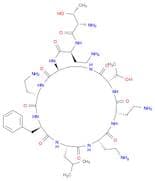
- Polymyxin B nonapeptide
- Pmbn
- Polymyxin B cyclononapeptide
- Polymyxin B1, 1-de(N2-(6-methyl-1-oxooctyl)-L-2,4-diaminobutanoic acid)-
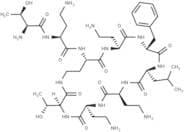
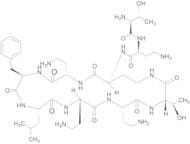
- N-[(2S)-4-amino-1-oxo-1-{[(3S,6S,9S,12S,15R,18S,21S)-6,9,18-tris(2-aminoethyl)-15-benzyl-3-[(1R)-1-hydroxyethyl]-12-(2-methylpropyl)-2,5,8,11,14,17,20-heptaoxo-1,4,7,10,13,16,19-heptaazacyclotricosan-21-yl]amino}butan-2-yl]-L-threoninamide
(2S,3R)-2-amino-N-[(1S)-3-amino-1-[[(3S,6S,9S,12S,15R,18S,21S)-6,9,18-tris(2-aminoethyl)-15-benzyl-3-(1-hydroxyethyl)-12-(2-methylpropyl)-2,5,8,11,14,17,20-heptaoxo-1,4,7,10,13,16,19-heptazacyclotricos-21-yl]carbamoyl]propyl]-3-hydroxy-butanamide
CAS:Formel:C43H74N14O11Reinheit:98%Molekulargewicht:963.1349Polymyxin B nonapeptide
CAS:Polymyxin B nonapeptide boosts hydrophobic antibiotic uptake in Gram-negative bacteria by enhancing membrane permeability.Formel:C43H74N14O11Reinheit:98%Farbe und Form:SolidMolekulargewicht:963.13Polymyxin B nonapeptide hydrochloride
CAS:Polymyxin B nonapeptide hydrochloride is a potent antibiotic compound derived from the bacterium *Bacillus polymyxa*. As a cationic polypeptide, it exhibits its antibacterial activity by interacting with the lipopolysaccharides and phospholipids in the bacterial cell membrane, leading to increased permeability and ultimately causing cell lysis. The compound is specifically effective against a broad range of Gram-negative bacteria, making it crucial in studying antibiotic resistance mechanisms.
Formel:C43H74N14O11•(HCl)xReinheit:Min. 95%Molekulargewicht:963.14 g/molPolymyxin B Nonapeptide
CAS:Kontrolliertes ProduktFormel:C43H74N14O11Farbe und Form:NeatMolekulargewicht:963.135Polymyxin B nonapeptide
CAS:Polymyxin B nonapeptide is a polymyxin antibiotic that is effective against Gram-negative bacteria. It has been shown to inhibit the growth of wild-type strains of Escherichia coli and Salmonella enterica in laboratory tests, as well as cancer tissues. Polymyxin B nonapeptide binds to the il-2 receptor on human cells and inhibits the activation of interleukin 2, which is an important immune response regulator. The drug also has biocompatible properties and does not cause any significant physiological effects or alterations in redox potentials when injected into humans. This antibiotic has a phase transition temperature of 56°C and can be used for treating tissue infections caused by bacteria with a high resistance to antibiotics.
Formel:C43H74N14O11Reinheit:Min. 95%Molekulargewicht:963.1 g/mol