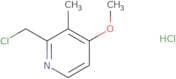
CAS 86604-74-2
:Pyridin, 2-(chloromethyl)-4-methoxy-3-methyl-, Hydrochlorid (1:1)
Beschreibung:
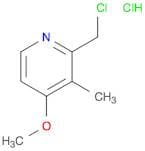
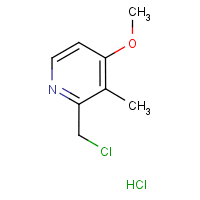
Pyridin, 2-(chloromethyl)-4-methoxy-3-methyl-, Hydrochlorid (1:1), mit der CAS-Nummer 86604-74-2, ist eine chemische Verbindung, die zur Klasse der substituierten Pyridine gehört. Sie weist einen Pyridinring auf, der mit einer Chloromethylgruppe, einer Methoxygruppe und einer Methylgruppe substituiert ist, was zu ihrer einzigartigen Reaktivität und ihren Eigenschaften beiträgt. Als Hydrochloridsalz wird sie typischerweise in fester Form angetroffen, was ihre Stabilität und Löslichkeit in polaren Lösungsmitteln, insbesondere Wasser, erhöht. Diese Verbindung kann biologische Aktivität zeigen, was sie in der medizinischen Chemie und der pharmazeutischen Forschung von Interesse macht. Ihre Struktur deutet auf potenzielle Anwendungen in der organischen Synthese und als Zwischenprodukt in der Herstellung verschiedener chemischer Entitäten hin. Die Anwesenheit der Chloromethylgruppe kann nucleophile Substitutionsreaktionen erleichtern, während die Methoxy- und Methylgruppen die elektronischen Eigenschaften und die sterische Hinderung der Verbindung beeinflussen können. Sicherheitsdaten sollten für den Umgang und die Verwendung konsultiert werden, wie bei allen chemischen Substanzen, um sicherzustellen, dass angemessene Vorsichtsmaßnahmen aufgrund möglicher Toxizität oder Reaktivität getroffen werden.
Formel:C8H10ClNO·ClH
InChl:InChI=1S/C8H10ClNO.ClH/c1-6-7(5-9)10-4-3-8(6)11-2;/h3-4H,5H2,1-2H3;1H
InChI Key:InChIKey=WHAGSNVVBXOIGQ-UHFFFAOYSA-N
SMILES:O(C)C=1C(C)=C(CCl)N=CC1.Cl
Synonyme:- 2-(Chloromethyl)-4-Methoxy-3-Methylpyridine
- 2-(Chloromethyl)-4-methoxy-3-methylpyridinehydrochloride
- 2-Chloromethyl-4-Methoxy-3-Methylpyridine Hydrochloride
- Pyridine, 2-(chloromethyl)-4-methoxy-3-methyl-, hydrochloride
- Pyridine, 2-(chloromethyl)-4-methoxy-3-methyl-, hydrochloride (1:1)
Sortieren nach
Reinheit (%)
0
100
|
0
|
50
|
90
|
95
|
100
9 Produkte.
2-(Chloromethyl)-4-methoxy-3-methylpyridine hydrochloride
CAS:Formel:C8H11Cl2NOReinheit:95%Farbe und Form:SolidMolekulargewicht:208.0850Ilaprazole Impurity 32 HCl
CAS:Formel:C8H10ClNO·HClFarbe und Form:White To Off-White SolidMolekulargewicht:171.63 36.462-(Chloromethyl)-4-methoxy-3-methylpyridine hydrochloride
CAS:2-(Chloromethyl)-4-methoxy-3-methylpyridine hydrochlorideReinheit:99%Molekulargewicht:208.08504g/mol2-(Chloromethyl)-4-methoxy-3-methylpyridine hydrochloride
CAS:Formel:C8H11Cl2NOReinheit:98%Molekulargewicht:208.082-Chloromethyl-4-methoxy-3-methylpyridine Hydrochloride
CAS:Kontrolliertes ProduktApplications A pyridine derivative used in the preparation of anti-ulcerative agents and other pharmaceutical compounds.
References Kuehler, T.C. et al.: J. Med. Chem., 38, 4906 (1995);Formel:C8H10ClNO·ClHFarbe und Form:NeatMolekulargewicht:208.082-(Chloromethyl)-4-methoxy-3-methylpyridine hydrochloride
CAS:2-(Chloromethyl)-4-methoxy-3-methylpyridine hydrochloride is a lead compound that belongs to the family of pyridine derivatives. It has been shown to be a potent inhibitor of bacterial RNA synthesis, with an IC50 value of 1.2 μM for Escherichia coli and 8 μM for Bacillus subtilis. 2-(Chloromethyl)-4-methoxy-3-methylpyridine hydrochloride also inhibits the growth of Gram negative bacteria such as Pseudomonas aeruginosa and Enterobacter cloacae. The compound binds to the nucleophilic site on ribosomes, which prevents the formation of peptide bonds between amino acids in protein synthesis. This leads to cell death by inhibiting protein synthesis, leading to cell division.Formel:C8H11Cl2NOReinheit:Min. 95%Molekulargewicht:208.08 g/mol