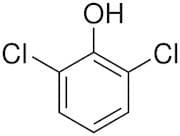
CAS 87-65-0
:2,6-Dichlorphenol
Beschreibung:
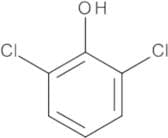
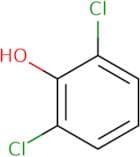
2,6-Dichlorphenol ist eine organische Verbindung, die durch ihre chlorierte phenolische Struktur gekennzeichnet ist, mit zwei Chloratomen, die an den Kohlenstoffen 2 und 6 des Benzolrings positioniert sind. Sie erscheint als kristalliner Feststoff von weiß bis blassgelb mit einem charakteristischen Geruch. Diese Verbindung ist in organischen Lösungsmitteln wie Ethanol und Ether löslich, hat jedoch eine begrenzte Löslichkeit in Wasser. 2,6-Dichlorphenol wird hauptsächlich in der Synthese verschiedener chemischer Zwischenprodukte, einschließlich Pestiziden und Arzneimitteln, verwendet. Sie zeigt antimikrobielle Eigenschaften, was sie in einigen Desinfektionsmitteln und Konservierungsmitteln nützlich macht. Es ist jedoch wichtig, diese Substanz mit Vorsicht zu behandeln, da sie giftig und reizend für Haut, Augen und Atemwege sein kann. Umweltbedenken ergeben sich aus ihrer potenziellen Persistenz und Bioakkumulation in aquatischen Systemen, was angemessene Entsorgungs- und Managementpraktiken erforderlich macht. Insgesamt ist 2,6-Dichlorphenol eine bedeutende Verbindung in industriellen Anwendungen, aber ihre Sicherheit und Umweltverträglichkeit müssen sorgfältig berücksichtigt werden.
Formel:C6H4Cl2O
InChl:InChI=1S/C6H4Cl2O/c7-4-2-1-3-5(8)6(4)9/h1-3,9H
InChI Key:InChIKey=HOLHYSJJBXSLMV-UHFFFAOYSA-N
SMILES:OC1=C(Cl)C=CC=C1Cl
Synonyme:- 2,6-Dcp
- 2,6-Dichlorfenol
- 2,6-Dichlorfenol(Czech)
- 2,6-Dichloro Phenol
- 2,6-Dichloro-Pheno
- 2,6-Dichlorphenol
- 2,6-Diclorofenol
- 2.6-Dichlorohydroxybenzene
- Dichloro-2,6phenol
- Dichlorophenol
- Nsc 60647
- Phenol,2,6-Dichloro-
- Rcra Waste Number U082
- Rcrawastenumberu082
- Weitere Synonyme anzeigen
Sortieren nach
Reinheit (%)
0
100
|
0
|
50
|
90
|
95
|
100
SVOC Mixture 231 100 µg/mL in Methanol
CAS:Kontrolliertes Produkt- 105-67-9
- 106-44-5
- 106-48-9
- 108-39-4
- 108-43-0
- 108-68-9
- 108-95-2
- 120-83-2
- 123-07-9
- 1570-64-5
- 15950-66-0
- 2416-94-6
- 4901-51-3
- 496-78-6
- 526-75-0
- 527-54-8
- 527-60-6
- 576-24-9
- 576-26-1
- 58-90-2
- 583-78-8
- 59-50-7
- 591-35-5
- 609-19-8
- 620-17-7
- 697-82-5
- 87-65-0
- 87-86-5
- 88-06-2
- 90-00-6
- 933-75-5
- 933-78-8
- 935-95-5
- 95-48-7
- 95-57-8
- 95-65-8
- 95-77-2
- 95-87-4
- 95-95-4
Farbe und Form:Mixture2,6-Dichlorophenol
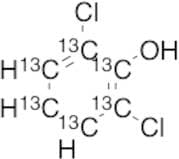
CAS:Kontrolliertes Produkt<p>Applications 2,6-Dichlorophenol is a reagent used in the synthesis of α-chloroesters and chlorophenols as well as chlorinated pharmaceutical compounds such as the anti-HIV agent chloropeptin I.<br> Not a dangerous good if item is equal to or less than 1g/ml and there is less than 100g/ml in the package<br>References Deng, H. et al.: J. Am. Chem. Soc., 125, 9032 (2003); Hoke, J. et al.: App. Cat. B. Env., 1, 285 (1992); Reynolds, N. et al.: J. Am. Chem. Soc., 127, 16406 (2005);<br></p>Formel:C6H4Cl2OFarbe und Form:ColourlessMolekulargewicht:163.002,6-Dichlorophenol-13C6
CAS:Kontrolliertes ProduktFormel:C6H4Cl2OFarbe und Form:NeatMolekulargewicht:168.9572,6-Dichlorophenol
CAS:<p>2,6-Dichlorophenol is a hydrogen-bond inhibitor that inhibits the reaction of receptors with their specific treatment. It has been shown to have an inhibitory effect on the light-induced activation of receptor cells and to inhibit the reaction mechanism of analytical methods. 2,6-Dichlorophenol has also been shown to be effective in synchronous fluorescence spectroscopy as a probe for detecting hydrogen bonds in biological samples. The chemical structure of 2,6-dichlorophenol is C6H4Cl2O. It is soluble in water and reacts with acids to form hydrogen chloride gas and 2,6-dichlorophenol hydrochloride (C6H3Cl2O).</p>Formel:C6H4Cl2OReinheit:Min. 95%Farbe und Form:White PowderMolekulargewicht:163 g/mol2,6-Dichlorophenol extrapure, 99%
CAS:Formel:C6H4Cl2OReinheit:min. 99%Farbe und Form:White to off-white, Crystal / Crystalline Powder / Crystalline solid, ClearMolekulargewicht:163.00