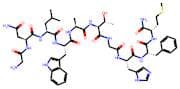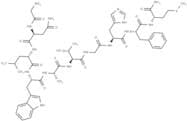
CAS 87096-84-2
:Neuromedin B
Beschreibung:
Neuromedin B ist ein Neuropeptid, das eine bedeutende Rolle in verschiedenen physiologischen Prozessen spielt, einschließlich der Regulierung der Kontraktion der glatten Muskulatur und der Modulation neuroendokriner Funktionen. Es besteht aus einer Aminosäuresequenz und wird als Mitglied der Neuromedin-Familie klassifiziert, die an der Neurotransmission und Signalübertragung im zentralen Nervensystem beteiligt ist. Neuromedin B wirkt hauptsächlich über spezifische Rezeptoren und beeinflusst Prozesse wie die Regulierung des Appetits, die Stressreaktion und die Fortpflanzungsfunktionen. Das Peptid ist bekannt dafür, an der Physiopathologie bestimmter Erkrankungen, einschließlich Fettleibigkeit und Angststörungen, beteiligt zu sein. Seine Struktur umfasst typischerweise eine C-terminale Amidierung, die für seine biologische Aktivität entscheidend ist. Neuromedin B wird in verschiedenen Geweben, einschließlich des Gehirns und des Magen-Darm-Trakts, synthetisiert, und seine Wirkungen werden durch Wechselwirkungen mit G-Protein-gekoppelten Rezeptoren vermittelt. Die Forschung untersucht weiterhin seine potenziellen therapeutischen Anwendungen, insbesondere im Kontext von Stoffwechsel- und neuropsychiatrischen Störungen.
Formel:C52H73N15O12S
InChl:InChI=1/C52H73N15O12S/c1-27(2)17-36(64-51(78)40(21-41(54)69)61-42(70)22-53)48(75)66-38(19-31-23-57-34-14-10-9-13-33(31)34)47(74)60-28(3)46(73)67-44(29(4)68)52(79)58-25-43(71)62-39(20-32-24-56-26-59-32)50(77)65-37(18-30-11-7-6-8-12-30)49(76)63-35(45(55)72)15-16-80-5/h6-14,23-24,26-29,35-40,44,57,68H,15-22,25,53H2,1-5H3,(H2,54,69)(H2,55,72)(H,56,59)(H,58,79)(H,60,74)(H,61,70)(H,62,71)(H,63,76)(H,64,78)(H,65,77)(H,66,75)(H,67,73)/t28-,29+,35-,36-,37?,38-,39-,40-,44-/m0/s1
Synonyme:- H-Gly-Asn-Leu-Trp-Ala-Thr-Gly-His-Phe-Met-NH2
- (2S)-2-[(2-aminoacetyl)amino]-N-[(1S)-1-[[(1S)-2-[[(1S)-2-[[(1S,2R)-1-[[2-[[(1S)-2-[[1-benzyl-2-[[(1S)-1-carbamoyl-3-methylsulfanyl-propyl]amino]-2-oxo-ethyl]amino]-1-(3H-imidazol-4-ylmethyl)-2-oxo-ethyl]amino]-2-oxo-ethyl]carbamoyl]-2-hydroxy-propyl]amino]-1-methyl-2-oxo-ethyl]amino]-1-(1H-indol-3-ylmethyl)-2-oxo-ethyl]carbamoyl]-3-methyl-butyl]butanediamide
Sortieren nach
Reinheit (%)
0
100
|
0
|
50
|
90
|
95
|
100
8 Produkte.
Neuromedin B
CAS:For cellular and molecular biology applications
Formel:C52H73N15O12SFarbe und Form:Lyophilized powderMolekulargewicht:1132.3Neuromedin B
CAS:NMB, a bombesin-linke peptide, binds to the bombesin receptors BRS1-4. NMB is expressed in the pituitary, brain, pancreas, adrenal and gastrointestinal tract. Its expression in adipose tissue appears to be regulated by changes in energy balance. NMB could inhibit food intake and modulates stress-related behavior.Formel:C52H73N15O12SReinheit:97.4%Farbe und Form:White PowderMolekulargewicht:1132.31Neuromedin B
CAS:Neuromedin B, a mammalian peptide related to bombesin, is found in the CNS and GI tract, originally purified from pig spinal cords.Formel:C52H73N15O12SReinheit:99.39%Farbe und Form:SolidMolekulargewicht:1132.29Neuromedin C (Human, Porcine, Canine)
CAS:Neuromedin C (NMC) is a peptide that belongs to the family of neuromedin and is a potent activator of ion channels. It has been shown to be a ligand for opioid receptors, which may be due to its ability to inhibit the release of neurotransmitters such as acetylcholine and noradrenaline. Neuromedin C has also been shown to inhibit the binding of morphine-6 beta-glucuronide in rat brain synaptosomes. In addition, NMC has been reported as an inhibitor of cell proliferation and induce apoptosis in various cancer cells including colon and prostate cancers.
Formel:C50H73N17O11SReinheit:Min. 95%Molekulargewicht:1,120.3 g/molNeuromedin B (Human, Porcine, Rat)
CAS:Neuromedin B is a neuropeptide that has been shown to activate the TRPC ion channels in mammalian cells. It also has been shown to bind to receptors and have a potent effect on cell biology, as well as being used as a research tool for studying protein interactions. Neuromedin B is found in humans, pigs, and rats, where it is expressed primarily in the brain and gastrointestinal tract. This peptide has been shown to be an inhibitor of some types of ion channels.Formel:C52H73N15O12SReinheit:Min. 95%Molekulargewicht:1,132.3 g/molNeuromedin B trifluoroacetate salt
CAS:Neuromedin B is a peptide hormone that is produced by the hypothalamus and regulates many physiological processes such as energy metabolism, appetite, and sleep. Neuromedin B is a member of the family of guanine nucleotide-binding proteins (G proteins) that bind to G protein-coupled receptors on the surface of cells. It has been shown to stimulate calcium release from intracellular stores in response to an increase in cytosolic Ca2+. Neuromedin B has been shown to have anti-inflammatory effects on infectious diseases such as meningitis, sepsis, and tuberculosis, which may be due to its ability to inhibit neutrophil migration. Neuromedin B also stimulates hippocampal formation activity in rats during the rotarod test, which may be due to its effects on dopamine release.Formel:C52H73N15O12SReinheit:Min. 95%Molekulargewicht:1,132.3 g/molNeuromedin B (porcine)
CAS:Custom research peptide; min purity 95%. For different specs please use the Peptide Quote Tool
Formel:C52H73N15O12SMolekulargewicht:1,132.3 g/mol