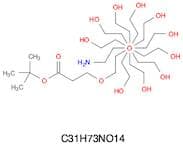
![Poly(oxy-1,2-ethanediyl), α-(2-aminoethyl)-ω-[3-(1,1-dimethylethoxy)-3-oxopropoxy]-](/_next/image/?url=https%3A%2Fstatic.cymitquimica.com%2Fcas-image%2Fthumb-webp%2F301937-poly-oxy-12-ethanediyl-a-2-aminoethyl-o-3-11-dimethylethoxy-3-oxopropoxy.webp&w=3840&q=75)
CAS 872340-65-3
:Poly(oxy-1,2-ethandiyl), α-(2-aminoethyl)-ω-[3-(1,1-dimethylethoxy)-3-oxopropoxy]-
Beschreibung:
Poly(oxy-1,2-ethandiyl), α-(2-aminoethyl)-ω-[3-(1,1-dimethylethoxy)-3-oxopropoxy]- ist ein synthetisches Polymer, das durch sein Polyether-Rückgrat gekennzeichnet ist, das aus Ethylenoxid abgeleitet ist. Diese Verbindung weist eine Aminoethylgruppe auf, die Potenzial für Reaktivität und Interaktion mit biologischen Systemen verleiht, was sie für verschiedene Anwendungen, einschließlich der Arzneimittelabgabe und biokompatibler Materialien, von Interesse macht. Das Vorhandensein der Gruppen 1,1-Dimethylethoxy und Oxopropoxy deutet darauf hin, dass das Polymer hydrophobe Eigenschaften aufweisen kann, die seine Löslichkeit in organischen Lösungsmitteln erhöhen, während es aufgrund der Polyethersegmente eine gewisse Hydrophilie beibehält. Dieses Gleichgewicht der Eigenschaften kann die Verwendung in Formulierungen erleichtern, die eine kontrollierte Freisetzung oder spezifische Interaktionen mit biologischen Zielen erfordern. Darüber hinaus deutet die Struktur auf ein Modifikationspotenzial hin, das es ermöglicht, seine Eigenschaften für spezifische Anwendungen in Bereichen wie Pharmazie, Kosmetik und Materialwissenschaften anzupassen. Insgesamt veranschaulicht diese Verbindung die Vielseitigkeit von polyetherbasierten Materialien in fortschrittlichen Anwendungen.
Formel:(C2H4O)nC9H19NO3
InChl:InChI=1S/C11H23NO4/c1-11(2,3)16-10(13)4-6-14-8-9-15-7-5-12/h4-9,12H2,1-3H3
InChI Key:InChIKey=XIVHGTLMLORWEP-UHFFFAOYSA-N
SMILES:C(C(OC(C)(C)C)=O)COCCOCCN
Synonyme:- Poly(oxy-1,2-ethanediyl), α-(2-aminoethyl)-ω-[3-(1,1-dimethylethoxy)-3-oxopropoxy]-
Sortieren nach
Reinheit (%)
0
100
|
0
|
50
|
90
|
95
|
100
8 Produkte.
Amino-PEG12-t-butyl ester
CAS:Formel:C11H23N2O4Reinheit:98%Farbe und Form:LiquidMolekulargewicht:247.3113Amino-PEG24-t-butyl ester
CAS:Amino-PEG24-t-butyl esterReinheit:95%Farbe und Form:SolidMolekulargewicht:1,202.46g/molAmino-dPEG®36-t-Butyl Ester
CAS:Amino-dPEG®36-t-Butyl Ester is a PEG compound with two different functional groups (also known as heterobifunctional). Unlike homobifunctional PEG compounds (same functional group on both ends), this type of compounds are more versatile as have two different anchor points. Amino-dPEG®36-t-Butyl Ester is used as a linker and spacer to add a PEG moiety, via pegylation (a bioconjugation technique) to proteins, peptides, oligonucleotides, small molecules and nanoparticles.Formel:C79H159NO38Reinheit:Min. 95%Molekulargewicht:1,731.09 g/molAmino-dPEG®12-t-Butyl Ester
CAS:Amino-dPEG®12-t-Butyl Ester is a PEG compound with two different functional groups (also known as heterobifunctional). Unlike homobifunctional PEG compounds (same functional group on both ends), this type of compounds are more versatile as have two different anchor points. Amino-dPEG®12-t-Butyl Ester is used as a linker and spacer to add a PEG moiety, via pegylation (a bioconjugation technique) to proteins, peptides, oligonucleotides, small molecules and nanoparticles.Formel:C31H63NO14Reinheit:Min. 95%Molekulargewicht:673.83 g/molAmino-dPEG®24-t-Butyl Ester
CAS:Amino-dPEG®24-t-Butyl Ester is a PEG compound with two different functional groups (also known as heterobifunctional). Unlike homobifunctional PEG compounds (same functional group on both ends), this type of compounds are more versatile as have two different anchor points. Amino-dPEG®24-t-Butyl Ester is used as a linker and spacer to add a PEG moiety, via pegylation (a bioconjugation technique) to proteins, peptides, oligonucleotides, small molecules and nanoparticles.
Formel:C55H111NO26Reinheit:Min. 95%Molekulargewicht:1,202.46 g/mol