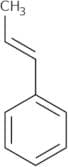
CAS 873-66-5
:trans-β-Methylstyrol
Beschreibung:
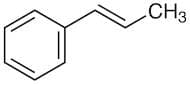
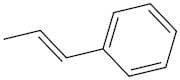
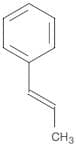
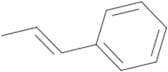
trans-β-Methylstyrol, mit der CAS-Nummer 873-66-5, ist eine organische Verbindung, die durch ihre Struktur gekennzeichnet ist, die ein Styrol-Rückgrat mit einer Methylgruppe in der trans-Konfiguration relativ zur Vinylgruppe aufweist. Diese Verbindung ist eine farblose bis blassgelbe Flüssigkeit, die in Wasser unlöslich, aber in organischen Lösungsmitteln löslich ist. Sie hat einen ausgeprägten aromatischen Geruch und ist bekannt für ihre Reaktivität, insbesondere in Polymerisationsprozessen, wo sie als Monomer zur Herstellung verschiedener Copolymere verwendet werden kann. trans-β-Methylstyrol zeigt Eigenschaften, die typisch für Alkene sind, einschließlich der Fähigkeit, elektrophile Additionsreaktionen zu durchlaufen. Ihr Siedepunkt ist relativ niedrig, was sie flüchtig macht, und sie hat einen moderaten Flammpunkt, was auf Entflammbarkeit hinweist. In Bezug auf die Sicherheit ist es wichtig, diese Verbindung mit Vorsicht zu behandeln, da sie reizend für Haut und Augen sein kann und das Einatmen von Dämpfen vermieden werden sollte. Insgesamt ist trans-β-Methylstyrol in industriellen Anwendungen von Bedeutung, insbesondere in der Herstellung von Kunststoffen und Harzen.
Formel:C9H10
InChl:InChI=1S/C9H10/c1-2-6-9-7-4-3-5-8-9/h2-8H,1H3/b6-2+
InChI Key:InChIKey=QROGIFZRVHSFLM-QHHAFSJGSA-N
SMILES:C(=C/C)\C1=CC=CC=C1
Synonyme:- (1E)-1-Propen-1-ylbenzene
- (1E)-1-Propenylbenzene
- (E)-(1-Propen-1-yl)benzene
- (E)-1-Phenyl-1-propene
- (E)-1-Phenylpropene
- (E)-1-Propenylbenzene
- (E)-Prop-1-en-1ylbenzene
- (E)-Propenylbenzene
- (E)-β-Methylstyrene
- Benzene, (1E)-1-propen-1-yl-
- Benzene, 1-propenyl-, (E)-
- Benzene, propenyl-, (E)-
- Nsc 73958
- Trans-Β-Methyl Styrene
- Trans-Β-Methylstyrene
- Trans-Β-Metilestireno
- trans-1-Methyl-2-phenylethene
- trans-1-Phenyl-1-propene
- trans-1-Phenylpropene
- trans-1-Propenylbenzene
- trans-3-Phenyl-2-propene
- trans-Propenylbenzene
- trans-β-Methylstyrol
- Weitere Synonyme anzeigen
Sortieren nach
Reinheit (%)
0
100
|
0
|
50
|
90
|
95
|
100
7 Produkte gefunden.
trans-β-Methylstyrene (stabilized with TBC)
CAS:Formel:C9H10Reinheit:>97.0%(GC)Farbe und Form:Colorless to Light yellow clear liquidMolekulargewicht:118.18Trans-β-Methylstyrene
CAS:Trans-β-MethylstyreneFormel:C9H10Reinheit:97%,stabilized with 20ppm TBCFarbe und Form:LiquidMolekulargewicht:118.18ASTM Method D7845 Check Standard 0.01-0.05 Wt% in Toluene
CAS:Kontrolliertes Produkt- 100-42-5
- 100-80-1
- 105-67-9
- 108-93-0
- 108-95-2
- 1195-32-0
- 122-99-6
- 123-07-9
- 141-32-2
- 142-96-1
- 19902-08-0
- 2039-89-6
- 2234-20-0
- 25837-05-2
- 4169-04-4
- 5989-27-5
- 60-12-8
- 611-15-4
- 620-17-7
- 622-97-9
- 71-36-3
- 77-73-6
- 770-35-4
- 80-56-8
- 873-66-5
- 90-00-6
- 90-12-0
- 91-20-3
- 91-57-6
- 93-56-1
- 95-13-6
- 98-83-9
- 98-85-1
- 99-89-8
Farbe und Form:Mixturetrans-β-Methylstyrene (Stabilized with 3,5-di-tert-butylcatechol)
CAS:Kontrolliertes ProduktStability Light Sensitive
Applications trans-β-Methylstyrene is an isomer of β-Methylstyrene (M301155), a styrene derivative that is used as a chemical intermediate in the manufacture of plasticizers, resins and polymers. trans-β-Methylstyrene is also produced from the combustion of methamphetamine (M258795).
Not a dangerous good if item is equal to or less than 1g/ml and there is less than 100g/ml in the package
References Lin, H., et al.: Tetrahedron, Asym., 22, 134 (2011); Hirata, T., et al.: Tetrahedron., 54, 15993 (1998);Formel:C9H10Farbe und Form:NeatMolekulargewicht:118.18trans-β-Methylstyrene
CAS:Trans-beta-Methylstyrene is an inorganic acid that has been shown to be carcinogenic to animal tissue. It is a reactive compound that can undergo chemical reactions with other substances, such as hydroxyl groups, and can form adducts by reacting with nucleophilic groups. Trans-beta-Methylstyrene can react with human liver DNA and tumor cells in the presence of enzymes. The reactive properties of this compound have been used for analytical methods such as particle ionization and chemical ionization. Trans-beta-Methylstyrene has also been found to inhibit the activity of certain enzymes, including squamous carcinoma, which may be due to its ability to inhibit the production of prostaglandins from arachidonic acid.Formel:C9H10Reinheit:Min. 95%Molekulargewicht:118.18 g/mol