CAS 873694-46-3
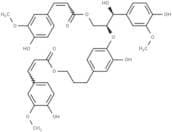
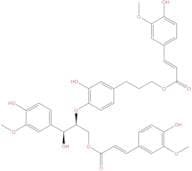
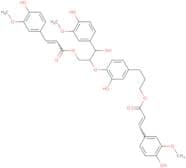
:2-Propenoinsäure, 3-(4-hydroxy-3-methoxyphenyl)-, 3-[3-hydroxy-4-[(1S,2S)-2-hydroxy-2-(4-hydroxy-3-methoxyphenyl)-1-[[[3-(4-hydroxy-3-methoxyphenyl)-1-oxo-2-propenyl]oxy]methyl]ethoxy]phenyl]propylester
Beschreibung:
Die chemische Substanz, die als "2-Propenoinsäure, 3-(4-hydroxy-3-methoxyphenyl)-, 3-[3-hydroxy-4-[(1S,2S)-2-hydroxy-2-(4-hydroxy-3-methoxyphenyl)-1-[[[3-(4-hydroxy-3-methoxyphenyl)-1-oxo-2-propenyl]oxy]methyl]ethoxy]phenyl]propylester" bekannt ist und die CAS-Nummer 873694-46-3 trägt, ist eine komplexe organische Verbindung, die durch ihre multifunktionale Struktur gekennzeichnet ist, die mehrere aromatische Ringe und Hydroxylgruppen umfasst. Diese Verbindung wird wahrscheinlich Eigenschaften aufweisen, die typisch für phenolische Verbindungen sind, wie z.B. antioxidative Aktivität, aufgrund der Anwesenheit von Hydroxylgruppen an den aromatischen Ringen. Die Anwesenheit der propenoischen Säuregruppe deutet auf eine potenzielle Reaktivität in Polymerisationsprozessen hin, was sie in verschiedenen Anwendungen, einschließlich Materialwissenschaften und Pharmazie, nützlich macht. Darüber hinaus kann die komplexe Struktur ihre Löslichkeit, Stabilität und biologische Aktivität beeinflussen, was in der medizinischen Chemie relevant sein könnte. Insgesamt stellt diese Verbindung ein anspruchsvolles Beispiel für organische Synthese mit potenziellen Implikationen in verschiedenen Bereichen dar.
Formel:C39H40O13
Synonyme:- Carolignan M
- 2-Propenoic acid, 3-(4-hydroxy-3-methoxyphenyl)-, (2S,3S)-3-hydroxy-2-[2-hydroxy-4-[3-[[3-(4-hydroxy-3-methoxyphenyl)-1-oxo-2-propen-1-yl]oxy]propyl]phenoxy]-3-(4-hydroxy-3-methoxyphenyl)propyl ester
- DeMethylcarolignan E
Sortieren nach
Reinheit (%)
0
100
|
0
|
50
|
90
|
95
|
100
3 Produkte.
Demethylcarolignan E
CAS:Demethylcarolignan E is a natural product from Hibiscus taiwanensis.Formel:C39H40O13Reinheit:98%Farbe und Form:SolidMolekulargewicht:716.73Demethylcarolignan E
CAS:Demethylcarolignan E is a lignan derivative, which is a type of polyphenolic compound. It is primarily sourced from plants, particularly those belonging to the Saururaceae family. Like other lignans, it is biosynthesized through a series of oxidative coupling reactions involving phenylpropanoid precursors.Formel:C39H40O13Reinheit:Min. 95%Molekulargewicht:716.7 g/mol