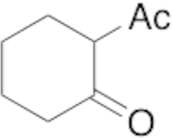
CAS 874-23-7
:2-Acetylcyclohexanon
Beschreibung:
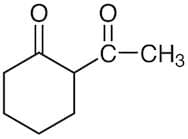
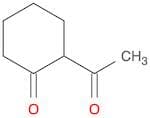
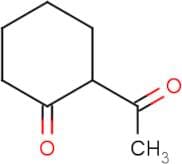
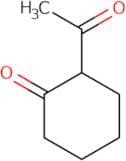
2-Acetylcyclohexanon, mit der CAS-Nummer 874-23-7, ist eine organische Verbindung, die durch ihre Ketongruppe und einen Cyclohexanring gekennzeichnet ist. Sie erscheint als farblose bis blassgelbe Flüssigkeit mit einem charakteristischen süßen, karamellartigen Geruch. Die molekulare Formel von 2-Acetylcyclohexanon ist C9H10O, was die Anwesenheit von neun Kohlenstoffatomen, zehn Wasserstoffatomen und einem Sauerstoffatom anzeigt. Diese Verbindung ist bekannt für ihre Rolle als Aromastoff und Duftstoff in verschiedenen Anwendungen, einschließlich Lebensmitteln und Kosmetika. Sie zeigt eine moderate Löslichkeit in Wasser und ist in organischen Lösungsmitteln wie Ethanol und Ether besser löslich. Die Verbindung ist unter normalen Bedingungen stabil, sollte jedoch aufgrund möglicher reizender Eigenschaften mit Vorsicht behandelt werden. Ihre Reaktivität umfasst die Teilnahme an verschiedenen organischen Reaktionen, wie der Aldol-Kondensation und der Michael-Addition, was sie zu einem wertvollen Zwischenprodukt in der synthetischen organischen Chemie macht. Insgesamt ist 2-Acetylcyclohexanon eine vielseitige Verbindung mit Anwendungen sowohl in industriellen als auch in Forschungsumgebungen.
Formel:C8H12O2
InChl:InChI=1S/C8H12O2/c1-6(9)7-4-2-3-5-8(7)10/h7H,2-5H2,1H3
InChI Key:InChIKey=OEKATORRSPXJHE-UHFFFAOYSA-N
SMILES:C(C)(=O)C1C(=O)CCCC1
Synonyme:- (2S,3S)-1,4-dioxane-2,3-diol
- 1-(2-Hydroxycyclohex-1-En-1-Yl)Ethanone
- 2-Acetyl-1-cyclohexanone
- 2-Acetyl-cyclohexanone
- Ai3-19261
- Cyclohexanone, 2-acetyl-
- Nsc 7713
- alpha-Acetylcyclohexanone
- α-Acetylcyclohexanone
- 2-Acetylcyclohexanone
Sortieren nach
Reinheit (%)
0
100
|
0
|
50
|
90
|
95
|
100
6 Produkte.
2-Acetylcyclohexanone
CAS:Formel:C8H12O2Reinheit:>97.0%(GC)Farbe und Form:Colorless to Brown clear liquidMolekulargewicht:140.182-Acetylcyclohexanone
CAS:Formel:C8H12O2Reinheit:95%Farbe und Form:Liquid, ClearMolekulargewicht:140.1822-Acetyl cyclohexanone
CAS:2-Acetylcyclohexanone is a chemical compound that belongs to the group of aryl halides. It is used as a raw material in the production of other chemicals, such as ethylene diamine and acetic anhydride. The reaction mechanism of 2-acetylcyclohexanone is mainly via nucleophilic substitution with hydrochloric acid or trifluoroacetic acid. The reaction with acetic anhydride or ethylene diamine has been shown to be through an acetylation reaction. 2-acetylcyclohexanone can be synthesized by reacting acetaldehyde with sodium cyclopentadienide in the presence of hydrochloric acid, followed by elimination of hydrogen chloride by heating. This compound has two tautomers: keto and enol.Formel:C8H12O2Reinheit:Min. 95%Farbe und Form:Colorless Clear LiquidMolekulargewicht:140.18 g/mol2-Acetylcyclohexanone
CAS:Kontrolliertes ProduktApplications 2-Acetylcyclohexanone is used in the synthesis of 1-(pyridyl)ethanol derivatives that can reduce keto-esters and ketones. Also used in the synthesis of phenothiazine derivatives that can inhibit protein farnesyltransferase molecules and some that show anti-proliferative activity.
References Baciu-Atudosie, L. et al.: Bioorg. Med. Chem. Lett., 22, 6896 (2012); Kawano, S. et al.: Biosci. Biotech. Biochem., 75, 1055 (2011);Formel:C8H12O2Farbe und Form:NeatMolekulargewicht:140.18