CAS 88-05-1
:2,4,6-Trimethylanilin
Beschreibung:
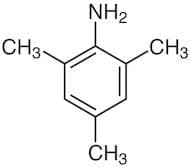
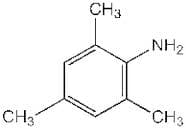
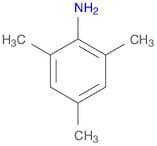
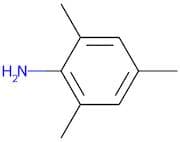
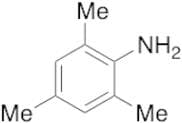
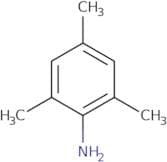
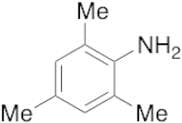
2,4,6-Trimethylanilin, mit der CAS-Nummer 88-05-1, ist eine organische Verbindung, die zur Klasse der Aniline gehört, die aromatische Amine sind. Sie weist einen Benzolring auf, der an den Positionen 2, 4 und 6 mit drei Methylgruppen substituiert ist, sowie eine Aminogruppe (-NH2) an der Position 1. Diese Verbindung ist typischerweise eine farblose bis blassgelbe Flüssigkeit oder ein Feststoff, abhängig von der Temperatur, und hat einen charakteristischen Amin-Geruch. Sie ist in organischen Lösungsmitteln löslich, hat jedoch eine begrenzte Löslichkeit in Wasser aufgrund ihrer hydrophoben Methylgruppen. 2,4,6-Trimethylanilin wird hauptsächlich in der Herstellung von Farbstoffen, Pigmenten und als Zwischenprodukt in der Synthese verschiedener Chemikalien verwendet. Sie zeigt basische Eigenschaften aufgrund der Anwesenheit der Aminogruppe, die es ihr ermöglicht, an verschiedenen chemischen Reaktionen, einschließlich der elektrophilen aromatischen Substitution, teilzunehmen. Es ist jedoch wichtig, diese Verbindung mit Vorsicht zu behandeln, da sie Gesundheitsrisiken, einschließlich Haut- und Atemwegsreizungen, darstellen kann und als umweltschädlich gilt.
Formel:C9H13N
InChl:InChI=1S/C9H13N/c1-6-4-7(2)9(10)8(3)5-6/h4-5H,10H2,1-3H3
InChI Key:InChIKey=KWVPRPSXBZNOHS-UHFFFAOYSA-N
SMILES:NC1=C(C)C=C(C)C=C1C
Synonyme:- 1-Amino-2,4,6-trimethylbenzene
- 2,4,6-Trimethylanilin
- 2,4,6-Trimethylaniline (mesidine)
- 2,4,6-Trimethylbenzenamine
- 2,4,6-Trimethylphenylamine
- 2,4,6-Trimetilanilina
- 2-Aminomesitylene
- Aminomesitylene
- Aniline, 2,4,6-Trimethyl-
- Benzenamine, 2,4,6-trimethyl-
- Mesidin
- Mesidine
- Mesitylamine
- Mesitylene, 2-amino-
- Weitere Synonyme anzeigen
Sortieren nach
Reinheit (%)
0
100
|
0
|
50
|
90
|
95
|
100
10 Produkte.
2,4,6-Trimethylaniline
CAS:Formel:C9H13NReinheit:>98.0%(GC)(T)Farbe und Form:Colorless to Yellow to Orange clear liquidMolekulargewicht:135.212,4,6-Trimethylaniline, 98%
CAS:2,4,6-Trimethylaniline is useful for the preparation of Grubbs' catalyst. It is used as a precursor to dyes. It undergoes condensation reaction with glyoxal to prepare glyoxal-bis(mesitylimine). It is also involved in the preparation of 1,3-diketimines ligands by condensation with 1,3-diketones. FurFormel:C9H14ClNReinheit:98%Farbe und Form:Clear, pale yellow to orange or brown, LiquidMolekulargewicht:171.672,4,6-Trimethylaniline
CAS:2,4,6-Trimethylaniline is an aromatic amine compound, widely used in biochemical experiments and drug synthesis research.Formel:C9H13NReinheit:99.87%Farbe und Form:SolidMolekulargewicht:135.212,4,6-Trimethylaniline
CAS:2,4,6-TrimethylanilineFormel:C9H13NReinheit:98%Farbe und Form: colourless to light yellow liquidMolekulargewicht:135.21g/mol2,4,6-Trimethylaniline
CAS:2,4,6-Trimethylaniline is a trifluoroacetic acid derivative that has been used in analytical chemistry as a reagent for the quantitative determination of hydrogen peroxide (H2O2) and ammonia (NH3). It can be synthesized by reacting 2,4,6-trimethylaniline hydrochloride with trifluoroacetic acid. 2,4,6-Trimethylaniline is not toxic to liver cells at concentrations up to 100 mM. This compound is a bicyclic heterocycle containing two amines and two nitrogen atoms. The reaction mechanism of 2,4,6-trimethylaniline has been studied extensively and it is known that this chemical reacts with molecular oxygen to form an excited state species which then emits light. The phase transition temperature of 2,4,6-trimethylaniline has also been determined experimentally to be approximately -10 °C.Formel:C9H13NReinheit:Min. 98%Farbe und Form:Clear LiquidMolekulargewicht:135.21 g/mol2,4,6-Trimethylaniline
CAS:Kontrolliertes ProduktApplications 2,4,6-Trimethylaniline is a sterically hindered, aromatic amine that is present in tobacco and tobacco smoke. 2,4,6-Trimethylaniline is also an industrial chemical that is known to be a hepatoxic and carcinogenic agent to humans.
Not a dangerous good if item is equal to or less than 1g/ml and there is less than 100g/ml in the package
References Pilotti, A., et al.: Toxicology, 5, 49 (1975); Shu, C., et al.: Angew. Chem. Int. Edit., 43, 4797 (2004); Weisburger, J. & Goodall, C.: Life Sci., 7, 263 (1968)Formel:C9H13NFarbe und Form:Yellow To BrownMolekulargewicht:135.21