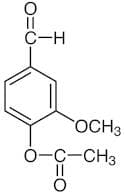
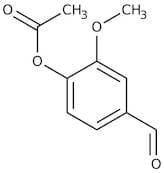
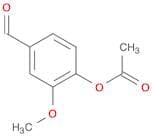
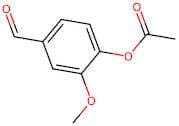
CAS 881-68-5
:Acetovanillin
Beschreibung:
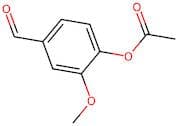
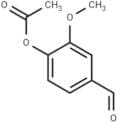
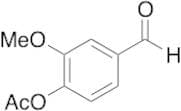
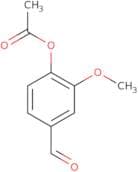
Acetovanillin, auch bekannt als 4-Hydroxy-3-methoxyacetophenon, ist eine organische Verbindung mit der CAS-Nummer 881-68-5. Es ist ein Derivat von Vanillin, das durch das Vorhandensein einer Acetylgruppe, die an die phenolische Struktur gebunden ist, gekennzeichnet ist. Acetovanillin erscheint typischerweise als kristalliner fester Stoff von weiß bis blassgelb mit einem süßen, vanilleähnlichen Aroma, was es in der Lebensmittel- und Duftstoffindustrie wertvoll macht. Es ist in organischen Lösungsmitteln wie Ethanol und Ether löslich, hat jedoch eine begrenzte Löslichkeit in Wasser. Die Verbindung zeigt antioxidative Eigenschaften und wurde auf ihre potenziellen gesundheitlichen Vorteile untersucht, einschließlich entzündungshemmender und antimikrobieller Wirkungen. Acetovanillin wird häufig als Aromastoff in Lebensmitteln und als Duftstoff in Kosmetika und Parfums verwendet. Seine chemische Struktur umfasst eine Methoxygruppe und eine Hydroxylgruppe, die zu seiner Reaktivität und seinen Wechselwirkungen in verschiedenen chemischen Prozessen beitragen. Insgesamt ist Acetovanillin eine vielseitige Verbindung mit Anwendungen sowohl in kulinarischen als auch in industriellen Kontexten.
Formel:C10H10O4
InChl:InChI=1/C10H10O4/c1-6(12)9-7(5-11)3-4-8(13)10(9)14-2/h3-5,13H,1-2H3
InChI Key:InChIKey=PZSJOBKRSVRODF-UHFFFAOYSA-N
SMILES:O(C(C)=O)C1=C(OC)C=C(C=O)C=C1
Synonyme:- 4-(Acetyloxy)-3-methoxybenzaldehyde
- 4-Acetoxy-3-methoxybenzaidehyde
- 4-Acetoxy-3-methoxybenzaldehyde
- 4-Acetoxy-5-methoxybenzaldehyde
- 4-Formyl-2-Methoxyphenyl Acetate
- 4-Formyl-2-methoxyphenol acetate
- 4-O-Acetylvanillin
- Acetovanillin
- Acetylvanillin
- Benzaldehyde, 4-(acetyloxy)-3-methoxy-
- NSC 25863
- NSC 8499
- Vanillin acetate
- o-Acetylvanillin
- 3-METHOXY-4-ACETOXYBENZALDEHYDE
- 4-ACETYLVANILLIN
- AKOS 239-07
- AKOS B004358
- Benzaldehyde, 4-acetoxy-3-methoxy
- AKOS BBS-00003243
- FEMA 3108
- 4-(acetyloxy)-3-methoxy-benzaldehyd
- ACETYL VANILLIN
- Weitere Synonyme anzeigen
Sortieren nach
Reinheit (%)
0
100
|
0
|
50
|
90
|
95
|
100
10 Produkte.
Vanillin Acetate
CAS:Formel:C10H10O4Reinheit:>98.0%(GC)Farbe und Form:White to Almost white powder to crystalMolekulargewicht:194.194-Acetoxy-3-methoxybenzaldehyde, 98%
CAS:This Thermo Scientific Chemicals brand product was originally part of the Alfa Aesar product portfolio. Some documentation and label information may refer to the legacy brand. The original Alfa Aesar product / item code or SKU reference has not changed as a part of the brand transition to Thermo SciFormel:C10H10O4Reinheit:98%Farbe und Form:White to cream, Crystals or powder or crystalline powderMolekulargewicht:194.194-Formyl-2-methoxyphenyl acetate
CAS:Formel:C10H10O4Reinheit:97%Farbe und Form:SolidMolekulargewicht:194.18404-Acetoxy-3-methoxybenzaldehyde
CAS:4-Acetoxy-3-methoxybenzaldehydeFormel:C10H10O4Reinheit:≥95%Farbe und Form: white to off white crystalline solidMolekulargewicht:194.18g/molVanillin acetate
CAS:Acetylvanillin is a derivative of Vanillin, the primary component found in vanilla bean extract.Formel:C10H10O4Reinheit:98.71%Farbe und Form:SolidMolekulargewicht:194.184-Acetoxy-3-methoxybenzaldehyde
CAS:4-Acetoxy-3-methoxybenzaldehyde is an antimicrobial agent that is used specifically for the treatment of lemongrass oil and eugenol. It has been shown to be effective against a wide range of microorganisms, such as Escherichia coli, Pseudomonas aeruginosa, Salmonella enterica, Staphylococcus aureus, and Streptococcus pneumoniae. 4-Acetoxy-3-methoxybenzaldehyde has been shown to inhibit the growth of bacteria by binding to the 50S ribosomal subunit. The molecule also has hydroxyl group which can react with potassium dichromate and sodium carbonate. This reaction results in the formation of 4-acetoxy-3-hydroxybenzaldehyde through an S N 2 substitution mechanism.
Formel:C10H10O4Reinheit:Min. 95%Farbe und Form:PowderMolekulargewicht:194.18 g/mol4-Acetoxy-3-methoxybenzaldehyde
CAS:Formel:C10H10O4Reinheit:97%Farbe und Form:SolidMolekulargewicht:194.186