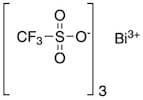
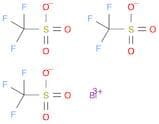
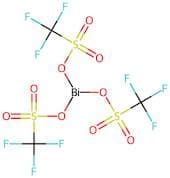
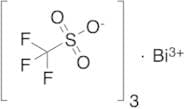
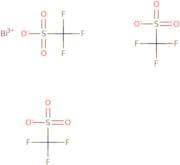
CAS 88189-03-1
:Bismut(III)-trifluormethansulfonat
- Bismuth trifluoromethanesulfonate
- Bismuth(3+) Tris(Trifluoromethanesulfonate)
- Bismuth(III) trifluoromethanesulphonate
Bismuth(III) trifluoromethanesulfonate, 99%
CAS:Bismuth(III) trifluoromethanesulfonate acts as a catalyst in Friedel-Crafts acylation and cycloisomerization of allene-enol ethers. It behaves as a direct substitution catalyst and involved in the substitution of allylic, propargylic, and benzylic alcohols with sulfonamides, carboxamides and carbamFormel:C3BiF9O9S3Reinheit:99%Farbe und Form:White, PowderMolekulargewicht:656.17Bismuth(III) trifluoromethanesulfonate, min. 98% (Bismuth triflate)
CAS:Bismuth(III) trifluoromethanesulfonate, min. 98% (Bismuth triflate)
Formel:Bi(SO3CF3)3Reinheit:min. 98%Farbe und Form:white to off-white pwdr.Molekulargewicht:656.19Bismuth(III) trifluoromethanesulfonate
CAS:Formel:C3BiF9O9S3Reinheit:98%Farbe und Form:SolidMolekulargewicht:656.1877Bismuth(III) trifluoromethanesulphonate
CAS:Bismuth(III) trifluoromethanesulphonate
Formel:C3BiF9O9S3Reinheit:≥95%Farbe und Form: white powderMolekulargewicht:656.1877g/molBismuth(III) Trifluoromethanesulfonate (3:1)
CAS:Kontrolliertes ProduktApplications Bismuth(III) Trifluoromethanesulfonate (3:1) is a catalyst used in Friedel-Crafts acylation and cycloisomerization of allene-enol ethers.
References Repichet, S., et. al.: Eur. J. Org. Chem., 12, 2743 (1998); Ondet, P., et. al.: Org. Lett., 17, 1002 (2015)Formel:C3BiF9O9S3Farbe und Form:NeatMolekulargewicht:656.19Bismuth(III) trifluoromethanesulfonate
CAS:Trifluoromethanesulfonic acid is a strong acid, which is typically used as a catalyst in acylation reactions. It is also used to catalyze epoxidation and amination reactions. Trifluoromethanesulfonic acid can be prepared by the careful addition of hydrochloric acid to trifluoroacetic anhydride at 0°C. The reaction of this acid with alcohols produces an ester and hydrogen chloride gas. Trifluoromethanesulfonic acid reacts with amines to produce an amide and hydrogen fluoride gas. Trifluoromethanesulfonic acid is also capable of removing a hydroxyl group from carboxylic acids or phenols, which can lead to the formation of aldehydes or ketones respectively. Trifluoromethanesulfonic acid is also known for its ability to efficiently catalyze allylation and triflation reactions, respectively.
Formel:C3BiF9O9S3Reinheit:Min. 95%Farbe und Form:PowderMolekulargewicht:656.19 g/mol