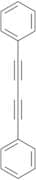
CAS 886-66-8
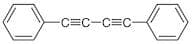
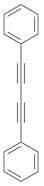
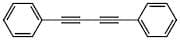
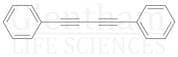
:1,4-Diphenyl-1,3-butadiin
- 1,1′-(1,3-Butadiyne-1,4-diyl)bis[benzene]
- Butadiyne, diphenyl-
- Diphenylbutadiyne
- Diphenyldiacetylene
- Benzene, 1,1′-(1,3-butadiyne-1,4-diyl)bis-
1,4-Diphenylbutadiyne
CAS:Formel:C16H10Reinheit:>98.0%(GC)Farbe und Form:White to Light yellow powder to crystalMolekulargewicht:202.261,4-Diphenylbutadiyne, 99%
CAS:1,4-Diphenylbutadiyne was used in the preparation of 7,8-dehydropurpurin dimers via two-fold Pd-catalyzed [3+2] annulation of meso-bromoporphyrin. This Thermo Scientific Chemicals brand product was originally part of the Alfa Aesar product portfolio. Some documentation and label information may refe
Formel:C16H10Reinheit:99%Farbe und Form:White to pale cream, Crystals or powder or crystalline powderMolekulargewicht:202.261,4-Diphenylbutadiyne
CAS:1,4-Diphenylbutadiyne is a conjugated diyne and aromatic compound widely used in biochemical experiments and drug synthesis research.Formel:C16H10Farbe und Form:SolidMolekulargewicht:202.251,4-Diphenylbutadiyne
CAS:Formel:C16H10Reinheit:≥ 98.5%Farbe und Form:White to off-white powderMolekulargewicht:202.251,4-Diphenylbutadiyne
CAS:1,4-Diphenylbutadiyne is a chemical compound that has been used in fluorescence studies. It is insoluble in water and can be used as a polymer with high values. 1,4-Diphenylbutadiyne reacts with sodium carbonate to form the light emitting compound dimethyl fumarate. This reaction mechanism is due to the formation of an intramolecular hydrogen bond between the carbonyl group and one of the phenyl groups. The basic structure of this molecule is made up of nitrogen atoms that are arranged in a planar fashion. The molecule has high resistance to heat and oxidation, making it useful as a solid catalyst for reactions involving organic compounds.
Formel:C16H10Reinheit:Min. 95%Molekulargewicht:202.25 g/mol1,4-Diphenylbutadiyne
CAS:Formel:C16H10Reinheit:98%Farbe und Form:Solid, No data available.Molekulargewicht:202.256