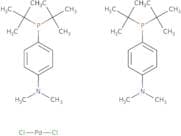
![Dichlorobis[di-tert-butyl(4-dimethylaminophenyl)phosphino]palladium(II)](/_next/image/?url=https%3A%2Fstatic.cymitquimica.com%2Fcas-image%2Fthumb-webp%2F308009-dichlorobis-di-tert-butyl-4-dimethylaminophenyl-phosphino-palladium-ii.webp&w=3840&q=75)
CAS 887919-35-9
:Dichlorobis[di-tert-butyl(4-dimethylaminophenyl)phosphino]palladium(II)
Beschreibung:
Dichlorobis[di-tert-butyl(4-dimethylaminophenyl)phosphino]palladium(II) ist ein Palladiumkomplex, der durch die Koordination von Palladium mit zwei bidentaten Phosphinliganden gekennzeichnet ist. Die Struktur weist ein Palladiumzentrum auf, das mit zwei Chloridionen und zwei voluminösen Phosphinliganden koordiniert ist, die von Di-tert-butyl(4-dimethylaminophenyl)phosphin abgeleitet sind. Dieser Komplex ist bemerkenswert für seine potenziellen Anwendungen in der Katalyse, insbesondere in Kreuzkopplungsreaktionen, aufgrund der günstigen elektronischen und sterischen Eigenschaften, die durch die Phosphinliganden vermittelt werden. Die Anwesenheit der Dimethylamino-Gruppe verbessert die Elektronendonationsfähigkeit der Liganden, was die Reaktivität des Palladiumzentrums beeinflussen kann. Darüber hinaus bieten die voluminösen tert-Butylgruppen sterische Hinderung, die dazu beitragen kann, den Komplex zu stabilisieren und unerwünschte Nebenreaktionen zu verhindern. Insgesamt veranschaulicht diese Verbindung die Vielseitigkeit von Palladiumkomplexen in der organischen Synthese und der Materialwissenschaft und zeigt das Zusammenspiel zwischen Ligandendesign und katalytischer Aktivität.
Formel:C32H56Cl2N2P2Pd
InChl:InChI=1/2C16H28NP.2ClH.Pd/c2*1-15(2,3)18(16(4,5)6)14-11-9-13(10-12-14)17(7)8;;;/h2*9-12H,1-8H3;2*1H;/q;;;;+2/p-2
SMILES:CC(C)(C)P(c1ccc(cc1)N(C)C)C(C)(C)C.CC(C)(C)P(c1ccc(cc1)N(C)C)C(C)(C)C.Cl.Cl.[Pd]
Synonyme:- 4-(Di-tert-butylphosphino)-N,N-dimethylaniline-dichloropalladium (2:1)
- 4-(di-tert-butylphosphanyl)-N,N-dimethylaniline-dichloropalladium (2:1)
- Bis(di-tert-butyl(4-dimethylaminophenyl)phosphine)dichloropalladium(II)
- Dichlorobis(di-tert-butyl-4-dimethylaminophenylphosphine) palladium(II)
- (A-taPhos)2PdCl2
- (AmPhos)2PdCl2
Sortieren nach
Reinheit (%)
0
100
|
0
|
50
|
90
|
95
|
100
8 Produkte.
Bis[di-tert-butyl(4-dimethylaminophenyl)phosphine]dichloropalladium(II)
CAS:Formel:C32H56Cl2N2P2PdReinheit:>98.0%(T)Farbe und Form:Light yellow to Yellow to Orange powder to crystalMolekulargewicht:708.08Dichlorobis[di-tert-butyl(4-dimethylaminophenyl)phosphine]palladium(II), Pd 15%
CAS:Dichlorobis[di-tert-butyl(4-dimethylaminophenyl)phosphine]palladium(II) is a highly active, air-stable catalyst for Suzuki-Miyaura cross-coupling with aryl halides including 5- and 6-membered heteroaryl chlorides. This Thermo Scientific brand product was originally part of the Alfa Aesar product porFormel:C32H56Cl2N2P2PdMolekulargewicht:708.08Bis(4-(di-tert-Butylphosphanyl)-N,N-dimethylaniline); palladium chloride
CAS:Formel:C32H56Cl2N2P2PdReinheit:98%Farbe und Form:SolidMolekulargewicht:708.0740Bis{bis(tert-butyl)[4-(dimethylamino)phenyl]phosphine}palladium(II) chloride
CAS:Bis{bis(tert-butyl)[4-(dimethylamino)phenyl]phosphine}palladium(II) chlorideFormel:·2C16H28NP·Cl2PdReinheit:97%Farbe und Form: yellow solidMolekulargewicht:708.07396g/molPdCl2(amphos)2 (HPMC encapsulated)
CAS:Formel:C32H56Cl2N2P2PdFarbe und Form:White to Light yellow capsuleMolekulargewicht:708.08Bis(4-(di-tert-Butylphosphanyl)-N,N-dimethylaniline)-palladium chloride
CAS:Formel:C32H56Cl2N2P2PdReinheit:98%Farbe und Form:SolidMolekulargewicht:708.08Dichlorobis{[4-(N,N-dimethylamino)phenyl]di-t-butylphosphino}palladium(II), min. 98% PdAmphos
CAS:Dichlorobis{[4-(N,N-dimethylamino)phenyl]di-t-butylphosphino}palladium(II), min. 98% PdAmphos
Formel:(C16H28NP)2PdCl2Reinheit:min. 98%Farbe und Form:yellow pwdr.Molekulargewicht:708.07Bis(4-(di-tert-butylphosphino)-N,N-dimethylbenzenamine) palladium dichloride
CAS:Kontrolliertes ProduktBis(4-(di-tert-butylphosphanyl)-N,N-dimethylaniline) is a boronic acid that has been used as a surfactant in organic chemistry. It is hydrophobic and has hydrogen bonding interactions with other molecules. Bis(4-(di-tert-butylphosphanyl)-N,N-dimethylaniline) is also a proton acceptor and can form stable complexes with metal ions such as palladium chloride. This compound is kinase selective and can be used to inhibit tyrosine kinases by binding to the ATP binding site of the enzyme's kinase domain. The functional groups of this compound are able to undergo cross-coupling reactions with other functional groups that have been activated by a reagent such as palladium chloride. Bis(4-(di-tert-butylphosphanyl)-N,N-dimethylaniline) has been used in highFormel:C32H56Cl2N2P2PdReinheit:Min. 95%Farbe und Form:PowderMolekulargewicht:708.07 g/mol
![Bis[di-tert-butyl(4-dimethylaminophenyl)phosphine]dichloropalladium(II)](/_next/image/?url=https%3A%2Fstatic.cymitquimica.com%2Fproducts%2F3B%2Fthumb%2FB6255.jpg&w=3840&q=75)

![Dichlorobis[di-tert-butyl(4-dimethylaminophenyl)phosphine]palladium(II), Pd 15%](/_next/image/?url=https%3A%2Fstatic.cymitquimica.com%2Fproducts%2F02%2Fthumb%2F045511.jpg&w=3840&q=75)

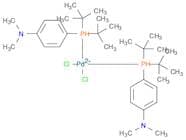

![Bis{bis(tert-butyl)[4-(dimethylamino)phenyl]phosphine}palladium(II) chloride](/_next/image/?url=https%3A%2Fstatic.cymitquimica.com%2Fproducts%2F54%2Fthumb%2FOR17048.jpg&w=3840&q=75)

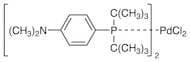


![Dichlorobis{[4-(N,N-dimethylamino)phenyl]di-t-butylphosphino}palladium(II), min. 98% PdAmphos](/_next/image/?url=https%3A%2Fstatic.cymitquimica.com%2Fproducts%2F08%2Fthumb%2F46-0825.jpg&w=3840&q=75)