CAS 88930-08-9
:3-Hydroxyoctansäure
Beschreibung:
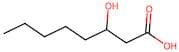
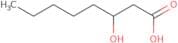
3-Hydroxyoctansäure, mit der CAS-Nummer 88930-08-9, ist eine mittelkettige Fettsäure, die durch ihre Hydroxylgruppe (-OH) gekennzeichnet ist, die am dritten Kohlenstoff einer acht-Kohlenstoff-Kette sitzt. Diese Verbindung ist bei Raumtemperatur eine farblose bis blassgelbe Flüssigkeit und ist aufgrund der Anwesenheit der Hydroxylgruppe wasserlöslich, die ihre Polarität erhöht. Sie zeigt typische Eigenschaften von Fettsäuren, einschließlich der Fähigkeit, Ester zu bilden und an verschiedenen biochemischen Reaktionen teilzunehmen. 3-Hydroxyoctansäure ist in verschiedenen Bereichen von Interesse, einschließlich Biochemie und Materialwissenschaft, da es als Baustein für die Synthese von biologisch abbaubaren Polymeren und Tensiden dienen kann. Darüber hinaus hat es potenzielle Anwendungen in der Produktion von Biokraftstoffen und als Lebensmittelzusatzstoff aufgrund seines Fettsäureprofils. Seine biologische Bedeutung wird auch in den Stoffwechselwegen hervorgehoben, insbesondere im Kontext von mittelkettigen Triglyceriden, die für ihre schnelle Absorption und Nutzung im Energiestoffwechsel bekannt sind.
Formel:C8H16O3
InChl:InChI=1/C8H16O3/c1-2-3-4-5-7(9)6-8(10)11/h7,9H,2-6H2,1H3,(H,10,11)
InChI Key:InChIKey=NDPLAKGOSZHTPH-UHFFFAOYSA-N
SMILES:C(C(CC(O)=O)O)CCCC
Synonyme:- 3-HYDROXY C8:0 ACID
- dl-B-hydroxycaprylic acid
- 3-Hydroxyoctanoic acid
- 3-Hydroxycaprylic acid
- β-Hydroxyoctanoic acid
- Octanoic acid, 3-hydroxy-
- (+/-)-3-HYDROXYOCTANOIC ACID
- Caprylic acid, β-hydroxy-
- DL-BETA-HYDROXYCAPRYLIC ACID
- 3-Hydroxyoctanoic acid, 98 % (GC)
- (+/-)-3-Hydroxyoctanoic acid >=97%
Sortieren nach
Reinheit (%)
0
100
|
0
|
50
|
90
|
95
|
100
2 Produkte.
(±)-3-Hydroxyoctanoic acid
CAS:<p>(±)-3-Hydroxyoctanoic acid is a fatty acid that is produced by the bacterial strain Pseudomonas putida. This compound is involved in energy metabolism and cell division as an intermediate in the synthesis of polymers. The hydroxyl group on this molecule can be used to synthesize various compounds, such as cyclic lipopeptides. The production of (±)-3-hydroxyoctanoic acid can be increased by dehydrogenase deficiency or by culturing cells under aerobic conditions. It has been shown that (±)-3-hydroxyoctanoic acid is also an important component for wastewater treatment, because it can be degraded by bacteria to produce carbon dioxide and water, which are then released into the atmosphere.</p>Formel:C8H16O3Reinheit:Min. 95%Farbe und Form:Clear LiquidMolekulargewicht:160.21 g/mol