CAS 890707-28-5
:2-Amino-5-chlor-N,3-dimethylbenzamid
Beschreibung:
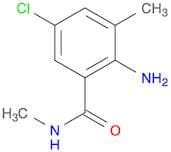
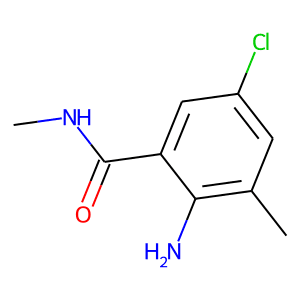
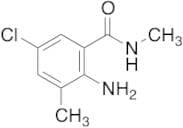
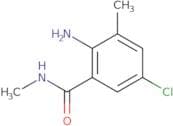
2-Amino-5-chlor-N,3-dimethylbenzamid ist eine organische Verbindung, die durch ihre Amidfunktionalität gekennzeichnet ist, die vom Benzoesäure abgeleitet ist. Diese Verbindung weist einen Benzolring auf, der an der Position 2 mit einer Aminogruppe, an der Position 5 mit einem Chloratom und an der Position 3 mit zwei Methylgruppen substituiert ist. Die Anwesenheit der Aminogruppe trägt zu ihrer Basizität bei, während das Chloratom elektronegative Eigenschaften einführt, die ihre Reaktivität und Löslichkeit beeinflussen können. Die Dimethylsubstitution verbessert ihre sterischen Eigenschaften, was potenziell ihre Wechselwirkungen mit biologischen Zielen beeinflussen kann. Diese Verbindung kann verschiedene biologische Aktivitäten aufweisen, was sie für die pharmazeutische Forschung von Interesse macht. Ihre molekulare Struktur deutet auf potenzielle Anwendungen in der medizinischen Chemie hin, insbesondere bei der Entwicklung neuer therapeutischer Wirkstoffe. Darüber hinaus können die Stabilität und Löslichkeit der Verbindung in organischen Lösungsmitteln variieren, was für ihre praktischen Anwendungen in Synthese und Formulierung wichtig ist. Wie bei vielen organischen Verbindungen sollten Sicherheits- und Handhabungsvorkehrungen aufgrund möglicher Toxizität oder Reaktivität beachtet werden.
Formel:C9H11ClN2O
InChl:InChI=1S/C9H11ClN2O/c1-5-3-6(10)4-7(8(5)11)9(13)12-2/h3-4H,11H2,1-2H3,(H,12,13)
InChI Key:InChIKey=WOBVZGBINMTNKL-UHFFFAOYSA-N
SMILES:C(NC)(=O)C1=C(N)C(C)=CC(Cl)=C1
Synonyme:- 2-Amino-5-chloro-N,3-dimethylhenzamide
- 2-Amino-5-chloro-N-methyl-3-methylbenzamide
- Benzamide, 2-amino-5-chloro-N,3-dimethyl-
- 2-Amino-5-chloro-N,3-dimethylbenzamide
- Bardoxolone Powder C9h11cln2o
- 2-Amino-5-chloro-N,3-dimethylbenzamide 98%
Sortieren nach
Reinheit (%)
0
100
|
0
|
50
|
90
|
95
|
100
8 Produkte.
2-Amino-5-chloro-N,3-dimethylbenzamide
CAS:Formel:C9H11ClN2OReinheit:95%Farbe und Form:SolidMolekulargewicht:198.64942-Amino-5-chloro-N,3-dimethylbenzamide
CAS:2-Amino-5-chloro-N,3-dimethylbenzamideReinheit:95%Molekulargewicht:198.65g/mol2-Amino-5-chloro-N,3-dimethylbenzamide
CAS:Kontrolliertes ProduktApplications 2-Amino-5-chloro-N,3-dimethylbenzamide is the key intermediate used in the synthesis of chlorantraniliprole, a novel insecticide.
References Zhang, T., et al.: Jingxi Huagong Zhongjianti, 40, 17 (2010); Peng, Y., et al.: Nongyao, 48, 326 (2009)Formel:C9H11ClN2OFarbe und Form:NeatMolekulargewicht:198.6492-Amino-5-chloro-N,3-dimethylbenzamide
CAS:2-Amino-5-chloro-N,3-dimethylbenzamide is a synthetic compound. It has been shown to induce necrotic cell death in mammalian cells. This compound was synthesized by the reaction of 2-aminoquinoline with a Grignard reagent, followed by nitration of the resultant amine. The synthesis of this compound was thermodynamically favorable and exhibited good solubility in water. The chlorantraniliprole and anthranilic acid moieties are activated with an acylation reaction, which allows them to bind to the ryanodine receptor and inhibit calcium release from the sarcoplasmic reticulum (SR) with ammonolysis. This inhibition leads to ferroptosis, a type of programmed necrosis.Formel:C9H11ClN2OReinheit:Min. 95%Farbe und Form:PowderMolekulargewicht:198.65 g/mol