CAS 89466-08-0
:2-Hydroxybenzenboronsäure
Beschreibung:
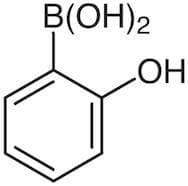
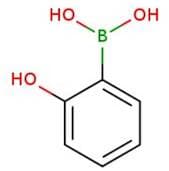
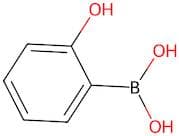
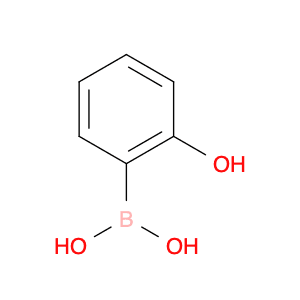
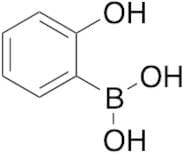
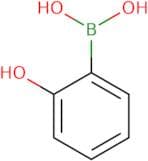
2-Hydroxybenzenboronsäure, auch bekannt als Salicylboronsäure, ist eine organoborverbindung, die durch das Vorhandensein einer boronsäurefunktionellen Gruppe gekennzeichnet ist, die an einen hydroxylsubstituierten Benzolring gebunden ist. Seine molekulare Struktur weist eine phenolische Hydroxylgruppe (-OH) ortho zur Boronsäuregruppe (-B(OH)2) auf, was zu seiner einzigartigen Reaktivität und seinen Eigenschaften beiträgt. Diese Verbindung ist typischerweise ein weißer bis off-white fester Stoff und ist in polaren Lösungsmitteln wie Wasser und Alkoholen löslich, was sie in verschiedenen chemischen Anwendungen nützlich macht. 2-Hydroxybenzenboronsäure ist bekannt für seine Fähigkeit, reversible kovalente Bindungen mit Diolen zu bilden, was in der Entwicklung von Sensoren und Arzneimittellieferungssystemen von Bedeutung ist. Darüber hinaus spielt es eine Rolle bei Suzuki-Miyaura-Kreuzkupplungsreaktionen, die die Bildung von Kohlenstoff-Kohlenstoff-Bindungen in der organischen Synthese erleichtern. Seine Boronsäurefunktionalität ermöglicht es ihm auch, an der Komplexierung mit Biomolekülen teilzunehmen, was es in der biochemischen Forschung und Anwendung wertvoll macht. Insgesamt ist 2-Hydroxybenzenboronsäure eine vielseitige Verbindung mit wichtigen Implikationen sowohl in der synthetischen als auch in der medizinischen Chemie.
Formel:C6H7BO3
InChl:InChI=1/C6H7BO3/c8-6-4-2-1-3-5(6)7(9)10/h1-4,8-10H
SMILES:c1ccc(c(c1)B(O)O)O
Synonyme:- 2-Boronophenol
- 2-Hydroxyphenylboronic acid
Sortieren nach
Reinheit (%)
0
100
|
0
|
50
|
90
|
95
|
100
7 Produkte gefunden.
2-Hydroxyphenylboronic Acid (contains varying amounts of Anhydride)
CAS:Formel:C6H7BO3Farbe und Form:White to Light yellow to Light orange powder to crystalMolekulargewicht:137.932-Hydroxybenzeneboronic acid, 97%
CAS:2-Hydroxybenzeneboronic acid is used as a pharmaceutical intermediate. This Thermo Scientific Chemicals brand product was originally part of the Alfa Aesar product portfolio. Some documentation and label information may refer to the legacy brand. The original Alfa Aesar product / item code or SKU reFormel:C6H7BO3Reinheit:97%Farbe und Form:Powder, White to pale creamMolekulargewicht:137.932-Hydroxybenzeneboronic acid
CAS:2-Hydroxybenzeneboronic acidFormel:C6H7BO3Reinheit:≥95%Farbe und Form:White SolidMolekulargewicht:137.928982-Hydroxyphenylboronic acid
CAS:Formel:C6H7BO3Reinheit:96%Farbe und Form:SolidMolekulargewicht:137.92902-Hydroxyphenylboronic acid
CAS:Formel:C6H7BO3Reinheit:98%Farbe und Form:White to off-white solidMolekulargewicht:137.932-Hydroxyphenylboronic acid
CAS:Kontrolliertes ProduktApplications 2-Hydroxyphenylboronic acid
Formel:C6H7BO3Farbe und Form:NeatMolekulargewicht:137.93(2-Hydroxyphenyl)boronic acid
CAS:(2-Hydroxyphenyl)boronic acid is an organic compound that contains a boronate ester group and a hydroxyl group. It is used in the synthesis of lysine-containing peptides, proteins, and other compounds. (2-Hydroxyphenyl)boronic acid is synthesized by cross-coupling reactions using palladium-catalyzed coupling reactions. The most common type of reaction is the Suzuki coupling reaction, which involves the addition of an aryl halide to an aryl or vinyl boronate ester. This reaction is carried out at elevated temperature in organic solvents such as tetrahydrofuran or dioxane. The yield for this reaction can be improved by using catalytic amounts of palladium acetate, which speeds up the rate at which the reaction occurs. The use of catalysts also decreases the need for high temperatures, making it possible to perform this process atFormel:C6H7BO3Reinheit:Min. 95%Molekulargewicht:137.93 g/mol