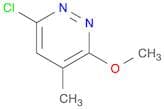
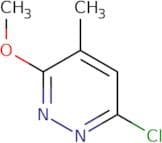
CAS 89466-38-6
:Pyridazin, 6-chlor-3-methoxy-4-methyl-
Beschreibung:
Pyridazin, 6-chlor-3-methoxy-4-methyl- ist eine heterocyclische organische Verbindung, die durch einen Pyridazinring gekennzeichnet ist, der aus zwei benachbarten Stickstoffatomen innerhalb eines sechsgliedrigen Rings besteht. Das Vorhandensein eines Chloratoms an der Position 6 und einer Methoxygruppe (-OCH3) an der Position 3 sowie einer Methylgruppe (-CH3) an der Position 4 trägt zu seinen einzigartigen chemischen Eigenschaften bei. Diese Verbindung zeigt typischerweise eine moderate Polarität aufgrund der elektronegativen Chlor- und Sauerstoffatome, was ihre Löslichkeit in verschiedenen Lösungsmitteln beeinflusst. Pyridazinderivate werden häufig wegen ihrer biologischen Aktivitäten untersucht, einschließlich potenzieller Anwendungen in der Pharmazie und Agrochemie. Die Verbindung kann auch an verschiedenen chemischen Reaktionen teilnehmen, wie nucleophilen Substitutionen oder elektrophilen aromatischen Substitutionen, aufgrund der Reaktivität der funktionellen Gruppen, die am Pyridazinring angebracht sind. Insgesamt deuten die strukturellen Merkmale von Pyridazin, 6-chlor-3-methoxy-4-methyl- darauf hin, dass es interessante chemische Reaktivität und potenzielle Nützlichkeit in der synthetischen Chemie und in medizinischen Anwendungen besitzen könnte.
Formel:C6H7ClN2O
Sortieren nach
Reinheit (%)
0
100
|
0
|
50
|
90
|
95
|
100
2 Produkte.
6-Chloro-3-Methoxy-4-methylpyridazine
CAS:6-Chloro-3-Methoxy-4-methylpyridazine is an alkoxide of hydrazine. It is a white crystalline solid that melts at 130 °C and has a mp of 138 °C. 6-Chloro-3-Methoxy-4-methylpyridazine is selective for the liver, and has been used in research to study hepatic diseases. It has also been used as an intermediate in the synthesis of other compounds. The 6-chloro group on the pyridine nitrogen atom reacts with phosphorus oxychloride to produce a monohydrate salt, which can be hydrolyzed by refluxing with water to form the oxychloride salt. The chloride atom on the methoxy group can be replaced by chlorine by heating with phosphorus and hydrazine monohydrate. This process is efficient because it produces only one chlorinated product instead of two chlorinated products that are produced when chlorine gas is added directly toFormel:C6H7ClN2OReinheit:Min. 95%Molekulargewicht:158.59 g/mol