CAS 89481-98-1
:Pyridin, 2-chlor-6-(1-methylethoxy)-
Beschreibung:
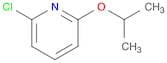
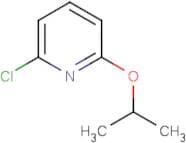
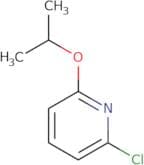
Die 2-Chloro-6-(1-methylethoxy)pyridin, auch bekannt unter ihrer CAS-Nummer 89481-98-1, ist eine heterocyclische organische Verbindung, die durch einen Pyridinring gekennzeichnet ist, der mit einem Chloratom und einer Ethoxygruppe substituiert ist. Die Anwesenheit des Chloratoms an der Position 2 und der 1-Methylethoxygruppe an der Position 6 trägt zu ihren einzigartigen chemischen Eigenschaften bei. Diese Verbindung ist typischerweise eine farblose bis blassgelbe Flüssigkeit mit einem charakteristischen Geruch und ist in organischen Lösungsmitteln löslich. Pyridingruppen sind bekannt für ihre Anwendungen in der Pharmazie, Agrochemie und als Zwischenprodukte in der organischen Synthese. Die Anwesenheit des Chloratoms kann die Reaktivität erhöhen, was sie in verschiedenen chemischen Reaktionen, einschließlich nucleophiler Substitutionen, nützlich macht. Darüber hinaus kann die Ethoxygruppe die Polarität und Löslichkeit der Verbindung beeinflussen, was ihr Verhalten in verschiedenen chemischen Umgebungen beeinflusst. Sicherheitsvorkehrungen sollten getroffen werden, wenn man mit dieser Verbindung umgeht, da sie Gesundheitsrisiken darstellen kann, wenn sie eingeatmet oder eingenommen wird.
Formel:C8H10ClNO
Sortieren nach
Reinheit (%)
0
100
|
0
|
50
|
90
|
95
|
100
4 Produkte.
Pyridine,2-chloro-6-(1-methylethoxy)-
CAS:Formel:C8H10ClNOReinheit:98%Farbe und Form:LiquidMolekulargewicht:171.62412-Chloro-6-isopropoxypyridine
CAS:2-Chloro-6-isopropoxypyridineReinheit:≥95%Molekulargewicht:171.62g/mol2-Chloro-6-isopropoxypyridine
CAS:2-Chloro-6-isopropoxypyridine is a reactive organometallic compound that has the ability to form stable, structurally diverse, and often useful compounds. It can be used as an intermediate in the synthesis of substituted pyridines, furans, and other heterocycles. The synthesis of these compounds is usually achieved through cycloaddition reactions with suitably substituted arenes. 2-Chloro-6-isopropoxypyridine can be synthesized by the lithium chloride induced elimination reaction between chloroacetone and isopropyl alcohol at low temperatures. This method is regioselective, in that it gives a mixture of 2-chloro-6-isopropoxypyridine and its diastereoisomer. 2CIP produces a mixture of products with different substitution patterns because it undergoes a cycloaddition reaction with substituents on the aromatic ring. The lithiationFormel:C8H10NOClReinheit:Min. 95%Molekulargewicht:171.62 g/mol