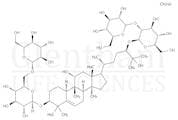
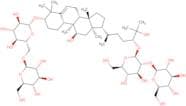
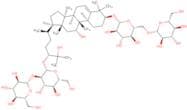
CAS 89590-95-4
:(2R,3R,4S,5S,6R)-2-[[(2R,3S,4S,5R,6R)-6-[[(3S,8R,9R,10R,11R,13R,14S)-17-[(1R,4R)-4-[(2S,3R,4S,5S,6R)-4,5-dihydroxy-6-(hydroxymethyl)-3-[(2R,3S,4R,5R,6S)-3,4,5-trihydroxy-6-(hydroxymethyl)tetrahydropyran-2-yl]oxy-tetrahydropyran-2-yl]oxy-5-hydroxy-1,5-dime
Beschreibung:
Die chemische Substanz mit dem Namen "(2R,3R,4S,5S,6R)-2-[[(2R,3S,4S,5R,6R)-6-[[(3S,8R,9R,10R,11R,13R,14S)-17-[(1R,4R)-4-[(2S,3R,4S,5S,6R)-4,5-dihydroxy-6-(hydroxymethyl)-3-[(2R,3S,4R,5R,6S)-3,4,5-trihydroxy-6-(hydroxymethyl)tetrahydropyran-2-yl]oxy-tetrahydropyran-2-yl]oxy-5-hydroxy-1,5-dime" und der CAS-Nummer "89590-95-4" ist ein komplexes organisches Molekül, das durch mehrere Stereozentren gekennzeichnet ist, was darauf hindeutet, dass es spezifische dreidimensionale Konfigurationen aufweist, die seine biologische Aktivität beeinflussen können. Diese Verbindung enthält wahrscheinlich mehrere Hydroxylgruppen (-OH), was darauf hindeutet, dass sie starke Wasserstoffbindungsfähigkeiten aufweisen könnte, die ihre Löslichkeit in polaren Lösungsmitteln erhöhen. Das Vorhandensein von Tetrahydropyranringen deutet auf eine zyklische Struktur hin, die zu ihrer Stabilität und Reaktivität beitragen kann. Solche Verbindungen sind oft von Interesse in der medizinischen Chemie aufgrund ihrer potenziellen therapeutischen Eigenschaften, insbesondere im Kontext des Kohlenhydratstoffwechsels oder als Glykosylierungsagenten. Die komplexe Struktur deutet darauf hin, dass sie auf hochspezifische Weise mit biologischen Systemen interagieren könnte, was sie zu einem Kandidaten für weitere Forschungen in der Pharmakologie oder Biochemie macht.
Formel:C54H92O24
InChl:InChI=1/C54H92O24/c1-22(9-13-33(51(4,5)70)77-49-45(41(66)36(61)28(20-57)74-49)78-48-44(69)39(64)35(60)27(19-56)73-48)23-15-16-52(6)30-12-10-24-25(54(30,8)31(58)17-53(23,52)7)11-14-32(50(24,2)3)76-47-43(68)40(65)37(62)29(75-47)21-71-46-42(67)38(63)34(59)26(18-55)72-46/h10,22-23,25-49,55-70H,9,11-21H2,1-8H3/t22-,23?,25-,26-,27+,28-,29-,30-,31-,32+,33-,34-,35+,36-,37-,38+,39-,40+,41+,42-,43-,44+,45-,46-,47+,48-,49+,52+,53-,54+/m1/s1
Synonyme:- Fructus Monordicae Extract
Sortieren nach
Reinheit (%)
0
100
|
0
|
50
|
90
|
95
|
100
7 Produkte.
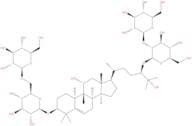
mogroside IV
CAS:Mogrosides IV: Cucurbitane glycoside, sweet, maltase inhibitor (IC50: 10 mM), antioxidant, antidiabetic, anticancer.Formel:C54H92O24Reinheit:98.19% - 99.35%Farbe und Form:SolidMolekulargewicht:1125.29Mogroside iv
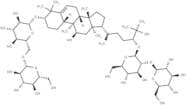
CAS:Natural glycosideFormel:C54H92O24Reinheit:≥ 95.0 % (HPLC)Farbe und Form:PowderMolekulargewicht:1125.31Mogroside IV
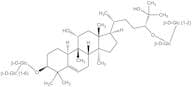
CAS:Mogroside IV is a natural sweetener, which is a compound extracted from the fruit of Siraitia grosvenorii, commonly known as monk fruit. This compound belongs to a group of terpene glycosides that contribute to the intensely sweet taste of monk fruit. With a sweetness intensity significantly higher than that of sucrose, Mogroside IV is utilized for its potential as a calorie-free sweetening agent.Formel:C54H92O24Reinheit:Min. 95%Farbe und Form:PowderMolekulargewicht:1,125.29 g/molMogroside IV
CAS:Mogroside IV is a natural sweetening compound, which is a cucurbitane-type saponin glycoside. It is primarily sourced from the Luo Han Guo (Siraitia grosvenorii), commonly known as monk fruit, a plant native to southern China. The compound is harvested by isolating it from the fruit’s extract, where it is one of several mogrosides contributing to the fruit’s intense sweetness, approximately 250-400 times that of sucrose.Formel:C54H92O24Reinheit:Min. 98.0 Area-%Molekulargewicht:1,125.29 g/mol