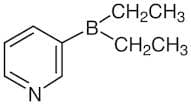
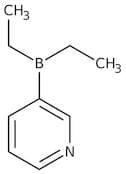
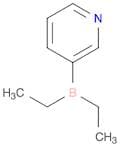
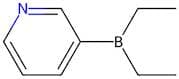
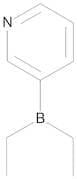
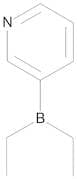
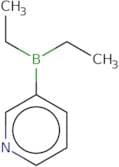
CAS 89878-14-8
:3-(Diethylboryl)pyridin
- 3-(Diethylboranyl)Pyridine
- 3-(Diethylboryl)Pyridine
- 3-Diethylboropyridine
- 3-Pyridinyldiethylborane
- 3-Pyridyldiethyl borane
- 3-Pyridyldiethylborane
- Abiraterone interMediate
- Debp
- Diethyl(3-(4-Pyridin-3-yl) borane
- Diethyl(3-Pyridinyl)-Borane
- Diethyl-(pyridin-3-yl)-borane
- Diethyl-3-pyridylborane
- Dithyl(3-pyridyl)Borane
- Pyridine, 3-(diethylboryl)-
- Weitere Synonyme anzeigen
Diethyl(3-pyridyl)borane
CAS:Formel:C9H14BNReinheit:>98.0%(HPLC)Farbe und Form:White to Almost white powder to crystalMolekulargewicht:147.03Diethyl(3-pyridyl)borane, 98%
CAS:Reactant for: preparation of inhibitors of ataxia telangiectasia mutated and Rad3 related (ATR) protein kinase as potential anticancer agents, N-Methylation reactions of the pyridyl group, Palladium catalyzed amination reactions, intramolecular Heck reactions, Coupling reactions and Synthesis of tri
Formel:C9H14BNReinheit:98%Molekulargewicht:147.03Diethyl-(3-pyridyl)borane
CAS:Diethyl-(3-pyridyl)boraneFormel:C9H14BNReinheit:98%Farbe und Form: white solidMolekulargewicht:147.03g/mol3-(Diethylboryl)pyridine
CAS:Kontrolliertes ProduktImpurity Abiraterone Impurity 7
Applications 3-(Diethylboryl)pyridine is an intermediate used to prepare inhibitors of ataxia telangiectasia mutated and Rad3 related (ATR) protein kinase as potential anticancer agents. It is also used in the synthesis of trisubstituted pyrimidines from polyhalopyrimidines via Suzuki coupling.
References Charrier, J., et al.; J. Med. Pharm. Chem., 54, 2320 (2011); Large, J., et al.: Synlett., 861 (2006)Formel:C9H14BNFarbe und Form:NeatMolekulargewicht:147.023-(Diethylboryl) pyridine
CAS:3-(Diethylboryl) pyridine is a halogenated biphenyl. It is used in the synthesis of 3-aryl substituted pyridines by cross-coupling reactions with aryl iodides, bromides and chlorides. Cross-coupling reactions are usually carried out at low temperatures (0 to 20°C) in order to minimize side reactions. The reaction is usually conducted in a biphasic system containing an organic solvent and water, which facilitates the extraction of the product from the mixture. 3-(Diethylboryl) pyridine reacts with halide ions via an electrophilic substitution reaction to form a reactive intermediate, which reacts with palladium catalyst to produce the desired product. This process is also called catalytic hydrogenation. 3-(Diethylboryl) pyridine has been shown to inhibit human cytochrome P450 enzymes, which are involved in drug metabolism and break down drugs
Formel:C9H14BNReinheit:Min. 95%Farbe und Form:PowderMolekulargewicht:147.03 g/molRef: 3D-FD29987
Ausgelaufenes produkt