CAS 90-16-4
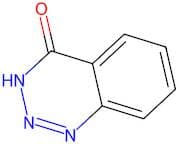
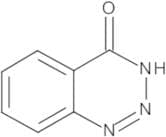
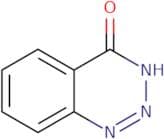
:1,2,3-benzotriazin-4(3H)-on
Beschreibung:
1,2,3-benzotriazin-4(3H)-on, mit der CAS-Nummer 90-16-4, ist eine heterocyclische organische Verbindung, die durch ihren mit einem Benzolring fusionierten Triazinring gekennzeichnet ist. Diese Verbindung erscheint typischerweise als kristalliner Feststoff und ist bekannt für ihre Stabilität und relativ geringe Löslichkeit in Wasser, während sie in organischen Lösungsmitteln besser löslich ist. Sie weist eine Reihe chemischer Eigenschaften auf, einschließlich der Fähigkeit, an verschiedenen Reaktionen teilzunehmen, aufgrund der Anwesenheit der Triazin-Gruppe, die je nach Reaktionsbedingungen als Nucleophil oder Elektrophil wirken kann. 1,2,3-benzotriazin-4(3H)-on wird häufig in der Synthese von Farbstoffen, Arzneimitteln und Agrochemikalien verwendet, aufgrund seiner potenziellen biologischen Aktivität. Darüber hinaus kann es als Baustein in der organischen Synthese dienen und zur Entwicklung komplexerer molekularer Architekturen beitragen. Sicherheitsdaten zeigen, dass, wie viele organische Verbindungen, es mit Vorsicht behandelt werden sollte, wobei geeignete Sicherheitsmaßnahmen zu ergreifen sind, um eine Exposition zu vermeiden.
Formel:C7H5N3O
InChl:InChI=1S/C7H5N3O/c11-7-5-3-1-2-4-6(5)8-10-9-7/h1-4H,(H,8,9,11)
InChI Key:InChIKey=DMSSTTLDFWKBSX-UHFFFAOYSA-N
SMILES:O=C1C=2C(NN=N1)=CC=CC2
Synonyme:- 1,2,3-benzotriazin-4(1H)-one
- 1,4-Dihydro-1,2,3-benzotriazin-4-one
- 1H-1,2,3-Benzotriazin-4-one
- 1H-Benzo[d][1,2,3]triazin-4-one
- 3,4-Dihydro-1,2,3-benzotriazin-4-one
- 3,4-Dihydro-4-oxo-1,2,3-benzotriazine
- 4-Ketobenz-1,2,3-triazine
- 4-Ketobenzo-1,2,3(3H)-triazine
- Benzazimide
- Benzazimidone
- Benzo-1,2,3-triazin-4(3H)-one
- BenzotriazinHone
- NSC 13563
- NSC 20121
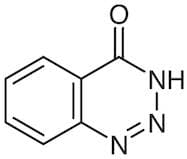
- benzo[d][1,2,3]triazin-4(3H)-one
- 1,2,3-Benzotriazin-4(3H)-one
- Weitere Synonyme anzeigen
Sortieren nach
Reinheit (%)
0
100
|
0
|
50
|
90
|
95
|
100
6 Produkte gefunden.
3,4-Dihydro-4-oxo-1,2,3-benzotriazine
CAS:Formel:C7H5N3OReinheit:>98.0%(T)(HPLC)Farbe und Form:White to Light gray to Light orange powder to crystalMolekulargewicht:147.14Benzo[d][1,2,3]triazin-4(3H)-one
CAS:Formel:C7H5N3OReinheit:96%Farbe und Form:SolidMolekulargewicht:147.13411,2,3-Benzotriazin-4(3H)-one
CAS:1,2,3-Benzotriazin-4(3H)-oneFormel:C7H5N3OReinheit:≥95%Farbe und Form: off-white to yellow solidMolekulargewicht:147.13g/mol1,2,3-Benzotriazin-4(3H)-one
CAS:Applications 1,2,3-Benzotriazin-4(3H)-one is part of a group of compounds that exhibit antimicrobial activity. 1,2,3-Benzotriazin-4(3H)-one is also used as a reagent to synthesize 1,2,3-Benzotriazin-4-one-arylpiperazine derivatives, compounds that act as Serotonin (HCl: S274980) receptor ligands.
References Caliendo, G., et al.: Bioorg. Med. Chem., 8, 533 (2000); Kar, A., et al.: Pharmazie, 35, 466 (1980)Formel:C7H5N3OFarbe und Form:NeatMolekulargewicht:147.131,2,3-Benzotriazin-4(3H)-one
CAS:1,2,3-Benzotriazin-4(3H)-one is a molecule that belongs to the class of anthranilic acid derivatives. It is a competitive inhibitor of hydrogen chloride in the reaction mechanism for the conversion of methyl anthranilate to piperazine. The bioassay showed that it inhibits the growth of an organism at a concentration of 10 μg/mL. This molecule has been shown to be effective against Staphylococcus aureus and Helicobacter pylori. A molecular modeling study was conducted on 1,2,3-benzotriazin-4(3H)-one and it was found that this molecule binds to the enzyme's active site by hydrogen bonding with the phosphate group on its target protein. This binding prevents substrate binding to the enzyme and inhibits its activity.Formel:C7H5N3OReinheit:Min. 95%Molekulargewicht:147.13 g/mol

![Benzo[d][1,2,3]triazin-4(3H)-one](/_next/image/?url=https%3A%2Fstatic.cymitquimica.com%2Fproducts%2FIN%2Fthumb%2FDA003IHI.jpg&w=3840&q=75)