CAS 90-59-5
:3,5-Dibromsalicylaldehyd
Beschreibung:
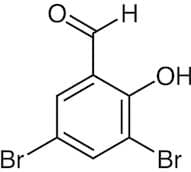
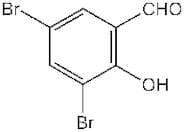
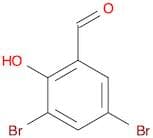
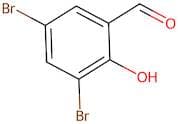
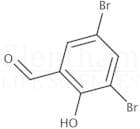
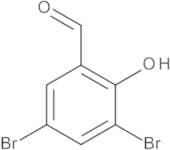
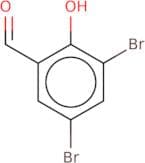
3,5-Dibromsalicylaldehyd ist eine organische Verbindung, die durch ihre aromatische Struktur gekennzeichnet ist und sowohl Bromsubstituenten als auch eine Aldehydfunktionalität aufweist. Sie wird aus Salicylsäure abgeleitet, wobei zwei Bromatome an den Positionen 3 und 5 des aromatischen Rings positioniert sind, während die Aldehydgruppe an der Position 1 liegt. Diese Verbindung erscheint typischerweise als blassgelber Feststoff und ist bekannt für ihre moderate Löslichkeit in organischen Lösungsmitteln wie Ethanol und Ether, jedoch mit begrenzter Löslichkeit in Wasser. 3,5-Dibromsalicylaldehyd zeigt eine für Aldehyde typische Reaktivität, einschließlich der Fähigkeit, Oxidations- und Kondensationsreaktionen zu durchlaufen. Ihre Bromsubstituenten können auch an elektrophilen aromatischen Substitutionsreaktionen teilnehmen, was sie zu einem nützlichen Zwischenprodukt in der organischen Synthese macht. Darüber hinaus kann diese Verbindung biologische Aktivität aufweisen, was zu einem Interesse an ihren potenziellen Anwendungen in der Pharmazie und Agrochemie geführt hat. Eine ordnungsgemäße Handhabung und Lagerung sind aufgrund ihrer potenziellen Toxizität und Umweltauswirkungen unerlässlich.
Formel:C7H4Br2O2
InChl:InChI=1/C7H4Br2O2/c8-5-1-4(3-10)7(11)6(9)2-5/h1-3,11H
InChI Key:InChIKey=JHZOXYGFQMROFJ-UHFFFAOYSA-N
SMILES:C(=O)C1=C(O)C(Br)=CC(Br)=C1
Synonyme:- 1-Formyl-2-hydroxy-3,5-dibromobenzene
- 2,4-Dibromo-6-formylphenol
- 2-Hydroxy-3,5-dibromobenzaldehyde
- 3,5-Dibromo-2-hydroxybenzaldehyde
- 3,5-Dibromosalicyladehyde
- 4,6-Dibromo-2-formylphenol
- Benzaldehyde, 3,5-dibromo-2-hydroxy-
- Dalyde
- NSC 6221
- Salicylaldehyde, 3,5-dibromo-
- 3,5-Dibromosalicylaldehyde
- AKOS BBS-00003256
- AKOS B028985
- 3,5-dibromo-2-hydroxy-benzaldehyd
- SALOR-INT L497649-1EA
- LABOTEST-BB LT00137784
- 3,5-DIBROMOSILICYLALDEHYDE
- OTAVA-BB BB7018801957
- Weitere Synonyme anzeigen
Sortieren nach
Reinheit (%)
0
100
|
0
|
50
|
90
|
95
|
100
8 Produkte.
3,5-Dibromosalicylaldehyde
CAS:Formel:C7H4Br2O2Reinheit:>98.0%(T)(HPLC)Farbe und Form:White to Orange to Green powder to crystalineMolekulargewicht:279.923,5-Dibromosalicylaldehyde, 98%
CAS:3,5-Dibromosalicylaldehyde reacts with alkyl cyanoacetates in the presence of ammonium acetate to yield 4H- chromenes. It can be used in the synthesis of Schiff base and can be used as reactant for synthesis of Schiff base ligands which forms mononuclear complexes with copper(II), nickel(II), zinc(IFormel:C7H4Br2O2Reinheit:98%Farbe und Form:Pale yellow, Crystals or powder or crystalline powder or fused solidMolekulargewicht:279.923,5-Dibromosalicylaldehyde
CAS:Formel:C7H4Br2O2Reinheit:96%Farbe und Form:SolidMolekulargewicht:279.91353,5-dibromo-2-hydroxybenzaldehyde
CAS:3,5-dibromo-2-hydroxybenzaldehydeFormel:C7H4Br2O2Reinheit:98%Farbe und Form: off-white to faint beige powderMolekulargewicht:279.91346g/molDembrexine EP Impurity C
CAS:Kontrolliertes ProduktFormel:C7H4Br2O2Farbe und Form:YellowMolekulargewicht:279.913,5-Dibromosalicylaldehyde
CAS:3,5-Dibromosalicylaldehyde is a copper complex that has been synthesized from 3,5-dibromosalicylaldehyde and copper chloride. FTIR spectroscopy revealed that the coordination geometry of the copper complex is octahedral with two nitrogen atoms in the equatorial plane. The presence of hydrogen bonding interactions was confirmed by homologous protein adsorption experiments. This chemical structure was determined using X-ray crystallography and fluorescence probe experiments. The copper complex showed high affinity for malonic acid, which is an ester hydrochloride. The molecular mechanism of this interaction is based on adsorption, which occurs through hydrogen bonding interactions and hydrophobic interactions. Structural analysis revealed that the polymeric matrix consists of a three-dimensional network of crosslinked chains, while FTIR analysis indicated a possible disulfide bond between two cysteine residues.Formel:C7H4Br2O2Reinheit:Min. 95%Farbe und Form:Yellow PowderMolekulargewicht:279.91 g/mol3,5-Dibromosalicylaldehyde
CAS:Formel:C7H4Br2O2Reinheit:95%Farbe und Form:Solid, PowderMolekulargewicht:279.915