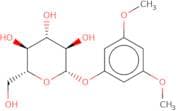
CAS 90-71-1
:alpha-(3,5-dimethoxyphenyl)-beta-D-glucopyranosid
Beschreibung:
alpha-(3,5-dimethoxyphenyl)-beta-D-glucopyranosid, auch bekannt unter seiner CAS-Nummer 90-71-1, ist eine Glykosidverbindung, die durch das Vorhandensein einer Glucoseeinheit, die an eine 3,5-Dimethoxyphenylgruppe gebunden ist, gekennzeichnet ist. Diese Verbindung zeigt typischerweise ein weißes bis off-white kristallines Aussehen und ist in polaren Lösungsmitteln wie Wasser und Methanol löslich, was ihre glykosidische Natur widerspiegelt. Die Methoxygruppen im Phenylring tragen zu ihren hydrophoben Eigenschaften bei, die ihre Löslichkeit und Reaktivität beeinflussen. Sie wird häufig wegen ihrer potenziellen biologischen Aktivitäten untersucht, einschließlich antioxidativer und entzündungshemmender Eigenschaften, die möglicherweise auf die phenolische Struktur zurückzuführen sind. Die glykosidische Bindung in dieser Verbindung macht sie unter neutralen Bedingungen stabil, aber anfällig für Hydrolyse in sauren oder enzymatischen Umgebungen, was zur Freisetzung des Aglycons und der Glucose führt. Insgesamt dient alpha-(3,5-dimethoxyphenyl)-beta-D-glucopyranosid als interessantes Thema sowohl in der synthetischen als auch in der medizinischen Chemie aufgrund seiner strukturellen Merkmale und potenziellen Anwendungen.
Formel:C14H20O8
InChl:InChI=1/C14H20O8/c1-19-7-3-8(20-2)5-9(4-7)21-14-13(18)12(17)11(16)10(6-15)22-14/h3-5,10-18H,6H2,1-2H3/t10-,11-,12+,13-,14+/m1/s1
Synonyme:- Taxicatin
Sortieren nach
Reinheit (%)
0
100
|
0
|
50
|
90
|
95
|
100
1 Produkte.
Taxicatin
CAS:Taxicatin is a secondary metabolite, which is a plant-derived alkaloid with significant pharmacological activity. It is sourced from a specific species of plant known for its bioactive compounds, often found within the tropics. The mode of action of Taxicatin involves the disruption of critical cellular processes, including the inhibition of microtubule assembly during cell division, which ultimately leads to apoptosis in rapidly dividing cells. This makes it a potent candidate for research into anticancer therapies. Taxicatin's uses and applications are primarily in the area of oncology, where its efficacy in interfering with malignant cell proliferation is being rigorously evaluated. Furthermore, its role as a template in drug design and development is of considerable interest, owing to its unique structural characteristics that can be utilized to synthesize novel compounds with improved therapeutic indices. Research is ongoing to explore the full spectrum of its biochemical interactions and potential synergistic effects when combined with other therapeutic agents.Formel:C14H20O8Reinheit:Min. 95%Farbe und Form:PowderMolekulargewicht:316.3 g/mol