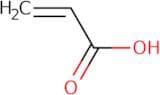
CAS 9003-01-4
:Poly(acrylsäure)
Beschreibung:
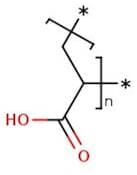
Poly(acrylsäure) (PAA) ist ein synthetisches Polymer, das durch seine sich wiederholenden Einheiten von Acrylsäure gekennzeichnet ist. Es ist ein wasserlösliches, anionisches Polymer, das einzigartige Eigenschaften aufweist, darunter hohe Viskosität und Verdickungsfähigkeiten, was es in verschiedenen Anwendungen wie Klebstoffen, Beschichtungen und Körperpflegeprodukten nützlich macht. PAA ist bekannt für seine Fähigkeit, Gele zu bilden, und sein pH-sensitives Verhalten, das es ihm ermöglicht, unter alkalischen Bedingungen zu quellen, während es sich in sauren Umgebungen zusammenzieht. Diese Eigenschaft macht es wertvoll in der Arzneimittelabgabe und als superabsorbierendes Material in Hygieneprodukten. Darüber hinaus kann PAA mit Metallionen interagieren, was seine Nützlichkeit in der Wasseraufbereitung und als Dispergiermittel erhöht. Seine Biokompatibilität und Nicht-Toxizität tragen weiter zu seiner Attraktivität in biomedizinischen Anwendungen bei. Insgesamt ist Poly(acrylsäure) ein vielseitiges Polymer mit erheblicher industrieller und pharmazeutischer Relevanz aufgrund seiner einzigartigen chemischen und physikalischen Eigenschaften.
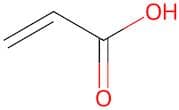
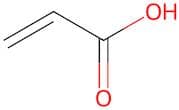
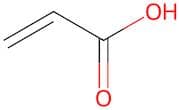
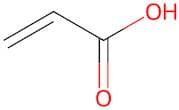
Formel:(C3H4O2)x
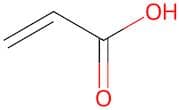
InChl:InChI=1S/C3H4O2/c1-2-3(4)5/h2H,1H2,(H,4,5)
InChI Key:InChIKey=NIXOWILDQLNWCW-UHFFFAOYSA-N
SMILES:C(C=C)(O)=O
Synonyme:- Arespol
- Aron
- Carbomer
- Carboxypolymethylene
- Gr-F
- Hydroplus
- K-Sorb
- PAA
- Polyacrylate
- Rh-E
- Sopronyl
- Tg-Sap
- XPA
- Xh-B
- Acrysol A 1
- Polyacrylic Acid
- Carbomer 910
- Propenoic acid, homopolymer
- Fluorosulfuric acid
- Propenoic acid, polymers, homopolymer
- Acrylic acid, polymers
- 2-Propenoic acid, homopolymer
- Carbopol
- Acrysol A 3
- Acrylic acid polymer
- Acrylic Acid glacial
- poly(1-carboxyethylene)
- 2-Propenoic acid, homopolymer
- acrylicacid,poly
- Acrylic polymer resins
- Propenoic acid polymer
- Poly(acrylic acid)
- Weitere Synonyme anzeigen
Sortieren nach
Reinheit (%)
0
100
|
0
|
50
|
90
|
95
|
100
17 Produkte gefunden.
Poly(acrylic acid), 25 wt% soln. in water
CAS:Polyacrylic acid is used in disposable diapers and in ion exchange resins. It is also used to study solute diffusion in polyvinyl alcohol/polyacrylic acid copolymer hydrogel. It is also employed as a thickening, suspending, emulsifying and dispersing agent in pharmaceuticals, cosmetics, adhesives anFormel:(C3H4O2)nFarbe und Form:LiquidMolekulargewicht:72.02113Poly(acrylic acid), 25% soln in water
CAS:Formel:C4H8O2Reinheit:%Farbe und Form:LiquidMolekulargewicht:88.1051Poly(acrylic acid); 35% solution in water
CAS:Formel:CH2CH(CO2H)Farbe und Form:Viscous, colourless to light-yellow liquidMolekulargewicht:72.02113Poly(acrylic acid)
CAS:Poly(acrylic acid) prevents corrosion on aluminium in acid; used as a pharmaceutical coating and inactive ingredient affecting drug ADME.Formel:(C3H4O2)xFarbe und Form:SolidMolekulargewicht:4000000(Average)Carbomer 980
CAS:Carbomer 980 is a broad-spectrum antimicrobial that is used as an absorption enhancer. It has been shown to be effective against many Gram-positive and Gram-negative bacteria, including methicillin-resistant Staphylococcus aureus. It also has shown activity against protozoa, fungi, and yeast. Carbomer 980 is a cationic surfactant that enhances the absorption of other active ingredients into the skin. This agent also has immune reaction effects and may cause adverse reactions in humans. Carbomer 980 is poorly bioavailable because it binds to fatty acids in the bloodstream and amines in skin tissue.Formel:(C3H4O2)xFarbe und Form:White PowderPoly(acrylic acid) solution
CAS:Poly(acrylic acid) solution is a polymer that is used in water treatment. It has been shown to be effective in removing sulfate and carbonates from water. Poly(acrylic acid) solution has a molecular weight of about 10,000 Daltons and a number average molecular weight of about 4,000 Daltons. This solution is supersaturated with poly(acrylic acid) but it does not form crystals because it crystallizes at high temperature and pressure. The polymers are adsorbed onto the surface of the particles in the water and then can form crystals when the polymers are forced to nucleate by lowering the temperature or increasing the force applied to them.Formel:(C3H4O2)xFarbe und Form:Colorless Clear LiquidCarbopol 940 (Carboxy Vinyl Polymer 940) extrapure
CAS:Formel:(C5H12O4)nFarbe und Form:White - off white, PowderCarbopol 934 (Carboxy Vinyl Polymer 934) extrapure
CAS:Reinheit:56.0 - 68.0% (For carboxylic acid content)Farbe und Form:White, Hygroscopic powder