CAS 9011-05-6
:Harnstoff-Formaldehyd-Harz
Beschreibung:
Harnstoff-Formaldehyd-Harz, mit der CAS-Nummer 9011-05-6, ist ein duroplastischer Polymer, das weit verbreitet in der Herstellung von Klebstoffen, Beschichtungen und Verbundmaterialien eingesetzt wird. Es entsteht durch die Polymerisation von Harnstoff und Formaldehyd, was zu einer vernetzten Struktur führt, die seine Haltbarkeit und Hitzebeständigkeit erhöht. Dieses Harz zeichnet sich durch hohe Zugfestigkeit, geringe Wasseraufnahme und hervorragende Klebeeigenschaften aus, was es für verschiedene Anwendungen, insbesondere in der Holz- und Bauindustrie, geeignet macht. Harnstoff-Formaldehyd-Harz ist typischerweise farblos bis blassgelb und kann in verschiedenen Formen, einschließlich Pulvern und flüssigen Lösungen, hergestellt werden. Es ist jedoch wichtig zu beachten, dass das Harz Formaldehydgas freisetzen kann, was eine Sorge für die Innenraumluftqualität und die Gesundheit darstellt; daher sind angemessene Belüftung und Sicherheitsmaßnahmen während der Verwendung unerlässlich. Darüber hinaus haben Fortschritte in der Formulierung zur Entwicklung von emissionsarmen Varianten geführt, um diese Bedenken zu mildern und gleichzeitig die Leistung aufrechtzuerhalten. Insgesamt wird Harnstoff-Formaldehyd-Harz für seine Vielseitigkeit und Effizienz in den Herstellungsprozessen geschätzt.
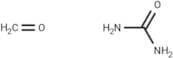
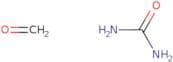
Formel:(CH4N2O·CH2O)x
InChl:InChI=1S/CH4N2O.CH2O/c2-1(3)4;1-2/h(H4,2,3,4);1H2
InChI Key:InChIKey=ODGAOXROABLFNM-UHFFFAOYSA-N
SMILES:C(N)(N)=O.C=O
Synonyme:- 10S60
- 113E1
- 12C257A
- 170B
- 3T/3Ts
- Acrisinfs017
- Aerolite300
- Aerolitea300
- Aeroliteffd
- Agroform
- Amikol65
- Anaflex
- Basf
- Capture
- Carbamol
- Catalure
- Cbu-Uf
- ChemBond
- Coladur
- Crosrez
- Cu-A
- DM
- Diakolin
- Dukol
- EMG
- FAN
- Gabrite
- Hydrocell
- Hygromull
- Iporka
- JT
- KF-BZh
- KF-KhTP
- KF-Zh
- KF-Zh(M)
- KFP
- KS
- Karbadur
- Karbamol
- Kf-A
- Kf-B
- Kf-Es
- Kf-Es(F)
- Kf-Mfp
- Kf-Mg
- Kf-Mt
- Kf-Mt(N)
- Kf-Mt-F
- Kf-Nfp
- Kf-Ns
- Kf-Nu
- Kf-Nv
- Kf-O
- Kf-Pr
- LP
- LPR
- Larex
- Lendur
- MF
- MF-Zh
- MFP
- MFS
- Micrea
- Moform
- Nitroform
- Noxylin
- Nqtrh
- Nutralene
- Oxymetylurea
- PMF
- Penoizol
- Pianizol
- Piatherm
- Placol
- Poly(formaldehyde/urea)
- Polynoxylin
- Polynoxyline
- Ponoxylan
- Ridlite
- SVS
- Silekol
- Skf-Nm
- TUF
- U-Lite
- UKS
- UST
- Uks-A
- Uks-B
- Um-G
- Umalur
- Uralite
- Uramite
- Urea-form
- Ureapap
- Urepret
- Urofix
- Urofoam
- Veganit
- Vps-G
- Wq-Ii
- Urea-formaldehyde copolymer
- Urea-formaldehyde resin
- Weitere Synonyme anzeigen
Sortieren nach
Reinheit (%)
0
100
|
0
|
50
|
90
|
95
|
100
2 Produkte.
Polynoxylin
CAS:Polynoxylin is an antiseptic. It is used for local treatment of the skin and the mouth.Formel:C2H6N2O2Reinheit:98%Farbe und Form:SolidMolekulargewicht:90.08Ureaformaldehyde
CAS:Ureaformaldehyde is a synthetic slow-release fertilizer that contains urea and formaldehyde. It has been shown to be highly active as a slow-release fertilizer in Langmuir adsorption isotherm studies. Ureaformaldehyde also has the ability to mineralize chloride and hydrogen bond to soil particles, increasing the availability of these ions for plant uptake. Ureaformaldehyde is also used in analytical methods such as chromatographic determination of fatty acids, which are an important component of animal and vegetable oils. !--
Formel:(CH4N2O•CH2O)xReinheit:Min. 95%Farbe und Form:Clear LiquidMolekulargewicht:90.08 g/mol