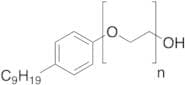
CAS 9016-45-9
:Polyethylenglykol-nonylphenylether
Beschreibung:
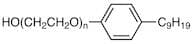
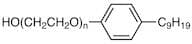
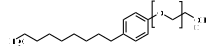
Polyethylenglykol-nonylphenylether (CAS 9016-45-9) ist ein nichtionischer Tensid, der häufig in verschiedenen industriellen und Verbraucheranwendungen eingesetzt wird. Er zeichnet sich durch sein hydrophiles Polyethylenglykol (PEG)-Rückgrat und eine hydrophobe Nonylphenylgruppe aus, die ihm Tensideigenschaften verleiht. Diese Verbindung zeigt typischerweise eine gute Löslichkeit sowohl in Wasser als auch in organischen Lösungsmitteln, was sie effektiv beim Emulgieren, Benetzen und Dispergieren von Formulierungen macht. Ihre molekulare Struktur ermöglicht es, die Oberflächenspannung zu senken, was die Stabilität von Emulsionen und Schäumen verbessert. Polyethylenglykol-nonylphenylether wird häufig in Körperpflegeprodukten, Reinigungsmitteln und landwirtschaftlichen Formulierungen verwendet, da es die Leistung der Wirkstoffe verbessert. Es ist jedoch wichtig zu beachten, dass Nonylphenol, ein Abbauprodukt dieses Ethers, Umwelt- und Gesundheitsbedenken aufgeworfen hat, was in einigen Regionen zu regulatorischen Prüfungen geführt hat. Infolgedessen werden in Formulierungen Alternativen untersucht, um potenzielle ökologische Auswirkungen zu mildern. Insgesamt wird diese Verbindung wegen ihrer Vielseitigkeit und Wirksamkeit bei der Verbesserung der Produktleistung in verschiedenen Anwendungen geschätzt.
Formel:(C2H4O)nC15H24O
Synonyme:- Agral
- Alfenol
- BLM
- DME
- Fenopal
- Fixade
- HME
- Hermoowet
- Imbentin
- Imbentine
- Kumiten
- Libsorb
- Makon
- Marlophen
- Mylura
- NP
- NPEO<sub>10</sub>
- NPEO<sub>20</sub>
- NPEO<sub>30</sub>
- NPEO<sub>40</sub>
- Nezhegol
- Nf-Peg
- Nonipol
- Nonoxynol-12
- Nonylphenolethoxylate
- Nonylphenoxypoly(Ethyleneoxy)Ethanol
- Nonylphenoxypoly(Oxyethylene)Ethanol
- Nonylphenoxypoly(ethylenoxy)ethanol
- Npeo10
- Npeo20
- Npeo30
- Npeo40
- Penetrax
- Polyoxyaethylen(10,5)(Nonylphenyl)-Aether
- Polyoxyaethylen(13,5)(Nonylphenyl)-Aether
- Polyoxyaethylen(20)(Nonylphenyl)-Aether
- Polyoxyaethylen(35)(Nonylphenyl)-Aether
- Polyoxyaethylen(4)(Nonylphenyl)-Aether
- Polyoxyaethylen(7)(Nonylphenyl)-Aether
- Polyoxyaethylen(8-9)(Nonylphenyl)-Aether
- Polyoxyaethylen(9)(Nonylphenyl)-Aether
- Polyoxyaethylen(9-10)(Nonylphenyl)-Aether
- Polyoxyaethylen-(Nonylphenyl)-Aether
- Polyoxyethylenenonylphenylether
- Polypol
- Sapal
- Slovafol
- Wasc
- α-(Nonylphenyl)-ω-hydroxypoly(oxy-1,2-ethanediyl)
- α-(Nonylphenyl)-ω-hydroxypoly(oxyethylene)
- α-(Nonylphenyl)-ω-hydroxypolyoxyethylene
- ω-Hydroxy-α-(nonylphenyl)poly(oxy-1,2-ethanediyl)
- Lubrol L
- Polyethylene glycol nonylphenyl ether
- Poly(oxy-1,2-ethanediyl), α-(nonylphenyl)-ω-hydroxy-
- Weitere Synonyme anzeigen
Sortieren nach
Der Reinheitsfilter ist nicht sichtbar, weil die aktuellen Produkte keine zugeordneten Reinheitsdaten für die Filterung besitzen.
6 Produkte.
Polyethylene Glycol Mono-4-nonylphenyl Ether (n=approx. 18)
CAS:Formel:HO(CH2CH2O)nC6H4C9H19Farbe und Form:White to Almost white lumpPolyethylene Glycol Mono-4-nonylphenyl Ether (n=approx. 15)
CAS:Formel:HO(CH2CH2O)nC6H4C9H19Farbe und Form:White or Colorless to Almost white or Almost colorless powder to lump to clear liquidNonidet P 40 Substitute
CAS:Kontrolliertes ProduktApplications Nonidet P 40 Aubstitute, a nonionic, non-denaturing detergent, with many applications, such as used in in paper industry, hand cleaners, metal cleaners. It can also be used used to solubilize cerebral GABA receptors, in solubilization of proteins and lipids of the scallop gill ciliary membrane, and of membranes from breast cancer tumors.This compound is a contaminant of emerging concern (CECs).
Not a dangerous good if item is equal to or less than 1g/ml and there is less than 100g/ml in the package
References Shick, M., et al.: Non-ionic Surfactants, p.929 (1967); Stephens, R. E., J Cell Bio., 100, 1082 (1985);Formel:C15H24O·(C2H4O)nFarbe und Form:NeatMolekulargewicht:308.5