CAS 901751-47-1
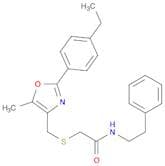
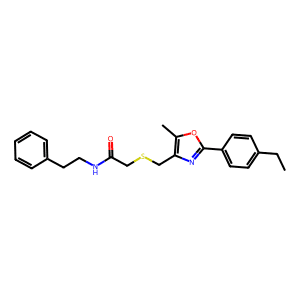
:2-[[[2-(4-ethylphenyl)-5-methyl-4-oxazolyl]methyl]thio]-N-(2-phenylethyl)acetamid
Beschreibung:
Die chemische Substanz, die als 2-[[[2-(4-ethylphenyl)-5-methyl-4-oxazolyl]methyl]thio]-N-(2-phenylethyl)acetamid bekannt ist, mit der CAS-Nummer 901751-47-1, ist eine synthetische organische Verbindung, die durch ihre komplexe Struktur gekennzeichnet ist, die einen Oxazolring, eine Thioetherbindung und eine Acetamidfunktionalgruppe umfasst. Diese Verbindung weist eine Phenylgruppe und eine ethylsubstituierte Phenylgruppe auf, die zu ihren hydrophoben Eigenschaften beiträgt. Das Vorhandensein des Oxazolrings deutet auf eine potenzielle biologische Aktivität hin, da Heterocyclen oft eine bedeutende Rolle in der medizinischen Chemie spielen. Die Thioethergruppe kann die Lipophilie der Verbindung erhöhen und ihre Wechselwirkung mit biologischen Zielen beeinflussen. Darüber hinaus kann die Acetamidgruppe an Wasserstoffbrückenbindungen teilnehmen, was die Löslichkeit und Reaktivität der Verbindung beeinflussen kann. Insgesamt können die einzigartigen strukturellen Merkmale dieser Verbindung spezifische pharmakologische Eigenschaften verleihen, was sie für die Arzneimittelentwicklung und Forschung von Interesse macht. Detaillierte Studien wären jedoch erforderlich, um ihre biologische Aktivität und potenziellen Anwendungen vollständig zu erhellen.
Formel:C23H26N2O2S
Synonyme:- iCRT3
- CS-2716
- 2-[[[2-(4-ethylphenyl)-5-methyl-4-oxazolyl]methyl]thio]-N-(2-phenylethyl)acetamide
- ICRT3;ICRT-3;ICRT 3
- Acetamide, 2-[[[2-(4-ethylphenyl)-5-methyl-4-oxazolyl]methyl]thio]-N-(2-phenylethyl)-
Sortieren nach
Reinheit (%)
0
100
|
0
|
50
|
90
|
95
|
100
5 Produkte.
iCRT3
CAS:iCRT3 is a Wnt and β-catenin-responsive transcription inhibitor.Formel:C23H26N2O2SReinheit:98.32% - 98.47%Farbe und Form:SolidMolekulargewicht:394.53iCRT3
CAS:iCRT3 is a natural compound that has been shown to reduce kidney fibrosis and improve the prognosis of patients with chronic kidney disease. It has been shown to inhibit the growth of skin cancer cells in vivo models. iCRT3 has also been found to regulate cellular physiology by inhibiting signal pathways, such as epidermal growth factor (EGF) and pro-apoptotic proteins. In addition, it was found to increase ATP levels in caco2 cells by reducing oxidative stress and inflammation.
Formel:C23H26N2O2SReinheit:Min. 95%Molekulargewicht:394.53 g/mol