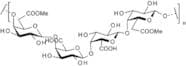
CAS 9049-37-0
:Natriumpektat
Beschreibung:
Natriumpektat ist ein Natriumsalz der Pektinsäure, das hauptsächlich aus dem natürlichen Polysaccharid Pektin gewonnen wird, das in den Zellwänden von Obst und Gemüse vorkommt. Es wird häufig als Geliermittel, Verdickungsmittel und Stabilisator in Lebensmitteln verwendet, insbesondere in Marmeladen und Gelees. Natriumpektat zeichnet sich durch seine Fähigkeit aus, in Gegenwart von Zucker und Säure Gele zu bilden, was es in der Lebensmittelverarbeitung wertvoll macht. Es handelt sich typischerweise um ein weißes bis off-white Pulver, das in Wasser löslich ist und eine viskose Lösung bildet. Die Substanz wird allgemein als sicher (GRAS) für den Verzehr anerkannt und wird auch in pharmazeutischen und kosmetischen Formulierungen aufgrund ihrer Biokompatibilität und verdickenden Eigenschaften verwendet. Darüber hinaus hat Natriumpektat Anwendungen in der Landwirtschaft als Bodenverbesserer und im biomedizinischen Bereich für Arzneimittelsysteme. Seine molekulare Struktur besteht aus einem Rückgrat von Galacturonsäure-Einheiten, die methylesterifiziert werden können und seine Gelier- und Funktionalitätseigenschaften beeinflussen.
Formel:Unspecified
Synonyme:- Pectic acid, sodium salt
- Sodium pectate
- Sodium polypectate
- NaPP
Sortieren nach
Reinheit (%)
0
100
|
0
|
50
|
90
|
95
|
100
2 Produkte.
Sodium pectate
CAS:The characteristic structure of pectin is a linear chain of α-(1,4)-linked D-galacturonic acid that forms the pectin-backbone, a homogalacturonan (pectic acid). The polygalacturonic acid is partly esterified with methyl groups and the free acid groups may be partly or fully neutralized with sodium, potassium or ammonium ions. The ratio of esterified galacturonic acid groups to total galacturonic acid groups - termed the degree of esterification (DE) - has vital influence on the properties of pectin, especially the solubility and the gel forming characteristics. The mechanism for gel formation with calcium ions is known as ‘The egg box’. Into this backbone, there are regions where galacturonic acid is replaced by (1,2)-linked L-rhamnose. From the rhamnose residues, sidechains of various neutral sugars branch off. This type of pectin is called rhamnogalacturonan-I (RG-I). Up to every 25th galacturonic acid in the main chain is replaced with rhamnose. Some stretches consist of alternating galacturonic acid and rhamnose – “hairy regions”, others with lower density of rhamnose – “smooth regions”. The neutral sugars are mainly D-galactose, L-arabinose and D-xylose, the types and proportions of neutral sugars varying with the origin of pectin. Another structural type of pectin is rhamnogalacturonan II (RG-II), which is a less frequent complex, highly branched polysaccharide.Reinheit:Min. 95%Farbe und Form:Powder