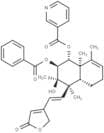
CAS 905929-95-5
:(1R,2S,3R,4R,4aS,8aR)-3-hydroxy-3,4,8,8a-tetramethyl-4-[(E)-2-(5-oxo-2,5-dihydrofuran-3-yl)ethenyl]-2-[(phenylcarbonyl)oxy]-1,2,3,4,4a,5,6,8a-octahydronaphthalin-1-yl pyridin-3-carboxylat
Beschreibung:
Die chemische Substanz mit dem Namen "(1R,2S,3R,4R,4aS,8aR)-3-hydroxy-3,4,8,8a-tetramethyl-4-[(E)-2-(5-oxo-2,5-dihydrofuran-3-yl)ethenyl]-2-[(phenylcarbonyl)oxy]-1,2,3,4,4a,5,6,8a-octahydronaphthalin-1-yl pyridin-3-carboxylat" und der CAS-Nummer "905929-95-5" ist eine komplexe organische Verbindung, die durch ihre komplizierte Stereochemie und mehrere funktionelle Gruppen gekennzeichnet ist. Diese Verbindung weist eine stark substituierte Naphthalen-Kernstruktur auf, die Hydroxyl-, Carbonyl- und Esterfunktionen umfasst, die zu ihrer potenziellen biologischen Aktivität beitragen. Das Vorhandensein eines Pyridinrings deutet auf mögliche Wechselwirkungen mit biologischen Zielen hin, was sie in der medizinischen Chemie von Interesse macht. Ihre stereochemische Konfiguration zeigt spezifische räumliche Anordnungen von Atomen an, die ihre Reaktivität und Wechselwirkungen erheblich beeinflussen können. Die molekulare Struktur der Verbindung deutet darauf hin, dass sie je nach Umgebung einzigartige Eigenschaften wie Löslichkeit und Stabilität aufweisen könnte. Insgesamt stellt diese Substanz ein anspruchsvolles Beispiel für organische Synthese mit potenziellen Anwendungen in der Pharmazeutik oder Agrochemie dar.
Formel:C33H35NO7
InChl:InChI=1/C33H35NO7/c1-21-10-8-14-25-31(2,16-15-22-18-26(35)39-20-22)33(4,38)28(41-29(36)23-11-6-5-7-12-23)27(32(21,25)3)40-30(37)24-13-9-17-34-19-24/h5-7,9-13,15-19,25,27-28,38H,8,14,20H2,1-4H3/b16-15+/t25-,27+,28+,31-,32+,33+/m1/s1
Sortieren nach
Reinheit (%)
0
100
|
0
|
50
|
90
|
95
|
100
4 Produkte.
Scutebarbatine B
CAS:Scutebarbatine B shows weak cytotoxicity with IC50 values ranging from 35.11 to 42.73 μM against K562 cell lines and HL60 cell lines.Formel:C33H35NO7Reinheit:98%Farbe und Form:SolidMolekulargewicht:557.63Scutebarbatine B
CAS:Scutebarbatine B is a bioactive alkaloid, which is derived from the roots of the Scutellaria genus, particularly known in species like Scutellaria barbata. This compound belongs to a class of naturally occurring phytochemicals prevalent in these plants, which have been used in traditional medicine. The mode of action of Scutebarbatine B involves interaction with specific neurotransmitter pathways, possessing potential neuroactive properties that may modulate neuronal excitability and neurochemical balance.Formel:C33H35NO7Reinheit:Min. 95%Molekulargewicht:557.6 g/mol