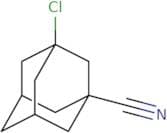
![3-Chlorotricyclo[3.3.1.13,7]decane-1-carbonitrile](/_next/image/?url=https%3A%2Fstatic.cymitquimica.com%2Fcas-image%2Fthumb-webp%2F209673-3-chlorotricyclo-3-3-1-137-decane-1-carbonitrile.webp&w=3840&q=75)
CAS 90812-27-4
:3-Chlorotricyclo[3.3.1.13,7]decan-1-carbonitril
Beschreibung:
3-Chlorotricyclo[3.3.1.1^3,7]decane-1-carbonitril, mit der CAS-Nummer 90812-27-4, ist eine bicyclische organische Verbindung, die durch ihre einzigartige tricyclische Struktur und das Vorhandensein eines Chloratoms sowie einer Nitrilfunktion gekennzeichnet ist. Die Verbindung weist eine komplexe Anordnung von Kohlenstoffatomen auf, die zu ihrer Starrheit und ihrem Potenzial für spezifische Wechselwirkungen in chemischen Reaktionen beiträgt. Der Chlorersatz kann die Reaktivität und Polarität der Verbindung beeinflussen, während die Carbonitrilgruppe ein starkes Dipolmoment einführt, das ihre Löslichkeit in polaren Lösungsmitteln erhöht. Diese Verbindung kann interessante Eigenschaften wie potenzielle biologische Aktivität aufweisen, was sie in der medizinischen Chemie und Materialwissenschaft von Interesse macht. Ihre strukturelle Komplexität kann auch zu einzigartigen stereochemischen Eigenschaften führen, die ihr Verhalten in verschiedenen chemischen Umgebungen beeinflussen können. Insgesamt ist 3-Chlorotricyclo[3.3.1.1^3,7]decane-1-carbonitril eine bemerkenswerte Verbindung für die Forschung in der organischen Synthese und Anwendungen in der Pharmazie.
Formel:C11H14ClN
InChl:InChI=1S/C11H14ClN/c12-11-4-8-1-9(5-11)3-10(2-8,6-11)7-13/h8-9H,1-6H2
InChI Key:InChIKey=WEGYYUWQZAELJZ-UHFFFAOYSA-N
SMILES:C(#N)C12CC3(Cl)CC(C1)CC(C2)C3
Synonyme:- Tricyclo[3.3.1.13,7]decane-1-carbonitrile, 3-chloro-
- 3-Chloroadamantane-1-carbonitrile
- 3-Chlorotricyclo[3.3.1.13,7]decane-1-carbonitrile
- 3-Chloro-1-adamantanecarbonitrile
- 1-Chloro-3-cyanoadamantane
Sortieren nach
Reinheit (%)
0
100
|
0
|
50
|
90
|
95
|
100
1 Produkte.
3-Chloroadamantane-1-carbonitrile
CAS:3-Chloroadamantane-1-carbonitrile is a derivative of acetonitrile. It can be used as a catalyst in the production of carboxylic acids and their derivatives, including esters and amides. 3-Chloroadamantane-1-carbonitrile reacts with a wide range of carboxylic acids to produce the corresponding carbonitriles. These reactions are catalyzed by metal salts such as molybdenum, tetrachloride, vanadium, or carbon tetrachloride. The product can then undergo hydrolysis to form the corresponding carboxylic acid.
Formel:C11H14ClNReinheit:Min. 95%Molekulargewicht:195.69 g/mol