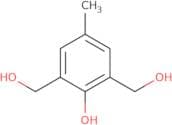
CAS 91-04-3
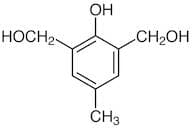
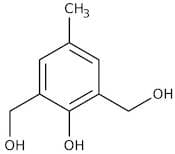
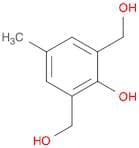
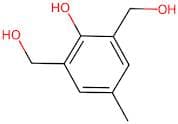
:2,6-Bis(hydroxymethyl)-p-kresol
Beschreibung:
2,6-Bis(hydroxymethyl)-p-kresol, allgemein bekannt als eine phenolische Verbindung, ist durch seine Struktur gekennzeichnet, die zwei Hydroxymethylgruppen enthält, die an den aromatischen Ring des p-Cresols gebunden sind. Diese Verbindung ist typischerweise ein weißer bis cremefarbener kristalliner Feststoff bei Raumtemperatur und ist in Wasser und organischen Lösungsmitteln löslich, was sie vielseitig für verschiedene Anwendungen macht. Sie weist antioxidative Eigenschaften auf, was sie nützlich macht, um Kunststoffe und andere Materialien gegen oxidative Zersetzung zu stabilisieren. Darüber hinaus hat sie Anwendungen in der pharmazeutischen und kosmetischen Industrie aufgrund ihrer antimikrobiellen Eigenschaften. Die Verbindung ist auch dafür bekannt, dass sie als Konservierungsmittel wirkt und dazu beiträgt, die Haltbarkeit von Produkten zu verlängern. Sicherheitsdaten zeigen, dass sie mit Vorsicht behandelt werden sollte, da sie bei Kontakt mit Haut oder Augen Reizungen verursachen kann. Insgesamt ist 2,6-Bis(hydroxymethyl)-p-kresol eine wertvolle chemische Verbindung mit vielfältigen Anwendungen, insbesondere zur Verbesserung der Stabilität und Langlebigkeit verschiedener Formulierungen.
Formel:C9H12O3
InChl:InChI=1S/C9H12O3/c1-6-2-7(4-10)9(12)8(3-6)5-11/h2-3,10-12H,4-5H2,1H3
InChI Key:InChIKey=KUMMBDBTERQYCG-UHFFFAOYSA-N
SMILES:C(O)C1=C(O)C(CO)=CC(C)=C1
Synonyme:- (2-Hydroxy-5-methyl-1,3-phenylene)dimethanol
- 1,3-Benzenedimethanol, 2-hydroxy-5-methyl-
- 2,3-Bis(Hydroxymethyl)-4-Methylphenol
- 2,6-Bis(Hydroxymethyl)-4-Methylphenol
- 2,6-Bis(hydroxymethyl)-p-cresol
- 2,6-Di(Hydroxymethyl)-4-Methylphenol
- 2,6-Di(hydroxymethyl)-p-cresol
- 2,6-Dimethylol-4-methylphenol
- 2,6-Dimethylol-p-cresol
- 26Dmpc
- 4-Methyl-2,6-bis(hydroxymethyl)phenol
- AV Lite 26DMPC
- Dml-Pc
- NSC 15838
- α<sup>1</sup>,α<sup>3</sup>,2-Trihydroxymesitylene
- α<sup>1</sup>,α<sup>3</sup>-Mesitylenediol, 2-hydroxy-
- α1,α3-Mesitylenediol, 2-hydroxy-
- Weitere Synonyme anzeigen
Sortieren nach
Reinheit (%)
0
100
|
0
|
50
|
90
|
95
|
100
6 Produkte.
2,6-Bis(hydroxymethyl)-p-cresol
CAS:Formel:C9H12O3Reinheit:>98.0%(GC)Farbe und Form:White to Yellow to Orange powder to crystalMolekulargewicht:168.192,6-Bis(hydroxymethyl)-p-cresol, tech. 90%
CAS:This Thermo Scientific Chemicals brand product was originally part of the Alfa Aesar product portfolio. Some documentation and label information may refer to the legacy brand. The original Alfa Aesar product / item code or SKU reference has not changed as a part of the brand transition to Thermo SciFormel:C9H12O3Reinheit:90%Farbe und Form:Cream or orange to pale brown, powderMolekulargewicht:168.192,6-Bis(hydroxymethyl)-p-cresol
CAS:Formel:C9H12O3Reinheit:97%Farbe und Form:SolidMolekulargewicht:168.18982,6-Bis(hydroxymethyl)-4-methylphenol
CAS:2,6-Bis(hydroxymethyl)-4-methylphenolFormel:C9H12O3Reinheit:95%Farbe und Form: pale brown crystals/ powderMolekulargewicht:168.19g/mol(2-Hydroxy-5-methyl-1,3-phenylene)dimethanol
CAS:Formel:C9H12O3Reinheit:95%Farbe und Form:Solid, No data available.Molekulargewicht:168.1922,6-Bis(hydroxymethyl)-p-cresol
CAS:2,6-Bis(hydroxymethyl)-p-cresol (BHMC) is a cross-linking agent that reacts with the hydroxyl groups of polymers to form covalent bonds. This reaction is irreversible and has been shown to be effective in thermal expansion applications. BHMC is insoluble in water and so can be used as a proton donor for the synthesis of polymer hydrogels. BHMC has also been used as a molecular modeling probe for studying protein structure and function. This compound reacts with nucleophiles by nucleophilic attack on the carbonyl carbon atom, producing an intermediate that tautomerizes to the corresponding enone. The reaction mechanism involves formation of a tetranuclear transition state followed by acid catalysis. Functional groups such as -OH, -NH2, or -COOH are required for this reaction to occur. NMR spectra have shown that there are three different chemical structuresFormel:C9H12O3Reinheit:Min. 95%Farbe und Form:PowderMolekulargewicht:168.19 g/mol