CAS 91037-75-1
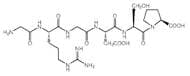
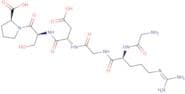
:Glycyl-N~5~-(diaminomethyliden)-L-ornithylglycyl-L-alpha-aspartyl-D-seryl-L-prolin
Beschreibung:
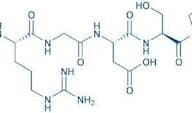
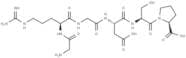
Glycyl-N~5~-(diaminomethyliden)-L-ornithylglycyl-L-alpha-aspartyl-D-seryl-L-prolin, identifiziert durch die CAS-Nummer 91037-75-1, ist ein synthetisches Peptid, das typische Eigenschaften komplexer Aminosäuresequenzen aufweist. Diese Verbindung besteht aus mehreren Aminosäuren, die zu ihren strukturellen und funktionalen Eigenschaften beitragen. Es weist eine Kombination aus L- und D-Aminosäuren auf, die seine biologische Aktivität und Stabilität beeinflussen können. Das Vorhandensein einer Diaminometyliden-Gruppe deutet auf potenzielle Reaktivität und Wechselwirkungen mit anderen Biomolekülen hin. Peptide wie dieses werden oft hinsichtlich ihrer Rolle in biologischen Systemen untersucht, einschließlich ihres Potenzials als therapeutische Mittel oder im Arzneimitteldesign. Die spezifische Anordnung der Aminosäuren kann die Konformation des Peptids, die Löslichkeit und die Wechselwirkung mit Rezeptoren oder Enzymen beeinflussen. Insgesamt stellt diese Verbindung eine komplexe Struktur dar, die Anwendungen in der Biochemie und Pharmakologie haben könnte, obwohl detaillierte Studien erforderlich wären, um ihre Eigenschaften und potenziellen Anwendungen vollständig zu klären.
Formel:C22H37N9O10
InChl:InChI=1/C22H37N9O10/c23-8-15(33)28-11(3-1-5-26-22(24)25)18(37)27-9-16(34)29-12(7-17(35)36)19(38)30-13(10-32)20(39)31-6-2-4-14(31)21(40)41/h11-14,32H,1-10,23H2,(H,27,37)(H,28,33)(H,29,34)(H,30,38)(H,35,36)(H,40,41)(H4,24,25,26)/t11-,12-,13+,14-/m0/s1
Sortieren nach
Reinheit (%)
0
100
|
0
|
50
|
90
|
95
|
100
8 Produkte.
Gly-Arg-Gly-Asp-Ser-Pro
CAS:For cellular and molecular biology applicationsFarbe und Form:White, Lyophilized powderH-Gly-Arg-Gly-Asp-Ser-Pro-OH
CAS:The hexapeptide GRGDSP is used for the affinity purification of fibronectin receptors, as it contains the RGD integrin recognition site of the fibronectin cell binding domain. The immobilized peptide promotes mouse blastocyst attachment and outgrowth, whereas in solution, GRGDSP is a reversible inhibitor of entactin-mediated blastocyst outgrowth.Formel:C22H37N9O10Reinheit:95.7%Farbe und Form:White LyophilisateMolekulargewicht:587.59glycyl-arginyl-glycyl-aspartyl-seryl-proline
CAS:Formel:C22H37N9O10Reinheit:97%Molekulargewicht:587.5835GRGDSP
CAS:GRGDSP (Gly-Arg-Gly-Asp-Ser-Pro) is a linear RGD peptide and a fibronectin-derived peptide, and is also an effective integrin inhibitor.Formel:C22H37N9O10Reinheit:99.75%Farbe und Form:SolidMolekulargewicht:587.58G-R-G-D-S-P
CAS:Custom research peptide; min purity 95%. For different specs please use the Peptide Quote Tool
Formel:C22H37N9O10Molekulargewicht:587.59 g/molG-R-G-D-S-P
CAS:H-GRGDSP-OH is a cell adhesion-promoting peptide (RGD peptide) that can be synthesized rapidly by our peptide experts in under 2 weeks. H-GRGDSP-OH is provided at greater that >95% purity (HPLC) from Cymit Quimica for a variety of research applications. We also offer H-GRGDSP-OH in bulk quantities in addition to our standard pack sizes.Please enquire for more information about H-GRGDSP-OH at the technical inquiry form on this page
Formel:C22H37N9O10Reinheit:Min. 95%Molekulargewicht:587.59 g/molG-R-G-D-S-P
CAS:Custom research peptide; min purity 95%.
Formel:C22H37N9O10Reinheit:Min. 95%Molekulargewicht:587.59 g/molH-Gly-Arg-Gly-Asp-Ser-Pro-OH
CAS:H-Gly-Arg-Gly-Asp-Ser-Pro-OH is a cyclic peptide that contains five amino acids. It was synthesized by the reaction of L-glycine and D-alanine with D,L-aspartic acid and L,D,L-serine. HAGGS has been shown to stimulate the proliferation of fibroblast cells in vitro. The presence of HAGGS on the surface of human breast cancer cells (MDA MB 231) promotes the proliferation of these cells and stimulates the production of growth factor β1. HAGGS also activates integrin receptors on these cells, which are proteins that bind to collagen or fibronectin. This may be due to its ability to form disulfide bonds with neighboring proteins, such as fibronectin and integrin.Formel:C22H37N9O10Reinheit:Min. 95%Molekulargewicht:587.58 g/mol